Cheaper gas, longer waits: Lagos motorists complain about CNG queues
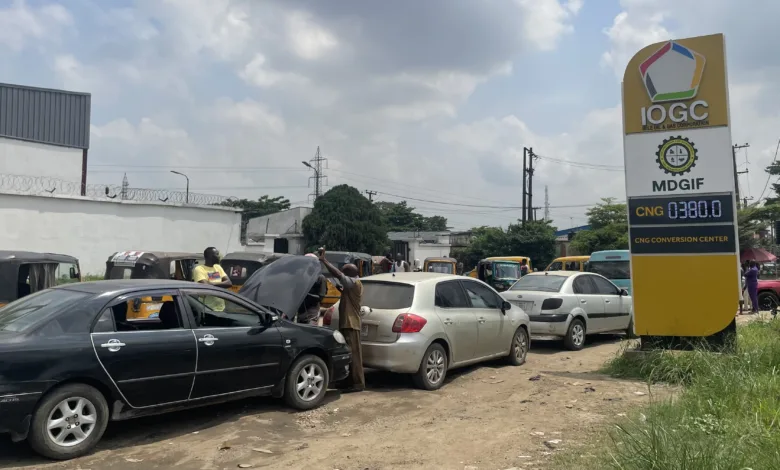
More than 60 vehicles, including cars, tricycles and buses, were seen in long queues at the IBILE Oil and Gas Corporation (IOGC) Compressed Natural Gas (CNG) station along Oba Ogunji Road, Lagos, on Monday, as motorists endured hours of waiting to access the cheaper alternative to petrol.
For many drivers, the switch to CNG was meant to reduce the cost of keeping their vehicles on the road following the removal of the petrol subsidy in 2023. However, the experience of motorists at the station suggests that the savings they seek may come with other costs, including lost working hours, repeated journeys and, in some cases, alleged vehicle damage.
The Federal Government established the Presidential Initiative on Compressed Natural Gas in 2023 to promote cheaper transportation through vehicle conversions and the expansion of refuelling infrastructure. The initiative, now known as the Presidential Initiative on Compressed Natural Gas and Electric Vehicles, includes conversion support and efforts to attract private investment into the sector. Yet, for motorists who depend on a limited number of accessible stations, the challenge is no longer simply the price of fuel but also the time and effort required to obtain it.
Hours in the queue, with no guarantee




For Comrade Omoghuei, a motorist in his early 60s, the wait had become a test of patience. He told Western Post that he arrived at the Oba Ogunji station as early as 8 a.m. but had yet to purchase gas by 11:37 a.m.
”When I got here at 8:00am, I met several other cars. I have been here for not less than three hours. I hope I will be able to get today. Unfortunately, there have been days when I stay here for hours only to hear that the product is no longer available,” he narrated.
Although he acknowledged that the station generally operated a first-come, first-served system, Omoghuei alleged that some security personnel collected bribes from motorists seeking to bypass the queue. The allegation could not be independently verified, and the station’s management would need to respond to it.

For drivers already spending hours waiting, any suggestion that others could jump the queue through unofficial payments raises questions about fairness and the management of access to a service on which their livelihoods increasingly depend.
When cheaper fuel brings additional expenses
For Emmanuel, who travelled from Agbado to refuel, the trip had already begun at 6 a.m. By the time he spoke about his experience, the wait had become more than an inconvenience.
He said moving his car repeatedly while its gas supply was running very low had resulted in damage that would require additional spending. According to him, he had already repaired the vehicle’s kick starter twice. When Western Post spoke to Emmanuel, he was shirtless, bent over the bonnet of his car fixing parts of the engine within the station’s premises.
The experience also raises a difficult question for motorists seeking relief from high petrol prices: how much of the money saved at the pump is retained when accessing cheaper fuel requires long journeys, hours away from work and additional vehicle maintenance?
A long journey for a limited supply
Alexander, who travelled from Idimu, said he had to cover several kilometres to reach the station. He alleged that other facilities operated by the same organisation had been completed but were yet to begin operations because they were awaiting commissioning.
Kayode, another respondent, supported calls for more accessible refuelling facilities. According to him, “When more facilities are opened, motorists would be able to easily move in and get CNG, just like petrol stations.”
Lost working hours, lost income
For Moses, a commercial tricycle operator who travelled from Oju-Ore in Sango, Ogun state, the long wait also affected his ability to earn a living.
He said he sometimes spent hours at the station without successfully purchasing gas, leaving him with less time to transport passengers and earn money. He also described the repeated journeys and waiting as physically exhausting.
“For me, wey be keke rider, the number of trips I take go determine my money. Time wey I spend for here dey shorten my money. Imagine say I even dey waka that distance (from Sango). At times, I go need use drug when I get home due to the struggle I face here (the CNG refill station).”
Additionally, Dapo, an e-hailing driver who said he fills his tank at least twice a day, called for an extension of the station’s operating hours to accommodate more motorists. He said the reported schedule of 7 a.m. to 7 p.m. from Monday to Saturday, and 1 p.m. to 5 p.m. on Sundays, was insufficient to meet demand.
He also called for more refuelling stations, saying motorists had previously been promised facilities around Oko-Oba, Super and the Council area towards Idimu. Dapo also urged the government to encourage more private investors to establish refuelling stations, arguing that a wider network could reduce the pressure on existing outlets and make compressed natural gas more convenient for commercial and private motorists.
Meeting demand
A supervisor at the station, who spoke on condition of anonymity, said the organisation was doing its best to meet motorists’ needs.
She said the station charged ₦380 per standard cubic metre for cars and ₦450 per standard cubic metre for trucks. She also explained that the facility served motorists from several parts of Lagos, including areas around Berger and communities on the mainland.
The supervisor’s account suggests that the station’s customer base extends beyond its immediate neighbourhood, helping to explain the concentration of vehicles observed during the visit. However, she didn’t reveal the total number of customers the station services per day.
The challenge, therefore, extends beyond the price of compressed natural gas. If the fuel is to provide meaningful relief to motorists, access must be reliable enough to allow drivers to plan their workdays without spending hours in queues or travelling long distances in search of supplies.
For the motorists at Oba Ogunji Road, the request is straightforward: more operational stations, fair and transparent queue management, and service arrangements that reflect actual demand. Until access improves, the promise of cheaper fuel risks being undermined by the cost of waiting for it.