
Seedconnect Africa 2026: Nigeria pushes regional seed trade, vows crackdown on fake seeds
The Federal Government has said Nigeria must position itself to benefit from opportunities in regional seed trade and African market integration, while strengthening enforcement against counterfeit and substandard seeds.
This was contained in a statement issued by the Head, Information Department, Federal Ministry Of Agriculture And Food Security, Ezeaja Ikemefuna.
The position was stated by the Minister of Agriculture and Food Security, Senator Abubakar Kyari, represented by the Permanent Secretary, Dr. Marcus Olaniyi Ogunbiyi, at the 9th SeedConnect Africa Conference and Exhibition 2026 held on 24th November 2026 in Abuja with the theme: “From Innovation to Impact: Transforming Seed Systems for Productivity, Resilience and Food Security.”
Sen. Kyari said that harmonised regulatory standards, improved certification systems, and effective cross-border cooperation can facilitate the movement of quality seeds across national boundaries, expand markets for domestic enterprises, and improve farmers’ access to suitable varieties.


He stressed, however, that such integration cannot succeed while counterfeit, adulterated, and poor-quality seeds continue to threaten agricultural productivity, adding that the Federal Government will keep strengthening the National Agricultural Seeds Council to handle seed certification, quality assurance, market surveillance, and standards enforcement.
According to the Minister, the theme is timely and strategic, as it aims to ensure that advances in science, technology and research translate into tangible improvements in farmers’ productivity, livelihoods and national food security.
Under the Renewed Hope Agenda of President Bola Ahmed Tinubu, GCFR, he added, the Federal Government is pursuing a comprehensive agricultural transformation plan to increase domestic food production, improve food availability and affordability, strengthen value chains, and position agriculture as a major driver of economic growth, employment, and national prosperity.
At the heart of this ambition, Sen. Kyari stressed, is the seed. Quality seed is the foundation of agricultural productivity and the principal means through which improved genetics and innovations move from laboratories to farmers’ fields. He noted that investments in fertiliser, irrigation, mechanisation and extension can only deliver full potential when supported by access to quality seeds of improved varieties.
The Minister stated further that the conference comes at an important moment for Africa, following the African Union’s first dedicated continental Seed Summit held from 5 to 7 October 2026 in Ezulwini, Kingdom of Eswatini, under the theme, “Resilient Seed Systems for a Food Secure Africa.”
He added that the Ezulwini Outcome Document highlights priorities including increased investment in agricultural research and development, improved access to climate-resilient seeds, stronger regulatory institutions, regional seed trade and enhanced collaboration.
Nigeria, Sen. Kyari disclosed, is committed to supporting the implementation of the outcomes, subject to their formal endorsement by the African Union Heads of State and Government and in accordance with national priorities. He affirmed that the continental ambitions are consistent with the Comprehensive Africa Agriculture Development Programme (CAADP) and the Kampala Declaration, and reinforce the need to move from policy commitments to coordinated implementation and sustained investments.
He noted that Nigeria has made important progress in research, crop improvement, seed production and a more commercially driven seed industry, but development of an improved variety is only the beginning. Real impact, he stressed, is achieved when varieties are efficiently multiplied, properly certified, commercially available, affordable and widely adopted by farmers.
The Federal Government, the Minister added, will continue to encourage research, development, multiplication and commercialisation of improved, climate-smart and nutrient-dense varieties, with attention to tolerance to drought, heat, flooding, pests and diseases, and biofortified crops for improved nutrition. He highlighted that research must respond to farmers’ needs and market requirements, and that research institutions must work more closely with private seed companies, processors and farmers.
On financing, Kyari stated further that access to affordable financing remains a major constraint for Africa’s seed industry, particularly for small and medium-sized enterprises.
The Minister encouraged development finance institutions, commercial banks, insurance companies, development partners and private investors to explore blended finance, credit guarantees, agricultural insurance and risk-sharing mechanisms. Government, he affirmed, recognises that public resources alone cannot finance the transformation required. Its responsibility is to create an enabling environment, strengthen institutions, reduce investment risks and mobilise private capital.
He noted that a modern seed industry must be supported by a robust regulatory framework that protects innovation, guarantees quality and inspires confidence, citing the Plant Variety Protection Act, 2021, its implementing framework and Nigeria’s accession to the International Union for the Protection of New Varieties of Plants (UPOV) in March 2025, as steps that have strengthened protection for breeders’ rights and encouraged investment in plant breeding.
He called for embrace of digital technologies, including digital traceability, electronic verification and reliable seed identification systems, to help farmers verify authenticity and enable regulators to monitor compliance.
Kyari acknowledged the conference as an important opportunity to advance discussions on the National Seed Road Map 2, building on the Nigeria Seed Sector Strategy and Investment Plan launched at last year’s conference.
He said strategies derive value not from presentation but from implementation, and must be supported by clearly defined priorities, assigned responsibilities, coordinated financing, realistic timelines and measurable indicators. He added that NASC must continue to play its statutory coordinating and regulatory role, working with MDAs, research institutions, private operators and development partners.
The Minister highlighted that transforming the seed industry requires coordinated effort as no single institution can address the challenges alone. He therefore called on development partners to support research capacity, access to improved planting materials, technology transfer and investment in seed enterprises, and urged private operators to take advantage of opportunities in domestic production, multiplication, processing and distribution.
He said success must be judged by the extent to which farmers can access quality seeds of appropriate varieties, in the right quantities, at affordable prices and at the time needed.
According to him, this requires stronger early-generation seed production, efficient multiplication, reliable distribution, accessible agro-dealer outlets and effective extension services. He also stressed attention to planting materials for vegetatively propagated and perennial crops, including cassava, yam and cocoa, and inclusive participation for women, young people, smallholder farmers and seed entrepreneurs.
Senator Kyari urged participants to move beyond general discussions and focus on practical actions, including greater investment in research, expanded access to affordable financing, stronger regulation to eliminate counterfeit seeds, accelerated adoption of climate-resilient varieties, regional cooperation and inclusive participation.
He urged NASC, in collaboration with relevant institutions, development partners and private stakeholders, to develop a clear follow-up framework for the conference recommendations, with defined responsibilities, timelines and measurable indicators.
Senator Kyari added that the Federal Government under President Tinubu remains committed to creating the enabling environment to strengthen the seed industry, promote private investment, encourage innovation and improve farmers’ access to quality planting materials.
He commended the National Agricultural Seeds Council (NASC), the private seed sector, development partners, the organising committee, sponsors, exhibitors and all participating institutions for sustaining the platform for knowledge exchange, innovation, investment and strategic partnerships, and formally declared the 9th SeedConnect Africa Conference and Exhibition 2026 open.
In his welcome address, the Director-General, National Agricultural Seeds Council (NASC), Hon. Fatuhu Muhammed, noted that despite progress in variety development, seed certification and private sector participation, the seed industry continues to face challenges, particularly inadequate financing, infrastructure gaps, limited adoption of improved varieties and weak linkages between research and commercial seed production.
He stated that this year’s SeedConnect is designed to address those challenges, with particular attention to how financial institutions and development partners can support seed companies to become bankable and competitive, while ensuring that research outputs translate into improved varieties that meet farmers’ and market preferences.
Hon. Muhammed explained that the exhibition provides an excellent opportunity for seed companies to showcase their products, technologies and innovations, and encouraged participants to take advantage of the platform to establish partnerships, explore investment opportunities and strengthen business relationships.
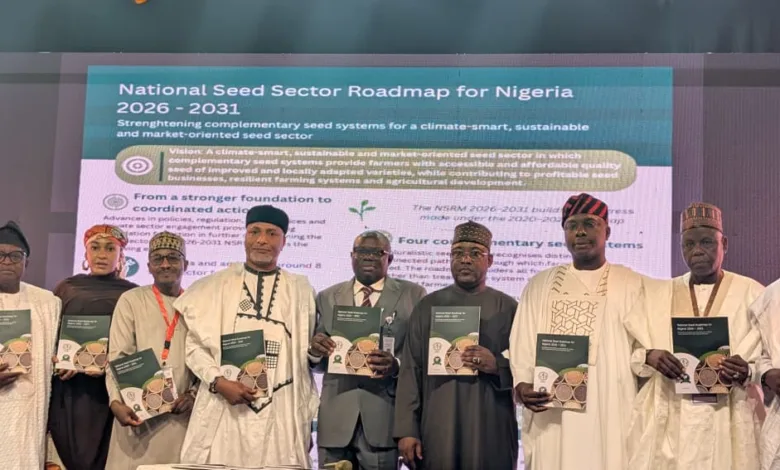
One of the major highlights of the event, he noted, is the unveiling of the National Seed Sector Roadmap. He described the roadmap as an important framework for aligning priorities, mobilising investments and coordinating interventions towards a more productive, resilient and commercially viable seed sector, adding that what matters most is collective commitment to its implementation.
The Director-General expressed appreciation to the Chairmen of the Senate Committee on Agriculture and the House Committee on Agricultural Production and Services, the Honourable Minister of Agriculture and Food Security, Sen. Abubakar Kyari, CON, as well as the Honourable Minister of State, Sen. Dr. Aliyu Sabi Abdullahi, for their leadership, the NASC Governing Board Chairman and members, development partners, sponsors, exhibitors and stakeholders.
He added that the true measure of SeedConnect 2026 will be the partnerships established, investments mobilized and practical commitments that emerge from the deliberations. He concluded with a quote from President Bola Ahmed Tinubu: “Plant the Right Seed, Feed an Entire Nation.”
The highlight of the event was the unveiling of the National Seed Sector Roadmap for Nigeria (2026–2031)