A lost legacy: Nigerian art, cultural memory, and one family’s irreparable loss, by Kio Amachree
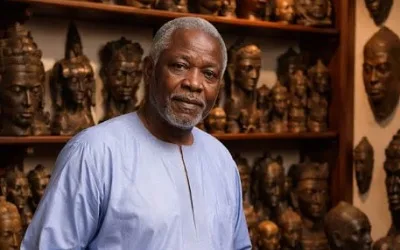
For more than fifty years, my father quietly assembled one of the most significant private collections of Nigerian and West African art ever held in a family home.
Carvings. Bronzes. Masks. Ritual objects. Works that carried centuries of history, belief, and mastery.
Chief Godfrey Amachree, Queen’s Counsel, was not a casual collector. He was one of the most respected private patrons Nigerian art traders ever encountered. In those days, traders did not operate galleries. They arrived in person, traveling from the North and across West Africa, carrying extraordinary objects to our home in Ikoyi. My father always had first choice.
He was known not only for his devotion to Nigerian art but also, during the golden era of horse racing, as one of the country’s most prominent racehorse owners. The Northern traders respected him deeply. He respected them in return. There was trust, history, and mutual regard.
Because I was exposed to this world from early childhood, those same traders took me under their wing. Simply mentioning my father’s name opened doors. Nigerian art was not decoration in our home. It was history. Identity. Proof of civilization.
The importance of Nigerian art cannot be overstated. From the ancient Nok terracottas, among the earliest large-scale sculptures in sub-Saharan Africa, to the refined naturalism of Ife bronzes and the courtly brilliance of Benin metalwork, Nigeria sits at the foundation of African artistic achievement. These works documented kingdoms, rituals, cosmology, and social order long before colonial contact.
Today, Nigerian art commands global recognition and extraordinary value. Benin bronzes sit at the center of international restitution debates. Major museums and auction houses compete for works by Nigerian modern masters. What was once dismissed as “tribal art” is now recognized as world heritage.
My father understood this instinctively. He collected not for prestige or investment but for preservation. When he died, his collection filled an entire house. I intended to build a museum — a permanent home where future generations could study and understand what Nigerian creativity truly represents.
That plan was destroyed by greed.
A half-brother — a man who never grew up under my father’s roof and never understood the significance of what he touched — stole the collection and sold it. He had already received substantial financial support from me after our father’s death. He squandered it. Then he betrayed the family.
I did not learn of the theft from authorities. I learned from the art traders themselves. Alhajis and Malams called me in alarm. They told me that Chief’s art was being sold in the North by a man claiming to be his son — a man they had never seen before. By the time the police were involved, it was too late. The collection had been dispersed across Nigeria.
Nigeria lost one of its most valuable private art collections. My siblings and I lost a legacy. History was broken into fragments and scattered.
This is not just a family tragedy. It reflects a larger pattern: how African cultural heritage is repeatedly lost — through colonial looting, neglect, and internal betrayal. Art that should anchor national memory instead disappears into private hands, vaults, or foreign markets.
I will not name the man responsible. I will not give him that recognition. But I will continue to speak about what was lost — and why it mattered.
My father believed Nigerian art was proof of who we were, long before anyone tried to define us otherwise. That belief still stands, even if the collection itself is gone.