Estimated inflation to average 21.9% y/y in 2025, analysts
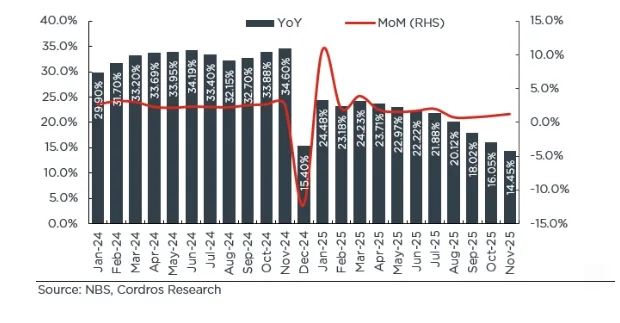
A group of analysts at Cordros Research have projected that Nigeria’s inflation rate is estimated to close 2025 with an average 21.9 per cent year-on-year (y/y).
The company noted that a spike in the December 2025 inflation reading is possible due to the December 2024 Consumer Price Index (CPI) rebasing, which introduced a discontinuity in the series.
“The artificially low base could mechanically lift the year-on-year reading, giving the appearance of a renewed uptick in price pressures, even though underlying momentum is expected to remain subdued. Overall, we estimate inflation to average 21.9per cent y/y in 2025E,” they noted.
The National Bureau of Statistics (NBS), had disclosed that Nigeria’s headline inflation fell for the eighth consecutive month.



“Specifically, headline inflation eased by 160basis points to 14.45per cent y/y in November (October: 16.05per cent y/y) – 21bps higher than Cordros’ estimate of 14.24 per cent y/y. Conversely, on a month-on-month basis, headline inflation rose by 29bps to 1.22per cent (October: 0.93per cent m/m).
NBS noted that food inflation continued to ease, falling by 204basis points to 11.08per cent y/y (October: 13.12per cent y/y) supported by relatively improved crop harvests, fewer flood-related disruptions to food supply, naira appreciation, and moderate increases in logistics costs.
“However, on a month-on-month basis, the food index rose after two months of deflation, increasing by 1.13per cent, due to higher prices for both farm produce (+0.77per cent m/m vs October: +0.00per cent m/m) and imported food (+0.60per cent m/m vs October: +0.35per cent m/m). The monthly uptick in price pressures reflects increased consumer demand associated with preemptive buying and stockpiling ahead of the December festive period.
“At the same time, core inflation (all items less farm produce and energy) moderated by 65bps to 18.04per cent y/y (October:18.69per cent y/y), underpinned by naira stability and lower energy costs.
“Similarly, on a monthly basis, core inflation slowed by 14bps to 1.28per cent m/m (October: +1.42per cent m/m), reflecting slower price increases across key sub-items – utilities (-233basis points to 0.54per cent m/m), insurance and financial services (-153basis points to 0.18per cent m/m), education services (-75basis points to 0.02per cent m/m), furnishings and household equipment maintenance (-72basis points to 0.19per cent m/m), information and communications (-41bps to 0.12per cent m/m), and clothing and footwear (-27basis points to 0.10per cent m/m).
Conversely, inflation rose in the health (+215basis points to 2.71per cent m/m), recreation, sport and culture (+78basis to 1.58per cent m/m), and alcoholic beverages and tobacco (+77basis points to 1.08per cent m/m) subcomponents.
Inflationary pressures are expected to remain tepid in December, particularly compared to the previous year. For food, the main harvest typically peaks in December, but improved supplies and a possible extension of the harvest due to continued rainfall should help contain price pressures.
The firm stated that the exchange rate has remained relatively stable (December average so far: N1,450.60/USD vs December 2024: N1,564.67/USD), appreciating 7.3per cent y/y, which supports lower price increases for imported food.
“For core items, reduced energy price pressures and the stronger naira are expected to limit upward pressure on core prices, keeping overall inflation broadly in check,” the firm added.