Stolen souls: Why keeping the Benin bronzes in London is no longer a defence — by Kio Amachree
I have argued this at great length with my old friend Sir Nicholas Coleridge, long-serving chairman of the Victoria and Albert Museum, a man of considerable learning and genuine goodwill. His position, like that of the British Museum establishment broadly, is not malicious. It is, however, wrong — and increasingly, the world is saying so with its actions rather than its words.
The argument London makes is familiar by now: Nigeria is unstable, corrupt, politically fractured. Who will protect these objects? Who will stop a powerful man — a governor, a general, the Oba himself — from selling them? Who will ensure public access? The British Museum, they say, is a library of the world, a sanctuary beyond the reach of greed and politics.
Let us be precise about what that argument actually says. It says: we stole from you, and now we will keep what we stole because you cannot be trusted with it. Dressed in the language of conservation, it is colonial paternalism at its most refined — so polished you can almost miss the condescension beneath the surface.
What Britain Actually Did in 1897
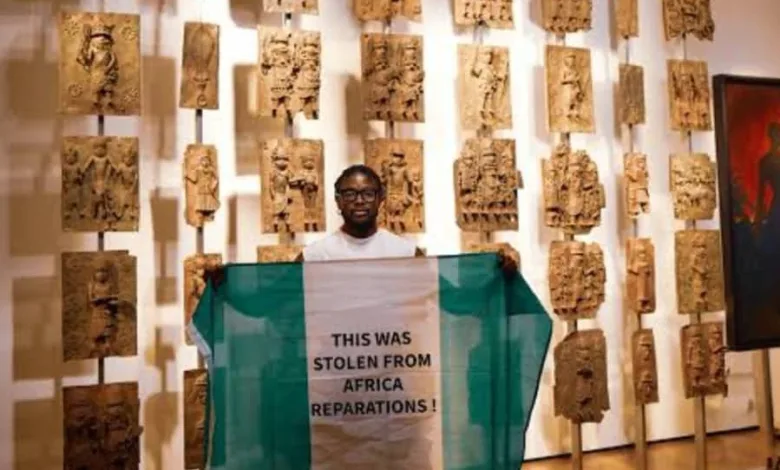
In February 1897, British forces invaded the centre of the Kingdom of Benin, storming the Royal Court and Palace where shrines, sacred objects, and approximately 3,000 to 10,000 artworks were forcibly removed or destroyed. This was not an accident of history. The British military subsidiarily targeted the royal treasures specifically to sell them to finance the invasion. The looting of Benin was, in the most literal sense, a government-organised smash-and-grab operation — colonial robbery dressed up as punishment.
The Bronzes consist of plaques and sculptures made from bronze and brass by the Edo people of Southern Nigeria. They had many functions: used in religious rituals, to decorate the Benin Court, and most importantly, they are physical manifestations of the spirits of generations of Edo ancestors. When Britain took them, it did not merely take art. It severed a living people from their dead. Present-day Edo who still practice traditional religion cannot pay their respects to their ancestors because their ancestors’ faces are behind glass in Bloomsbury.
The Museum That Lectures Others on Theft
The British Museum holds 928 Benin works — the largest collection in the world — and remains a holdout on repatriation, citing the British Museum Act of 1963, which prevents the institution from deaccessioning objects from its collection.
That Act was not written to prevent injustice. It was written to prevent inconvenience. And the argument that a parliamentary statute from 1963 — passed when Nigeria had been independent for precisely three years — should forever bind the conscience of a democratic nation is, on examination, no argument at all. It is a bureaucratic shield masquerading as principle.
The irony is devastating. When it emerged that a former British Museum employee had been systematically stealing objects from the collection — items disappearing “in increments” over years — Nigeria’s director of the National Commission for Museums and Monuments, Abba Isa Tijani, responded with a precision that cut to the bone: “It’s shocking to hear that the countries and museums that have been telling us that the Benin Bronzes would not be secure in Nigeria have thefts happening there.”
The safeguard argument died in that moment. A senior curator walked out of the British Museum with the crown jewels of antiquity stuffed in his pockets. The institution that would lecture Abuja on security.
The World Has Already Decided
While the British Museum drafts legal memoranda, the rest of the world is acting. In the largest restitution of its kind, the Netherlands returned 119 Benin Bronzes to the Nigerian government in 2025, part of a growing international reckoning with colonial-era looting of African cultural heritage.
The University of Cambridge’s Museum of Archaeology and Anthropology completed the official transfer of ownership for 116 Benin Bronzes to Nigeria, with arrangements underway for the artifacts to physically return before the end of 2026.
In 2026, hundreds more will be returned to Nigeria from museums in Sweden, Britain and Germany. The tide is not coming. The tide has arrived.
The Real Question Britain Won’t Ask
The concern about what happens to the bronzes once returned deserves honest engagement — not to justify retention, but because it is a legitimate question about stewardship.
A three-way power struggle existed within Nigeria over whether repatriated bronzes would be put on display and where: the governor of Edo State initiated plans for a state-of-the-art museum; the Royal Court of Benin objected and announced plans for its own museum near the palace grounds; and the Nigerian federal government maintained exclusive authority through the National Commission for Museums and Monuments.
The question of control was partially resolved in May 2023 when the Nigerian president issued a decree recognising the Oba as the owner of any Benin Bronzes returned to Nigeria — but the decree explicitly allowed the Oba to keep returned artworks in his palace compound with no obligation to show them to anybody, and contained no proscriptions on what the Oba may do with the bronzes, including selling them for profit.
This is a real concern. I will not pretend otherwise. A decree that hands 128 years of stolen heritage to a single royal custodian without transparency requirements, without public access guarantees, and without anti-alienation protections is — as the NCMM itself said — “not practical nor compatible with existing Nigerian law.”
A representative of the royal family said the Oba wants to display the works publicly, but the prospect of private ownership sparked anxiety among Western museums and the NCMM given the bronzes’ collective value of $130 billion.
These are tensions that Nigeria must resolve. But they are Nigeria’s tensions to resolve — not Britain’s pretext for continued possession. It appears unfair that Nigeria should have to justify why it is ready to be the home for objects that rightfully and legally belong within its borders.
And the practical reality on the ground is more hopeful than the alarmists suggest. About 100 returned works have been displayed at the Benin City National Museum. Nigeria is constructing the Edo Museum of West African Art in Benin City, designed to provide world-class conservation, research, and exhibition spaces for the returned artifacts. The infrastructure of return is being built. The political will to build it exists.
The Argument That Cannot Be Answered
There is a question that no trustee of the British Museum, no Whitehall mandarin, no learned friend of mine at the V&A has ever satisfactorily answered: on what moral basis does a thief retain stolen property by arguing that the victim’s house is not big enough?
The ruthless means by which Britain sought to plunder and erase the rich culture, identity, and history of the Benin Kingdom is why repatriating the Bronzes is not forgiveness — and should not be used as a tool to forget colonial wrongdoings.
These are not British objects. They were never British objects. They were taken at gunpoint, sold to offset the cost of the guns, and housed in a building whose enlightenment values were apparently not applied to the people whose belongings filled its galleries.
The bronzes do not belong in London because they are safe there. They belong in Nigeria because they were made there, by Nigerians, for Nigerians, to honour Nigerian ancestors and record Nigerian history. Every year they remain in Bloomsbury is another year that history is told from the wrong side of the Atlantic, by the wrong voice, for the wrong audience.
What Must Happen Now
Britain must amend the British Museum Act. This has already been done for other institutions — the political will exists, if the moral will can be summoned. Repatriation need not be instantaneous or unconditional. Loan-back arrangements, as Cambridge has pioneered, can ensure continuity of access during the transition. Nigeria must simultaneously finalise clear public governance frameworks — access guarantees, conservation standards, anti-alienation protections — that answer the legitimate stewardship questions with facts rather than promises.
But the starting point must be honest. Britain did not acquire the Benin Bronzes. Britain stole them. And the argument that the stolen goods are safer with the thief than with the victim is not a conservation policy.
It is an insult.
The author is President of Worldview International and a long-standing advocate for Nigerian governance accountability and diaspora rights. He writes from Stockholm.