
My weekend journey through Oke Igbo — by Bamidele Johnson
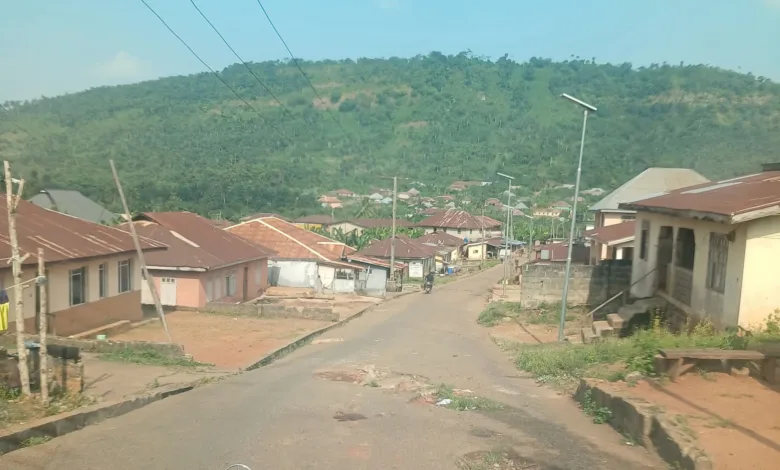
Living in rural Nigeria must be the very definition of wellness. That is until you fall ill and discover that there is no health facility within a reasonable distance, or that the one available is perfectly capable of finishing what the ailment started. It is an important qualification to the romance of country living. The countryside is lovely, sometimes spectacularly so. It is not paradise, but in many respects, paradise is probably no more than ten streets away, provided you are not ill.
I spent part of this weekend in Oke Igbo, Ondo State, a town whose most illustrious son is the Yoruba novelist, D.O. Fagunwa. His Ogboju Ode ninu Igbo Irunmole, which Wole Soyinka later translated as The Forest of a Thousand Demons, was something of a literary smash hit when I was growing up.
I am not in a position to say much about literature. I am wretched at it, possibly because I have no interest in it, or vice versa. What I have written about Fagunwa is roughly all I know about him. If only for the satisfaction of ticking a box, I would have loved to visit his home. Perhaps a connection might have developed.
Oke Igbo is a town of numerous hills, which give it a distinctive topography. Unfortunately, I did not get to see much of it. What I saw, however, was memorable. From one part of the town, houses appeared like miniature toys scattered down a slope. Buildings that would ordinarily look substantial from street level seemed reduced to little playthings against the green landscape.

The journey to Oke Igbo, however, was a different kind of adventure, and not one I would recommend to anyone seeking an uncomplicated road trip. Construction work on the Ibadan-Ife Road made the trip unnecessarily arduous. It began promisingly enough. The lane leading towards Ife, which had been closed to vehicular traffic in April when I last travelled in that direction, had reopened. It was a concrete road, and driving on it was close to nirvana. The smooth surface was a welcome relief, and for a while I entertained the comforting thought that somebody had finally decided to make life easier for motorists.
That feeling lasted approximately 15 kilometres. Then nirvana packed its bags and disappeared.
We were forced to switch to the opposite lane, which has yet to receive the same attention. What followed was an exhausting exercise in vehicular gymnastics. Every few minutes, motorists had to move from one lane to the other, depending on the state of construction and the available passage. Left to right, right to left, with the regularity of a windscreen wiper. It was thoroughly irritating, made worse by the uncertainty of what lay around the next bend. We eventually reached Ife after almost three hours.
I had not driven through Ife in about 30 years. There had simply been no reason to. My usual route towards Ilesa and Akure bypassed Lagere and Sabo, sparing me the need to navigate the heart of the town. This time, I got to see more of Ife and was struck by how much it had changed. Whether for the better, I cannot say.
One familiar sight was Diganga Hotel, which in its heyday was Ife’s equivalent of Transcorp Hilton. I was surprised to see that it still exists. It was one of those establishments that occupied a prominent place in the town’s social geography. I did not see Samtad Gardens or Mayfair Hotels. Perhaps they have disappeared, or perhaps I simply missed them.
On Ondo Road, I spotted Olympic Hotel, reputed in those days to be a whoremonger’s paradise. I also saw the old Oyo State College of Arts and Science, attended by some of my friends for their A-level studies. Its sight brought back memories of an era when such colleges played an important role in preparing young people for university education.
The journey also resurrected a collection of place names I had not heard in donkey’s years. Arubidi. Iyanfoworogi. Garage Olode. These names belong to a particular geography of memory, and encountering them again transported me to another period. Garage Olode, if my memory serves me correctly, was the scene of a violent clash between supporters of the National Party of Nigeria and the Unity Party of Nigeria in the run-up to the 1983 elections. Those were combustible times in old Oyo State, when political differences could quickly descend into something much more sinister.
And then there was Modakeke. The town has a history inseparable from its often troubled relationship with Ife. During the years when hostilities were at their worst, my Ife friends referred to Modakeke people, not exactly affectionately, as Modeko. The relationship between the two communities was complicated by questions of identity, land, political representation and local government autonomy. These were not mere disagreements between neighbours but deep-seated disputes that periodically erupted into violence.
My memories of that period are particularly tied to the politics of the Second Republic. Ife was strongly associated with the UPN, while Modakeke leaned towards the NPN. These political affiliations were not incidental. They became entangled with longstanding communal tensions, making an already difficult relationship even more combustible.
One of the figures caught up in this history was Wale Odelola, a member of the old Oyo State House of Assembly and a UPN politician. In July 1983, a UPN campaign team visiting Modakeke to canvass support for Governor Bola Ige’s re-election encountered violent opposition. The visit coincided with a cultural festival in the town, and what followed was a bloody confrontation. Odelola was among those killed.
His death became part of the bitter history of the Ife-Modakeke crisis and the political hostilities of the period. I remember that Modakeke High School was subsequently renamed Wole Odelola High School by the government of old Oyo State under Ige. It was a gesture that, given the political loyalties of the two communities, was bound to be controversial. Odelola was a UPN stalwart, while Modakeke was overwhelmingly NPN-inclined.
The renaming was therefore more than an attempt to honour a dead politician. It was an intervention in the community’s political and emotional space. The man whose influence helped shape Modakeke’s political direction was Chief Olaniyan Alawode, alias 007. He was an influential community leader and a major figure in the NPN’s political mobilisation in the area. His leadership helped consolidate Modakeke’s opposition to the UPN and its support for the NPN in the 1983 elections. This alignment was rooted in the community’s conviction that the NPN offered a better prospect of securing its longstanding demand for a separate local government.
Alawode was not merely a party operative. He was a powerful community figure whose political choices carried considerable weight. His place in the history of the crisis illustrates how political personalities and communal grievances can become dangerously intertwined.
The school name did not endure. After Ige lost the 1983 election to the NPN’s Omololu Olunloyo, the new administration restored the old name. In hindsight, I can understand why. Naming a community’s school after a figure associated with a rival political tradition, particularly one killed in a conflict involving that community, was hardly an exercise in political sensitivity. Whatever the intention, it was an affront waiting to happen.
It is worth remembering that the Ife-Modakeke conflict was never simply a contest between political parties. The underlying disagreements were much older, involving land, identity, traditional authority and Modakeke’s demand for administrative independence. Politics aggravated those tensions, sometimes with devastating consequences. The two communities endured several episodes of violence, particularly in the 1980s and 1990s.
Thankfully, that is no longer the defining picture of the two towns. Modakeke looks remarkably different from what I remember. It used to look like a baby’s custard, a thoroughly unappealing mess of a town. That description may be unkind, but it captures the impression it left on me in those days. There has been considerable improvement. More importantly, the hostility between the communities has subsided. The charred buildings and visible scars of communal warfare that once made the area so depressing are no longer the defining features of the landscape. That is perhaps the most pleasing thing about passing through Modakeke. Whatever disagreements remain, people can now get on with the business of living without the constant threat of another round of bloodletting.
Beyond Modakeke, the journey towards Oke Igbo became considerably more pleasurable. The road is largely desolate and bends-ridden, with long stretches of countryside punctuated by occasional settlements. There is something reassuring about driving through a landscape that has not been swallowed by the congestion and disorder of urban life. For much of the journey, the road was in reasonably good condition and quite motorable.
The countryside was the real attraction. There were farm settlements, modest houses and farmers displaying their produce by the roadside. The stalls were particularly inviting. There is something deeply satisfying about seeing agricultural produce in its natural setting rather than encountering it after it has passed through several layers of middlemen and questionable handling.
The plantains, vegetables and other produce looked fresh, and I had little doubt about their provenance. These were not the sorts of things that had spent days travelling through the supply chain before arriving in Lagos, where one sometimes wonders what has been done to them to hasten ripening or preserve their appearance. No carbide-ripened plantain or chemically assisted crap. Just farm produce, fresh from the countryside. There is a certain honesty about that kind of commerce.
One of the most delightful features of the journey was the vegetation. I cannot remember the last time I travelled along a road where lush green plants, particularly bamboo, formed such generous canopies overhead. The trees and bamboo seemed to lean towards one another, creating long stretches of natural tunnels. Their branches and leaves met above the road, filtering the sunlight and casting shifting patterns of green and shadow on the asphalt.
It was a daytime journey, and the sun was being particularly tyrannical. Beneath those canopies, however, its fury was considerably diminished. There were stretches when the road seemed to disappear into a green corridor, the vegetation providing natural shelter from the heat. It was beautiful in a way that is difficult to appreciate until one has spent enough time in Lagos, where trees are treated as inconvenient obstacles to development and shade is something of a luxury.
The experience reminded me of the pleasures of travelling through places where nature has not entirely surrendered to human ambition. There was no frantic construction, incessant honking, hawkers darting between vehicles, roadside generator noise or someone trying to sell me something at every turn. Just the road, the trees, occasional settlements and the quiet business of rural life. I also saw agbegilodo, those trucks used to transport timber, which have a particularly lethal reputation when their loads fall off.
I was told that Oke Igbo has very good palm wine. I received this information with considerable interest but did not act on it. I love palm wine, but I am also familiar with the consequences of making the wrong beverage choices in unfamiliar places. Explosive diarrhoea is not an aspiration, and I was not about to turn a pleasant weekend excursion into a desperate search for a functional toilet.
There is, after all, a limit to how adventurous one should be when travelling in rural Nigeria, particularly when one has already established that healthcare is not necessarily one of the countryside’s strongest selling points.
Still, I left Oke Igbo with a favourable impression. The hills, green landscape, quiet roads and general atmosphere offered a welcome departure from the familiar commotion of Lagos. There was also the satisfaction of passing through places that existed in my memory as names, political histories and fragments of stories, and discovering that they were still there, albeit changed by time.
Perhaps that is one of the pleasures of travelling. You revisit places you have not seen in decades, discover that some memories have been exaggerated, find that others were remarkably accurate and encounter new things you had no idea you were missing.
I did not explore Oke Igbo sufficiently to claim any great intimacy with the town. I saw its hills, admired its landscape and thought about the literary giant it produced. I also received a generous reminder of the complicated history of the communities along the route. And, for all the pleasures of rural living, I was reminded that it is best enjoyed in good health.



 Follow our WhatsApp Channel