Access Bank, other Nigerian banks well-positioned to meet 2026 Eurobond maturities, says Fitch
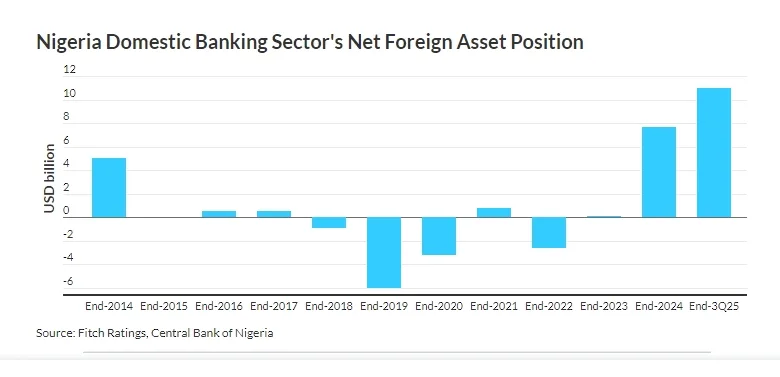
Fitch Rating has said a significant improvement in the Nigerian banking sector’s foreign-currency (FC) liquidity has reduced the refinancing risks associated with $1.7 billion of bank Eurobonds that mature or are callable in 2026.
The international rating agency said it expects strong foreign exchange inflows into Nigeria to continue to support the sector’s FC liquidity coverage.
Fitch Rating noted that the naira devaluation in 2023–2024 and reforms to reduce market distortions led to higher foreign-exchange market volumes, improving Nigerian importers’ access to FC and reducing their reliance on the banking sector for FC financing.
“Nigeria’s gross foreign reserves reached $46.3 billion at end-January 2026 in the wake of the reforms, up from a low of $32.2 billion in April 2024.




“This has helped the Central Bank of Nigeria to clear its backlog of overdue verified foreign-exchange forwards and settle many of the foreign-exchange swaps it has with local banks.
“Against this background, Nigerian banks have been able to pay down their correspondent banking lines and rebuild their placements at foreign banks.
“The banking sector has returned to a substantial net foreign asset position, reaching $11 billion at end-3Q25 from a net foreign liability position of $2.6 billion at end-2022. There has also been a corresponding improvement in FC liquidity coverage metrics.
“The sector’s improved FC liquidity should provide banks with greater flexibility in addressing upcoming bond maturities, reducing refinancing risk. Fitch-rated banks with maturing or callable Eurobond debt have sufficient FC liquid assets to redeem the bonds without the need for refinancing, in our view.
Senior unsecured bonds issued by Access Bank Plc (B/Stable; principal amount: $500 million), Fidelity Bank PLC (B/Stable; $400 million) and United Bank for Africa Plc (B/Stable; USD300 million) mature between September and November 2026.
“Access Bank also has an $500 million additional Tier 1 instrument that becomes callable in October 2026. The instrument is large, equivalent to 7.6per cent of bank-solo risk-weighted assets as of end-3Q25. Access Bank’s bank-solo capital adequacy ratio (CAR) of 16.5per cent at end-3Q25 (excluding unaudited 3Q25 profit) was also only slightly above the minimum regulatory requirement of 15per cent.
“However, Access Bank has since raised Tier 2 capital and plans to further strengthen its bank-solo CAR ahead of the initial call date through internal capital generation and the optimisation of risk-weighted assets.”
The report added that Ecobank Nigeria Limited completed two tender offers in 2025, redeeming a combined $245 million of its $300 million senior unsecured bond ahead of its 16 February 2026 maturity date. It repaid the remaining $55 million on maturity.
“ The bank’s FC liquidity is very tight by domestic standards, but Fitch views it as sufficient to continue servicing the bank’s FC liabilities (mainly deposits). The bank’s Long-Term Issuer Default Rating of ‘CCC’ and Viability Rating of ‘f’ also capture Ecobank Nigeria’s prolonged breach of the minimum CAR requirement and reliance on regulatory forbearance relating to the classification and provisioning of problem loans and single-obligor limit breaches,” the report added.