How Qatar, Turkiye, Pakistan and Indonesia are deepening defence ties
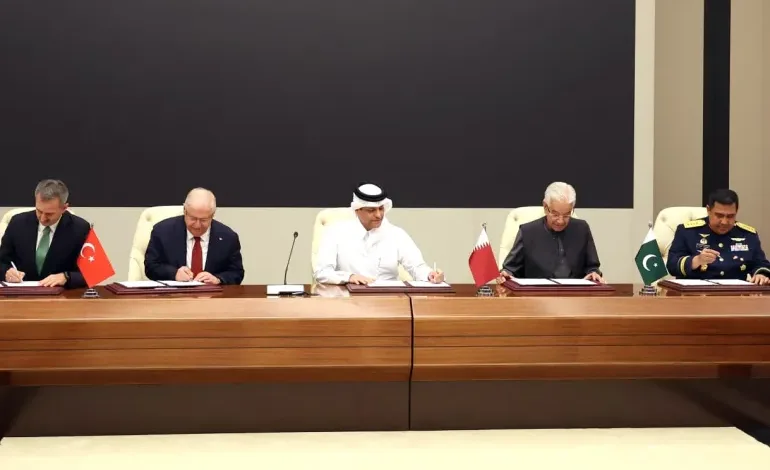
Qatar, Turkiye, Pakistan and Indonesia signed a deal on Wednesday to deepen their defence industry cooperation, reflecting a broader effort by countries in the region to widen their network of security partners amid the prolonged US-Israel war with Iran.
The four countries signed the memorandum of understanding in Doha, building on existing military projects through joint production, technology transfers and more closely integrated supply chains.
The initiative comes as the failure of the United States and Iran to reach a concrete peace agreement pushes countries in the region to diversify their defence partnerships and look beyond what experts described as an overreliance on Washington for their security.
However, experts stressed that closer cooperation does not mean abandoning long-standing alliances. Instead, the ambition is to gain greater control over their own security while strengthening existing partnerships.


Arda Mevlutoglu, a defence industry analyst and managing director of Mergen Analytical Strategies, told Al Jazeera that the implications could extend well beyond the four participants.
“We may be witnessing the emergence of an interconnected network of defence and security arrangements extending from the Gulf to South and Southeast Asia, rather than a single formal alliance,” he said.
What would the agreement do?
In a statement, the Qatari Defence Ministry said the “Badr” Memorandum of Understanding aims to foster cooperation in defence manufacturing, enhance the defence capabilities of the four countries and promote collaboration in technical defence training, research and development.
The ministry said the initiative would contribute to developing solutions and industries that meet the evolving demands of modern defence.
Experts said each country would contribute its own resources and expertise to the partnership.
“Turkiye contributes technological expertise, systems integration and a mature defence industry; Pakistan and Indonesia offer manufacturing capacity, skilled workforces and sizeable domestic markets; and Qatar provides investment potential and demand,” Mevlutoglu said.
Together, the four countries could establish integrated supply chains, enabling them to jointly develop, manufacture and maintain defence systems, he told Al Jazeera.
Such arrangements could give buyers a greater role in producing and supporting their own equipment while providing manufacturers with long-term orders and investment.
Albert Vidal, a research associate at the International Institute for Strategic Studies, told Al Jazeera that Pakistan and Indonesia were willing to purchase Turkish weapons and locate some of their production in their own countries.
He said the arrangement could reduce costs for Turkish companies and create jobs in Pakistan and Indonesia, while Qatar would provide financial support.
Building on existing partnerships
Turkiye, which has one of the world’s most advanced defence sectors, already maintains military manufacturing partnerships with Qatar, Pakistan and Indonesia individually.
Qatar and Turkiye, for instance, signed a bilateral defence industry memorandum in October 2025.
However, Vidal said the new agreement involving all four countries reflected both industrial and strategic calculations, as closer relationships could give more countries a stake in one another’s security.
He pointed to Qatar’s investments in the Turkish defence industry over more than a decade and Ankara’s deployment of troops to Doha during the 2017 diplomatic crisis.
Pakistan’s existing naval manufacturing project with Turkiye also demonstrates how weapons purchases can support domestic production. Under the project, two of four announced ships are to be built in Istanbul and the other two at Karachi Shipyard.
Indonesia and Turkiye, meanwhile, are jointly developing a tank.
“The rationale is to streamline these distinct defence export and joint production agreements under a more structured and resilient networked hub, rather than reinvent the wheel with each new defence agreement,” Burcu Ozcelik, a senior research fellow at the Royal United Services Institute, told Al Jazeera.
Less dependence on Washington?
The US-Israeli war with Iran and recent Houthi attacks on Saudi Arabia have heightened regional security concerns, analysts said.
Reported shortages of US weapons may also be increasing the urgency of efforts to strengthen existing partnerships and expand domestic arms production.
“Diversification is a major driver, particularly as recent conflicts have exposed vulnerabilities associated with dependence on foreign suppliers, technology restrictions and supply chain disruptions,” Mevlutoglu said.
However, he cautioned against interpreting the memorandum as a break with Washington.
“Qatar is unlikely to abandon its strategic relationship with Washington, while Turkiye seeks greater technological independence within NATO, not autonomy from it,” he said.
Bader Mousa Al-Saif, an associate fellow with Chatham House’s Middle East and North Africa Programme and an assistant professor at Kuwait University, said the initiative reflected a growing tendency among Gulf countries to look towards the Global South and fellow Muslim-majority countries.
Analysts said the agreement also complemented a separate effort to formalise military cooperation across the region.
Saudi Arabia, Pakistan and Turkiye signed the Mecca Joint Defence Agreement in August, establishing a mutual defence commitment.
Ankara submitted the agreement to parliament for ratification on Wednesday, although the deployment of Turkish troops abroad would require separate parliamentary approval.
The Doha memorandum focuses on industrial cooperation rather than a mutual defence pledge. However, Mevlutoglu said the two initiatives could complement each other.
“While Mecca focuses on collective deterrence and military cooperation, Doha could provide the industrial and technological foundations for such partnerships,” he said.
Credit: Aljazeera