Restorying ‘Ogbori Elemoso’: Oba Ghandi and Lere Paimo’s tears, by Folorunso Adisa
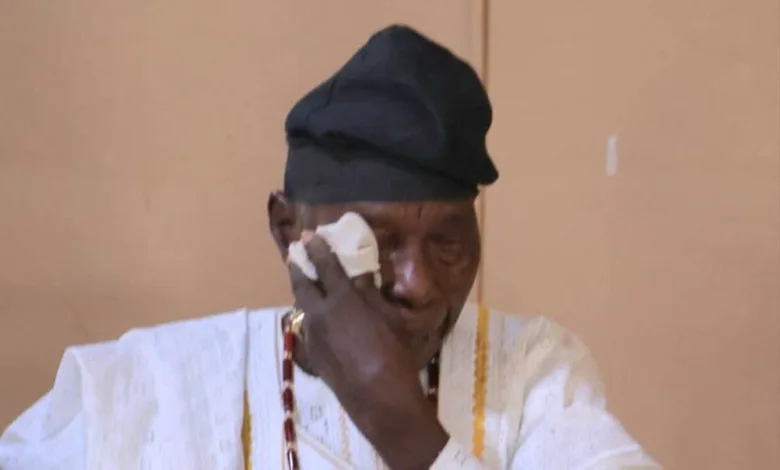
I have learned that there is an ongoing dispute between the legendary Baba Lere Paimo and the Soun of Ogbomoso, Oba Ghandi, regarding the remake of the epic movie, ‘Ogbori Elemoso.’ I hope the matter is resolved amicably. Below is the piece I wrote about the film back in 2020
REMINISCING ABOUT OGBORI ELEMOSHO
Among the three literary genres, Drama stands apart for its versatility, its social immediacy, and its ability to fuse literature, movement, and spectacle into a living, breathing art form. Unlike prose, which unfolds in the solitude of reading, or poetry, which sings in the silence of contemplation, Drama thrives in communal experience, pulsating with the rhythm of human interaction. It is a world where words are not just spoken but lived, where history, culture, and imagination collide on a grand stage.
One play that carries this artistic richness is Ogbori Elemosho, a masterpiece by Lere Paimo, better known as “Eda Onileola” or “Soun Ogunlola.” It is more than just a tale of robbery and unrest; it is a cultural mosaic, woven with the threads of Yoruba heritage, Bata dance, Pipa Aroko (symbolic messaging), proverbial wisdom, monarchy, communal bonds, and the haunting echoes of Ijala chants that summon the spirits of ancient warriors. The play is a gateway into a world where tradition meets destiny, and valor is the currency of survival.



The clashing titans were Soun Ogunlola and Elemosho. At the heart of the drama stand those formidable figures: Soun Ogunlola, the lion-hearted protagonist, and Lalude (Elemosho), the enigmatic villain whose presence alone sends shivers down the spine. Their battle is more than a clash of blades. It is a collision of fate, a test of willpower where the hunter must outwit the hunted.
Lere Paimo, the Soun, does not merely act; he becomes his character. His mastery of the Bata drums is a sight to behold, his feet tracing the language of rhythm, his body moving with an almost supernatural agility. And then there’s his Ijala: that deep, sonorous voice, dripping with ancestral authority, turning words into weapons sharper than steel. One could almost mistake him for a hunter who wandered onto the set straight from the Oke-Ogun forests.
But every great hero needs a villain who is just as unforgettable. Enter Lalude, Elemosho himself, the specter of death cloaked in flesh. His mere voice, high-pitched and ghostly, is an incantation of doom. When he utters his signature “Iwooooo”, it is as if the air itself turns to ice, and his victims drop lifeless at his feet. His movements are serpentine, his presence an unrelenting omen of destruction. Yet, paradoxically, he is a villain so wickedly captivating that you almost wish he wouldn’t die.
And then comes the final reckoning, the ultimate showdown between these two titans. Soun, the relentless warrior, meets Elemosho in a battle of wills and wits. Lalude’s athleticism adds fire to the confrontation, his gravity-defying backflips making him as unpredictable as a raging storm. But even the mightiest storm meets its match. With one decisive strike, Soun severs his foe’s head, delivering it to the Alaafin (played by Baba Wande). And just like that, the tormentor of the people is no more. Victory songs fill the air; the land breathes again.
Great storytelling is not just about entertainment, it is about transformation. Ogbori Elemosho does not merely transport us into a world of warriors and kingdoms; it awakens something within us. It reminds us that Drama is more than spectacle. It is the echo of our past, the mirror of our present, and the prophecy of our future.
In the hands of masterful actors like Lere Paimo and Fatai Adetayo (Lalude), storytelling becomes an art of enchantment. Their performances do not just hold our attention; they grip our souls, pulling us into a world where courage, destiny, and honor dance in a mesmerising waltz.
A well-told story never fades. And Ogbori Elemosho? It is not just a play. It is an experience, one that lingers long after the final curtain falls.