Tinubu and the remaking of Rashidi Ladoja — by Dare Babarinsa
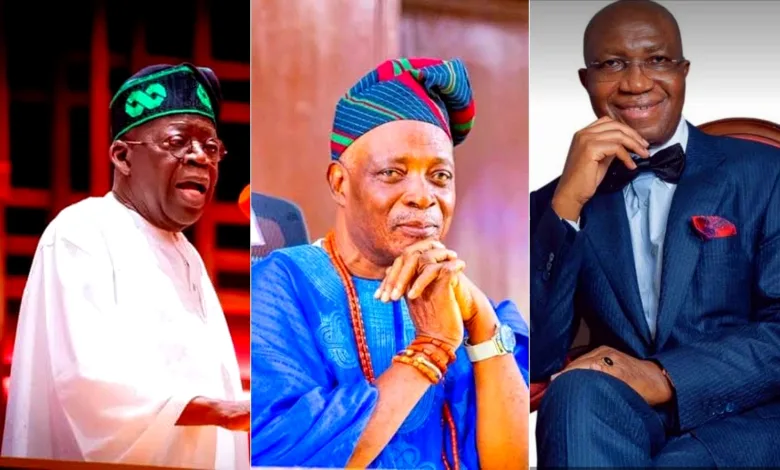
At his 75th birthday celebrations on Thursday, November 19, in Abuja, legal luminary Chief Wole Olanipekun, a Senior Advocate of Nigeria (SAN) and the Asiwaju of Ikerre-Ekiti, told an interesting story about President Bola Ahmed Tinubu and the Olubadan of Ibadan, Oba Rashidi Ladoja.
In 2003, Ladoja was elected Governor of Oyo State, displacing Alhaji Lam Adesina of the Alliance for Democracy (AD). That year, Ladoja’s party, the Peoples Democratic Party (PDP), had seized control of all the states in the South-West: Oyo, Osun, Ondo, Ekiti and Ogun, except Lagos, where Bola Ahmed Tinubu became the last man standing.
All the other AD governors had fallen to the PDP blitzkrieg. The South-West was now under the control of President Olusegun Obasanjo and his party.
On January 12, 2006, Tinubu called Olanipekun late at night. Olanipekun was already in bed.

“Where are you?” the governor enquired needlessly.
“I am on my bed!” the lawyer replied.
“There is no sleep for the wicked!”
The two of them laughed.
Tinubu enquired whether he was following developments in Oyo State, where Governor Ladoja had been impeached by the House of Assembly because of his clash with his godfather, Alhaji Lamidi Ariyibi Adedibu, the lionised strongman of Ibadan politics.
Tinubu instructed his lawyer that he must go to Ibadan to defend Ladoja’s interests despite the fierce rivalry between the PDP and the AD.
Olanipekun said Tinubu is a convinced democrat who believes he has a duty to defend the interests of people everywhere democracy is threatened.
That was how he dispatched Olanipekun to defend Ladoja, who eventually regained his job in December 2006. His deputy, Adebayo Alao-Akala, acted as governor during the impeachment period and eventually succeeded him on the platform of the PDP.
Olanipekun said he first met Tinubu in 1992 when he accompanied his principal, Governor Bamidele Olumilua of Ondo State, to the National Assembly, where the President was then serving as a senator representing Lagos State.
Olanipekun was then the Attorney-General under Olumilua. He said Tinubu told General Ibrahim Babangida at the time that he was interested in the survival of democracy because he also had the ambition of governing the country in the future.
After Babangida annulled the victory of Chief M.K.O. Abiola in the June 12, 1993, presidential election, Tinubu became a member of the vanguard fighting for the upholding of Abiola’s historic victory.
Babangida was forced out of power in August 1993, but the struggle for June 12 entered a new phase.
A crossroads was reached when General Sani Abacha toppled the regime of Chief Ernest Shonekan, the Head of the Interim National Government (ING), installed by Babangida.
Tinubu therefore joined some other senators, including Ameh Ebute, the then Senate President, and O.J. Adewumi, who instructed Olanipekun and his team to challenge Abacha’s dissolution of the National Assembly in court.
The case died a natural death when Tinubu fled into exile to escape Abacha’s dragnet. He was not to return until after Abacha’s death, when he began his new political odyssey as Governor of Lagos State in 1999.
Rashidi Ladoja was a contemporary of Tinubu in the Senate.
Since then, Tinubu has been doing everything to sustain the fight for democracy across party lines, helping in many states to restore stolen mandates and transforming himself into the ultimate Grand Master of Nigerian politics.
Olanipekun was involved in every one of those legal battles.
Tinubu therefore announced that if there were legal battles after his expected victory in 2027, Olanipekun would still be his lawyer.
He then conferred on the lawyer the second-highest national honour, the Grand Commander of the Order of the Niger (GCON).
He said opposition leaders had much to learn from Olanipekun’s new books, Wole Olanipekun Through the Cases, and promised to supply them with free copies.