Ìgbàlayé: Oga Bello was a loverboy — by Oladeinde Olawoyin
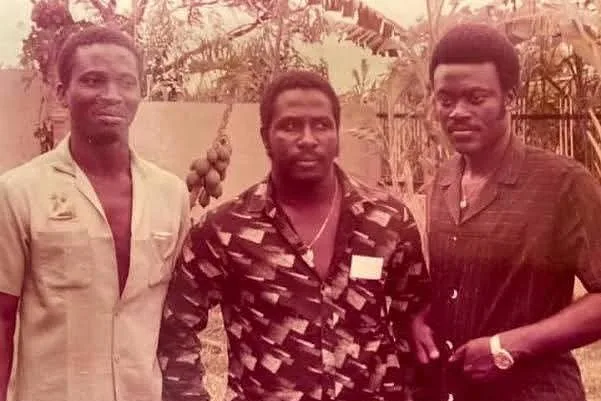
Oga Bello and Jide Kosoko were once romantic lover-boys in Yoruba flicks, and that’s one lesson that struck me midway into Professor Aderinto’s new documentary. That moment, I realised the transient nature of life, experiences, and beauty. In that documentary, Professor Aderinto deployed the didactic nature of cinema to paint an important picture of Fuji artistes as compulsive philanderers.
Drawing artistic insights from Dudu Alabi-Hundeyin’s blockbuster ‘Iyawo Alhaji’, he showed us how KWAM1 deployed his ‘fame’ and artistic gift to snatch a lady from one of his patrons at a party. Unknown to KWAM 1, the lady, who eventually defrauded the artist, turned out to be one of the girls of easy virtue on Allen Avenue. The artistic element of verisimilitude couldn’t have been better pictured.
What I found most fascinating about the clips was the casting: the ‘young’ lover-boy patron from whom KWAM1 snatched the Allen-Avenue lady was the iconic Adebayo Salami a.k.a Oga Bello, now in his 70s. For context, the movie was shot in the 90s.
And then it struck me, you know, the impermanence of the things we are intoxicated by at the moment––wealth, beauty, fame, money, youthful energy…name it!




And then a quick historical analysis of Yoruba Nollywood’s casting of default lover-boys in movies provided perhaps the most illuminating insight:
Between the 1980s through the early 1990s, Adebayo Salami and Jide Kosoko held sway as default choices in any such “lover boy” role in Yoruba movies. Before them, methinks, there was Ade Afolayan (Ade Love), and, perhaps at a lesser degree of versatility, Ishola Ogunsola (I-Show Pepper).
By the second half of the 1990s, the trio of Dele Odule, Taiwo Hassan Ogogo, and Yinka Quadri were already occupying that “lover boys” space. On his part, Yemi My Lover operated on the sidelines with Moji, his mermaid girlfriend, both of whom were locked in ridiculous gymnastics in their hyper-ridiculous stories. On the periphery of mainstream Nollywood, Thompson of the Mr Deinde fame stood apart, also as audience favourite, even as Olaiya Igwe operated as “lover-boy” too from his Abeokuta base. In Osogbo, Prince Oyewunmi (Laditi) and Omo Iya Mi L’eko operated as lover-boys in rural settings, too, mostly in Ajileye flicks. But across “Mainstream Nollywood”, irrespective of geography, Ogogo was the favourite.
On the cusp of the millennium, the klieg lights shifted toward Yomi Fash Lanso, Saheed Balogun, Ayo Badmus, Yemi Sodimu, Ade Eketunde, and a few others. Saheed Balogun aka Bobo Walata was so prolific in his Casanova role that he earned all sorts of sobriquets for being damn good. Meanwhile, Arakangudu and his ‘Iya Oko Bournvita’ Crew operated on the sidelines in Osogbo.
By the first half of the noughties, Balogun and company had competition in Olumuyiwa Ademola, Funso Adeolu, Akin Olaiya, Rotimi Makinde, Tayo Adeleye, and most prominently, Yemi Awomodu. Awomodu was so adored on screen that he literally became the poster boy of lovebirds in Yoruba cinema of that era, before he sought greener pasture elsewhere.
The middle and second half of the noughties threw up Femi Adebayo (more prominently, years after a cameo in Owo Blow), Ibrahim Chatta, Sunkanmi Omobolanle, Damola Olatunji, and later, Odunlade Adekola.
The Muyiwa-Femi-Odun-Chatta quartet, it would appear, has remained on the big screen but the recent mumbling in movie circles points to a truism: time would eventually play its role in pushing them off the lover-boys list. In any case, Rotimi Salami, Kiki Bakare, Solagbade Mustapha, and the new kid on the block, Habeeb Alagbe, have shown themselves as plausible replacements.
What’s the lesson in here?
Well, moments, such as those of sunsets or joys, triumphs or grief, dawn or breakthroughs… they are all fleeting and brief, and we should endeavour to appreciate them before they disappear.
Igbalaye.
Life is ephemeral.