The US midterms: Deeper crisis of American political legitimacy — by Olufemi Awoyemi
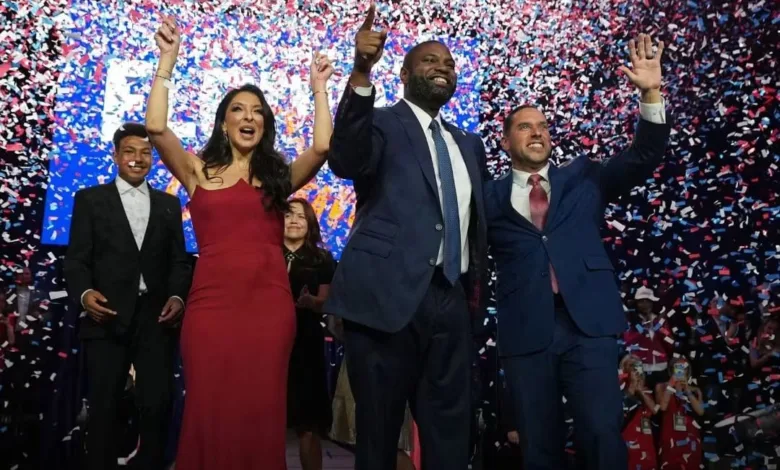
The outcome of the 2026 US midterm elections reinforces a proposition I have held for some time. The rise of Trump and MAGA was never simply about one man, his personality or political ideology. It represented something more profound, a rejection of the established political and economic elites and a challenge to the institutional arrangements that have historically sustained American power.
This includes the military-industrial complex (MIC), the financial-industrial complex (FIC) and the technology-industrial complex (TIC), whose influence over public policy, capital allocation, national security and increasingly the information environment raises fundamental questions about democratic accountability.
The midterm results are, on the surface, a repudiation of Trump and the Republican establishment. However, the underlying electoral discontent suggests something more complicated. Americans remain deeply dissatisfied with the direction of their country, the cost of living, the responsiveness of their institutions and the capacity of either political party to address their concerns.
We should be careful not to interpret every vote against Trump as an endorsement of the establishment he originally challenged. Nor should we assume that a Democratic electoral victory necessarily represents renewed confidence in the traditional governing consensus.


Therein lies the paradox.
Trump successfully mobilised resentment against an establishment that many Americans believed had ceased to represent their economic and social interests. Yet gaining control of government is different from transforming the institutional structures against which that resentment was directed.
Once in office, an anti-establishment movement becomes responsible for governing within those same structures. It must reconcile the expectations of its supporters with the realities of economic management, corporate influence, fiscal constraints, national security and international obligations.
The protest movement becomes the government, and the government eventually becomes the object of protest.
The more consequential issue, therefore, is not whether MAGA survives Trump. Political movements built around grievances that predate their leaders rarely disappear simply because those leaders leave the stage.
The central question is whether the movement can evolve beyond personal allegiance into a coherent governing philosophy, supported by institutions, capable leadership and a credible economic settlement.
MAGA is not necessarily a unified ideological project. Its coalition contains competing perspectives on trade, immigration, fiscal policy, corporate power, America’s international obligations and the appropriate role of government. Trump’s personal authority has helped accommodate these contradictions without necessarily resolving them.
What happens when that authority is no longer the organising principle?⁷
The Democrats face a related challenge. Winning elections on the strength of public dissatisfaction with Trump is not the same as securing a durable mandate for an alternative political and economic settlement. Opposition can produce electoral victories without necessarily producing a governing consensus.
This brings me to what I consider the defining issue.
How does America govern effectively in a post-Trump era without an established centre of gravity?
That centre need not be the traditional political centre. Indeed, the erosion of confidence in established institutions suggests that simply restoring the old arrangements may be insufficient.
A credible alternative would require a renewed settlement around economic opportunity, institutional accountability, the distribution of wealth and power, technological governance and America’s role in a changing global order.
The 2026 midterms do not, by themselves, establish an outright electoral rejection of the MIC, FIC and TIC. They do, however, provide further grounds to examine the relationship between concentrated institutional power, public dissatisfaction and political legitimacy.
My concern is that American politics may be moving from a contest over who controls the establishment towards a much deeper struggle over what should replace the governing consensus that once held the system together.
Trump did not create all the conditions that produced this rupture. He gave them a political identity, a language and a movement. His departure will not automatically resolve them.
The question of sustainability is therefore secondary to the problem of governance.
America’s post-Trump challenge is not merely to find another leader. It is to reconstruct a credible centre of political and institutional gravity in a society where the legitimacy of the old consensus is increasingly contested, but no coherent replacement has yet emerged.
That, to my mind, is the more consequential message beneath the midterm election results.