The digital anointing: Jimi Odukoya, the algorithm, and the church of the comment section — by Akin Olaniyan
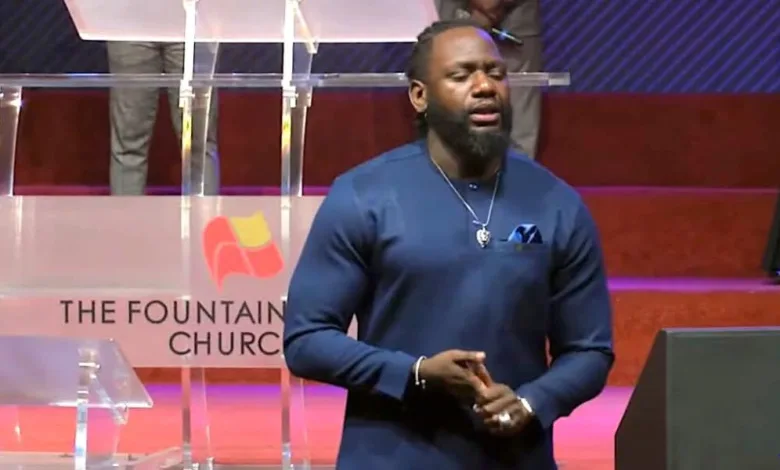
My initial intention was to ignore the ‘drama’ at The Fountain of Life Church but it seems I cannot. I have absolutely no interest in pastors and their churches but I am deeply intrigued by digital culture, hence my critical interrogation of the power play in Jimi Odukoya’s church. If all you see is the announcement of his removal on November 16, 2026, for what the Board of Trustees described as a violation of the founder’s succession plan, then you miss something more fundamental. That announcement, now being contested by the Senior Pastor, only formalised what had been concluded online. Make no mistake, Jimi Odukoya had been tried and found guilty by the digital mob – long before the Board of Trustees made their move.
I will not join the debate about the theological legitimacy of a tattooed, dreadlocks-wearing pastor, and I will equally ignore for this moment, the moral complexities of divorce and remarriage involving the clergy. My focus is on how – as it usually happens – the digital public sphere became the court and the digital mob the jury in determining a celebrity pastor’s legitimacy. Make no mistake, what is playing out is not merely a church crisis. Just as it did with Paystack’s Ezra Olubi, the unforgiving collective memory of the Internet has passed judgment on a man and found him unworthy to remain in an office. If the people living by and profiting from the prestige economy of Nigerian Pentecostalism do not see that the ‘unforgiving server’ has altered their system, then we should all be worried.
Understanding the ongoing ‘drama’ at The Fountain of Life will need us to critically examine the ‘digital theatre’ of modern-day Pentecostalism and the fact that with livestreaming of all programmes, churches have lost full control of their own stories. Like all celebrity pastors who hug the limelight on social media, The Digital Jury has been on Jimi Odukoya’s case long before he was forced out. From the time he emerged as Senior Pastor, his tattooed body, studs and dreadlocks, had been on trial. To make sense of why such things matter at all, we have to situate the contestation over Jimi Odukoya’s looks within Abimbola Adelakun’s concept of the “performance of power.” I find her argument in the book, “Performing power in Nigeria: Identity, politics, and Pentecostalism,” that the pastor’s body and aesthetics are not incidental, helpful in explaining Jimi Odukoya’s declaration that God called him just as he is. It looks to me like this pastor merely sought to weaponise his ‘authentic looks’ as an asset to draw a particular demographic. The problem is, even if you perform power in this way, there is a likelihood that others looking at you from a totally different Pentecostal lens will interpret your actions as a performance of “the flesh.”
Like other churches which have embraced social media and livestreaming, pastors’ conduct and other church issues no longer remain inside auditoriums; the comment section of every post is a public and uncontrolled tribunal, where followers believe – and feel obliged ‘to police’ the church and pastors. Jimi Odukoya’s case was already bad by all accounts, but the Digital Jury was handed new evidence on October 31, 2026, with that cryptic Instagram post featuring two hands with wedding rings and the caption “To New Beginnings”. I believe the Jury came to a decision when Pastor Mo Jasmine Odukoya was introduced as Jimi’s new wife and “First Lady”. If this was meant to be another digital strategy to introduce a new brand asset, then the blowback suggests that he and other celebrity pastors do not understand the digital Public Sphere.



His approach might fit into Ebenezer Obadare’s description of the “Pentecostal Republic” and the “prestige economy” it fosters. However, Obadare’s suggestion in his book appropriately titled, “Pentecostal republic: Religion and the struggle for state power in Nigeria,” that Nigerian Pentecostal pastors had replaced the intellectual elite as the primary locus of social authority and symbolic capital ought to be taken as a warning. It appears Jimi Odukoya and the church sought to ‘consolidate the prestige’ by that ‘made-for-TikTok’ introduction of the “First Lady”. I guess the lesson here is that positioning a church as a marketable, algorithm-friendly brand does have its drawbacks primarily because church leaders within the Pentecostal movement ignore the golden rule of networked publics – context collapse.
The ongoing drama should remind church leaders that the Internet cannot be treated like the weekly bulletin printed and circulated only to congregants. The decision to share the “reel-life” and “viral moment,” of introducing the new wife was an open invitation to the uncontrolled digital mob to bring “real-life” and “backstage” stories of divorce, doctrinal disputes, and Pastor Taiwo Odukoya’s succession video into the digital public sphere. Unsurprisingly, some of the reactions have been nothing but brutal with some critics labelling Jimi as an “end time pastor.”
The online rage highlights the ironic contestation that we are witnessing at the heart of digital Pentecostalism. Ruth Marshall’s respected study of the Nigerian Born-Again movement, published as a book under the title, “The Pentecostal revolution in Nigeria” reminds us that Pentecostalism rests on the core concept of “rupture and redemption,” the departure from a sinful past and the promise of a new beginning. That “To New Beginnings,” post might have been Jimi Odukoya’s attempt to send that very message to followers but the digital audience is unlike God. It does not forgive. In Ezra Olubi’s fall, we already know that conversations in the digital Public Sphere, have a certain persistent character. It is why people are demanding moral perfection that critics fear are being sidelined.
That action by Jimi Odukoya to contest the decision of the Board of Trustees is interesting. So, he goes to the digital Public Sphere to release a statement, which is like an ‘admission against interest’ because the digital audience already stripped him of the protection he enjoyed as an “unquestioned spiritual authority.” It is obvious that in the eyes of the digital mob, he lost the symbolic capital long before the Board of Trustees removed him as Senior Pastor. This is “the comment section” taking charge as the “new church council.”
This ongoing drama should be a reminder to church leaders of the shift in how authority is constructed and dismantled in the social media era. The platforms and algorithm enable pastors to bypass traditional gatekeepers – livestreaming to millions globally – but also deliver them into the hands of an “uncontrolled” digital mob that, unlike congregants, is more merciless when scrutinising leaders. The algorithm – and the comment sections have become sites of authority as strong as the pulpit.
For the institutional religion, the lesson is stark – digital prudence is as important as livestreaming to attract more members and more platform earnings. In this space, calling the church council to adjudicate is useless once a viral moment has invited the attention of the digital tribunal. Here is a reminder to the church – once you are livestreaming church programmes, your congregation is no longer limited to the people within your auditoriums. They include everyone in the comments section on platforms you are using. This is not a flock to be led but a very active, critical audience which does not hold back when they have to give feedback. I find it ironic that the collective clicks, comments, and outrage are the fuel for the attention economy the church is struggling to understand let alone to master.
The drama at The Fountain of Life should force us to critically interrogate the evolving moral economy of our collective online lives. It is tempting to see what we call the “cancel culture,” as a form of democratised regulation, allowing ordinary people a say when formal structures fail to act to correct deviancy. However, we have to determine whether the collective price we are paying is worth it. Somehow, we have to negotiate how to justify accountability that is judged on the whimsical standards of the algorithm.
While we all wait for the next scene in the ongoing drama at The Fountain of Life Church, there seems to be an urgent need for the Pentecostal movement to deal with a dispiriting reality – in the searchable, unforgiving server of the digital age, there will only be one winner and it is not the church.
The digital council which anoints you as a celebrity pastor is also programmed to disrobe you.