A stolen dawn: Reshaping the African future, by Victor Oladokun
I grew up listening to my late father idolize and speak fondly of five men – Muhammed Ali, John F. Kennedy, Nelson Mandela, Obafemi Awolowo, and Patrice Lumumba. As a child, I was thoroughly schooled about their ideals and what they meant for humanity.
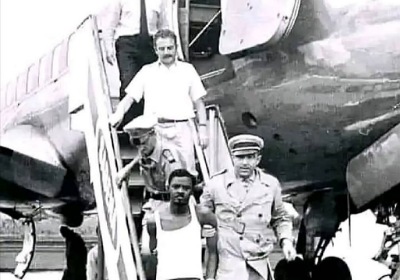
But one of them, Patrice Lumumba, was a haunting figure. On June 24, 1960, at the age of 34, he became the Democratic Republic of Congo’s first Prime Minister. Less than 3 months later, with the conivance of certain Western powers and Congolese opposition figures, he was deposed, arrested, shackled, and publicly paraded.
In a way, Lumumba’s ghost whispers warnings and wisdom to Africa’s leaders. His story is a heartbreaking requiem, a mirror, and an urgent call to rise, reclaim, reshape, and rebuild.
The picture below still remains one of the most troubling and humiliating in Africa’s modern history. It shows a shackled Lumumba being led down the ramp of a plane in the company of a Belgian police officer.
Four months after his overthrow, with the active involvement of Belgium and others, he was executed by firing squad and his remains dissolved in sulphuric acid. The only intact bodypart, kept as a ‘souvenir,’ was a tooth. A notorious Belgian Police Commissioner, Frans Verscheure, was in overall command of the gory details.
That day on January 17, 1961, in the heart of the Congo, a light was extinguished.
Patrice Lumumba, the poet-warrior, the dreamer of a free and united Africa, was silenced, his voice forever choked by the cold hands of betrayal. His assassination was not merely the murder of a man but the strangulation of a vision, a wound that still weeps in the soul of a continent.
To reflect on Lumumba is to feel the ache of what could have been. He was a father, a husband, a son of the soil, whose laughter once echoed in Kinshasa’s streets. He was a man who believed in the improbable, that a newly independent nation could defy the weight of centuries of plunder. His heart beat was for the people of Congo, for the children who deserved schools, for the mothers who deserved peace. But at the time, the West, with calculated indifference, the West ensured his demise, and propped up Mobutu’s decades-old kleptocracy.
Lumumba’s death was therefore a theft, not just of a life, but of a future.
Today, Africa’s leaders must look into and see the mirror clearly. In a dynamic global economy the operative words must be mutual cooperation, mutual benefit, and not capitulation.
For decades, the scramble for Africa’s resources has not been a partnership of equals, but rather a chessboard where Africa’s kings were too often pawns. But tîmes are changing. There are several bright stars emerging among the continent’s political and economic leaders.
Lumumba’s vision was not just Congolese. It was pan-African. He dreamed of a continent united, where borders drawn by colonial pens would dissolve in the face of shared purpose. African leaders today therefore have a responsibility to reconcile with this vision, heal the fractures of ethnic tribalism, corruption, and mistrust that make the continent vulnerable to chaos, conflict, and exploitation.
The African Union, is a seed of a dream. A powerful platform to negotiate as a bloc, and to set terms that prioritize African lives over African resources.
For me, reflecting on the life and times of Lumumba means learning from the past without being paralyzed by it. Lumumba’s assassination was a tragedy, but it was also a clarion call. As leaders we must honor his memory by building institutions that outlast individuals. We must demand transparent governments, independent judiciaries, and economies that serve the people.
Lumumba’s spirit and ideals are not dead. They live in countless Africans who dare to dream of of a sovereign and prosperous Africa.
His life offers an inspirational charge to be fearless, but wise. Africa’s leaders must negotiate with the cunning of serpents, and ensure that every mining contract, every trade deal, serves the people, the nation and the contînent … first.
History reminds us that one day Africa will have its say. A day when its riches will write a new chapter and when its minerals will fuel its rise. That day is now!