Africa at the United Nations: Power, pretense, and applause — by Victor Oladokun
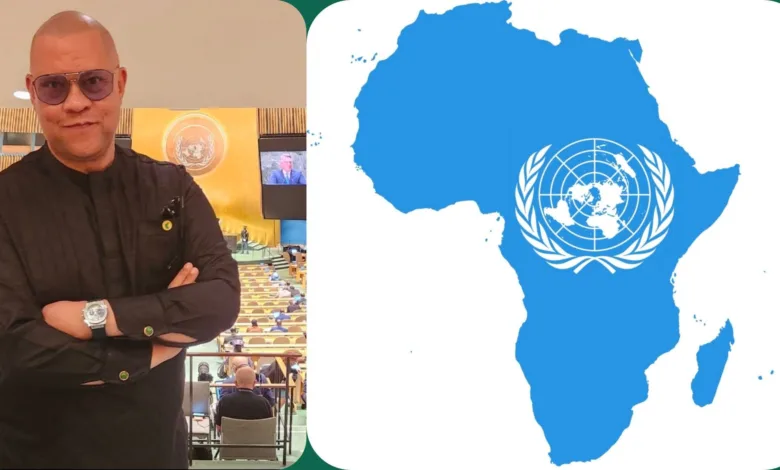
I have always had quite an ambivalent feeling about attending the United Nations General Assembly. It is indispensable to the global architecture. Yet, it is chronically and chronologically Disappointing with a capital ‘D.’
This week, the marble halls at the United Nations in New York are hearing something older than the institution itself … the loud echos of a continent refusing to remain an afterthought in a system built while most of it was still under colonial rule.
The 81st United Nations General Assembly opened under the theme “Restoring Trust, Managing Transformation: A United Nations that Delivers for All.”
From an African vantage point, the question is how can an organisation created in 1945 when most of Africa was under colonial flags, still claim to speak for ALL of humanity when 54 of its 193 members (one fifth of the world’s population), have no permanent voice on a Security Council that decides questions of war and peace?

On the gravest questions facing all of humanity, only five nations, the United States of America, France, Russia, China, and the United Kingdom, each hold a permanent power that the other 188 do not.
If Africa with a combined population of 1.6 billion and the largest land mass of any continent by far, does not have a permanent seat at the table, how can the UN talk about trust and delivering for all?
The bottom line is that the UN’s architecture is obsolete!
Let’s be clear, Africa’s demand and expectation at this UNGA is larger than a seat.
It is about whether multilateralism still means anything, especially when the continent’s most crippling and vexatious issues remain permanently discussed but permanently excluded.
Africa’s collective demand is about –
● climate finance that never arrives as promised or at the scale of damage which Africa did the least to cause.
● debt that has a stranglehold on development while the same countries are lectured about fiscal discipline.
● artificial intelligence that is daily being designed in global rooms where African voices are still too few.
● a map of the continent that until this monthsystematically shrank Africa’s true size.
Ultimately, representation is never only about chairs. It is about whose reality counts.
Unapologetically, Africa is no longer arriving as a supplicant or a beggar at the table asking for crumbs.
Rather, Africa arrives with the world’s youngest population, much-needed critical minerals to power the global economy, vast renewable potential, a growing market, the largest and most fertile uncultivated land in the world, and a new generation of entrepreneurs, thinkers, and diplomats, who refuse to buy into the tired and tattered old script of ‘aid’ and ‘pity.’
Africa will not be silenced. Nor ignored.
A few side events this week speak of financing Africa’s future; attracting global capital to fund a huge annual infrastructure finance deficit of about $170 billion; and of an “Unstoppable Africa.”
These demands are NOT charity. They are about equity and justice.
Basically, a United Nations that cannot make room for Africa, can NOT claim to deliver for all.
And, a Security Council that is frozen in time – 1945 – can NOT manage the emerging transformations and challenges of a totally different generation and era today.
Therefore, restoring trust can only begin when the original sin of exclusion at the table in 1945, in a postwar era, is corrected.
Africa is not asking permission to exist in the 21st century. What we are collectively insisting on is that the institutions that claim to represent ‘humanity’ finally begin to look like ‘humanity.’
Will this UNGA respond with more than polite applause?
Whether it does or not, Africa’s answer is clear. We will no longer watch history being decided about us, without us, and supposedly and benevolently for us.
Rather, the future will be written with African leaders at the table, and with African hands on the pen … or it will not be written at all.
Oladokun, is a strategic communications expert