The Blue Tsunami and the Broom Tsunami: How voters judge pain — by Olabode Opeseitan
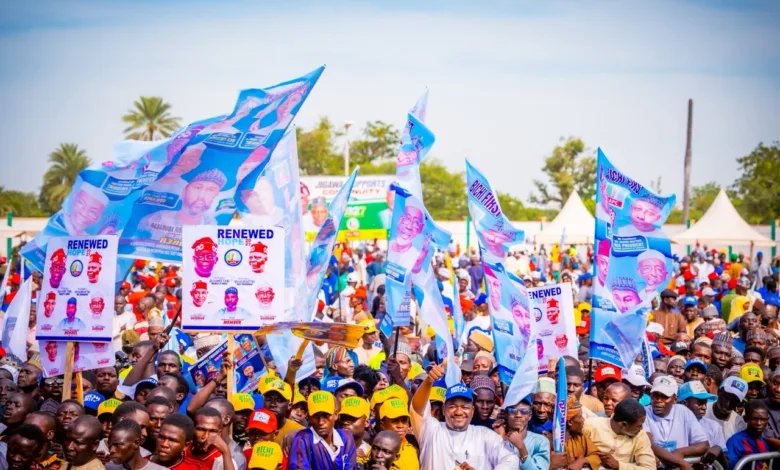
They are both defining elections. One has just been fought and its outcome has already entered political history. The other is approaching with increasing intensity, and every political conversation seems to circle back to the same question: what verdict will the electorate deliver?
Political analysts have described the sweeping Democratic victories in the United States midterm elections as a Blue Tsunami. Beyond the headlines, however, the result was less a triumph of ideology than a referendum on lived experience. Voters were not merely assessing campaign slogans. They were assessing the contents of their wallets, the price at the petrol station, the cost of healthcare, the direction of foreign policy and whether government was still responding to the anxieties of ordinary families. Across exit polls and post-election analyses, four themes surfaced repeatedly: the cost of living, the impact of tariffs on household prices, concerns that immigration enforcement had gone too far, and unease over the conflict with Iran. Surveys conducted throughout the fighting showed more Americans opposed than supported direct U.S. military action, while inflation and affordability remained dominant voter concerns.
Still, the election results were not a wholesale rejection of President Donald Trump’s agenda. Tens of millions of voters continued to back his “America First” doctrine, crediting him with reasserting national sovereignty, prioritising domestic manufacturing, and challenging a global trade order they believed disadvantaged American workers. Politics can be brutally unforgiving. A leader may be applauded for yesterday’s victories and punished for today’s frustrations. The average American mother was not studying tariff schedules. The retired factory worker was not reading foreign policy reports about Iran. They simply walked into grocery stores, paid medical bills, fuelled their vehicles and judged whether life felt more affordable than it did before.
The Blue Tsunami therefore offers a timeless lesson. Electorates rarely vote based on policy theory. They vote based on perceived consequences. They ask a simple question: Is my life improving? If the answer is no, even a successful government can be punished. Had Republican strategists paid closer attention to voter concerns about inflation, the economic impact of tariffs, the unease surrounding the Iran conflict and the perception that immigration enforcement had crossed a line for some communities, the outcome may have been markedly different.


This brings us to Nigeria and what may become the defining political story of 2027. On the surface, the similarities are obvious. Nigerians are also grappling with a cost of living crisis. Food prices remain a burden. Transportation costs continue to strain household budgets. Families are making difficult adjustments. Opposition politicians believe these hardships will inevitably translate into electoral punishment for the governing party. They may be mistaken.
The crucial difference is that many Nigerians increasingly see today’s pain as inherited rather than created. By the time President Bola Tinubu assumed office, the fuel subsidy regime had become fiscally unsustainable and the multiple exchange rate framework was choking economic productivity. The country was confronting a severe foreign exchange crisis. The removal of fuel subsidy and the unification of the foreign exchange market were not politically convenient choices. They were economic emergency measures intended to prevent a much deeper crisis. The International Monetary Fund has acknowledged that these reforms have strengthened macroeconomic stability, enhanced resilience and improved investor confidence, even while recognising that the pain on citizens remains very real.
The numbers are beginning to tell their own story. International rating agencies and multilateral institutions that once questioned Nigeria’s trajectory are increasingly pointing towards stabilisation. Fitch revised Nigeria’s outlook to Positive from Stable, citing stronger reserves, exchange rate reforms and growing resilience. Gross external reserves have climbed above $55 billion while net reserves have risen to about $46 billion from less than $1 billion. Investor confidence has strengthened, the foreign exchange market has become considerably more stable and economic growth has improved. None of this eliminates poverty, but it suggests that an economy which many feared was drifting towards collapse has begun to regain its footing.
More importantly, voters are seeing evidence beyond economic data. They drive past sections of the Lagos-Calabar Coastal Highway. They follow progress on the Sokoto-Badagry Highway, the Abuja-Kaduna-Kano Road, the Enugu-Onitsha Expressway and the Kano-Maradi rail project. They observe the rehabilitation of Murtala Muhammed International Airport and multiple strategic transport corridors across the federation. More than 1.6 million students have reportedly benefitted from the student loan programme. Across several states, abandoned projects are returning to life. They also point to a clear turnaround in daily security. For many citizens, these are not abstract statistics. They are visible signs that the sacrifice is producing movement.
There is another factor that political analysts cannot ignore. Elections are not won by economic arguments alone. They are won through political organisation. For perhaps the first time in Nigeria’s democratic history, a sitting President approaches a re-election contest with overwhelming support from the nation’s governors, the most powerful political mobilisers in the federation. The ruling party controls the vast majority of state governments, while several governors outside the party have publicly praised or endorsed aspects of President Tinubu’s leadership. Their support is not difficult to understand. States have seen their revenues rise substantially in recent years as economic reforms expanded the distributable pool of funds. Reforms in the power sector have given states greater authority to generate, transmit and distribute electricity within their jurisdictions, while the near-completed transition towards state policing promises to strengthen the ability of governors to confront local security challenges directly. For governors across party lines, these changes represent a significant devolution of power and responsibility from the centre to the states. Whether one agrees with all of the administration’s policies or not, many state leaders increasingly view the current arrangement as one that has expanded their capacity to govern. In a country where voter mobilisation is largely organised at the state level, that reality could prove politically consequential.
None of this means the critics are wrong. Inflation remains painfully high, even though it has fallen by more than half from its 2024 peak and is moving in the right direction. Food insecurity remains widespread, although food prices have moderated considerably from their highest levels in many markets. Many Nigerians still do not believe the benefits of the reforms have sufficiently reached ordinary households. Indeed, even government officials acknowledge that macroeconomic stabilisation has not yet translated into enough household relief and continue to roll out measures designed to cushion the impact of the reforms. Youth unemployment remains a serious concern, and many families are still struggling to make ends meet. Yet elections are often less about where people are and more about where they believe they are heading. The critical question for voters may not be whether the pain is real. It clearly is. The question is whether the pain represents a dead end or a bridge to something better.
People endure hardship when they trust the destination. History offers relevant parallels. Lee Kuan Yew’s reforms in Singapore were fiercely criticised before they became celebrated. Deng Xiaoping’s market reforms, and the state-sector restructuring that followed, subjected tens of millions of Chinese workers to painful layoffs before transforming China into an economy that grew from $150 billion to $18 trillion in 44 years. India navigated fierce political and industrial resistance during the liberalisation reforms launched in 1991 before those policies unlocked decades of accelerated growth. In each case, citizens initially experienced discomfort before eventually embracing the outcomes. The leaders were vilified before they were celebrated. Trust, not comfort, became the currency that sustained reform.
That is why the emerging political contest may not simply be about hardship. It may be about credibility. Voters increasingly understand that complaining about economic pain is easier than proposing a credible alternative. The opposition promises lower prices, a stronger naira and greater prosperity. Fair enough. But many Nigerians are beginning to ask the inevitable follow-up question: how? What is the roadmap? Which reforms would be reversed? Which would be retained? What is the pathway from today’s challenges to tomorrow’s prosperity? The answers remain unclear.
In America, many voters concluded that some of the hardships confronting them were the consequence of policy choices they neither wanted nor expected. In Nigeria, a growing number of voters may be reaching a different conclusion. They may not believe the hardship was chosen. They may believe it was inherited. More importantly, they may believe that enduring it today offers the possibility of a more prosperous tomorrow. They can still feel the rumbling sound of hunger in their stomachs, but in the distance they can smell the sweet aroma of food being prepared.
The American voter looked at pain and saw policy misjudgment. The Nigerian voter may look at pain and see national recovery. That is the difference between a repudiation and a reward.