Nvidia, creative libido, and why desire eats intelligence for breakfast — by Kelechi Deca
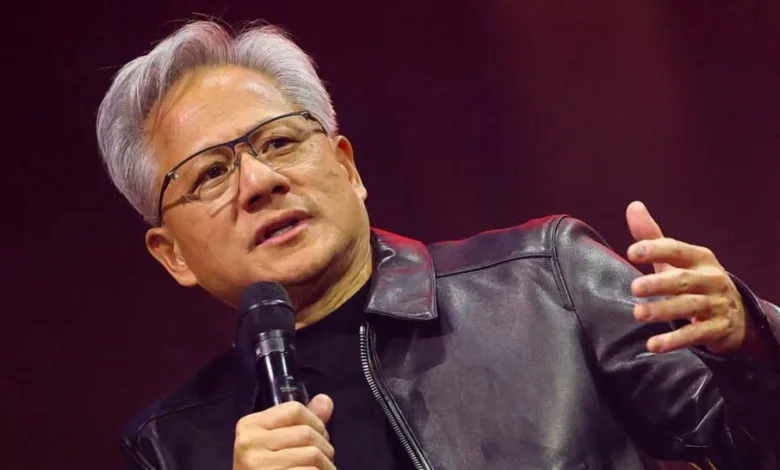
Nvidia shares fell in out-of-hours trading today after an internal investigation into whether CEO Jensen Huang had been targeted by a foreign intelligence operation put his future at the AI chip maker under scrutiny.
The New York Times reported in October that Huang had a relationship with Alice Huang, a former executive of Singapore-based Company Megaspeed.
US authorities investigated her and concluded she was a Chinese intelligence asset. The newspaper also noted that President Trump was briefed about the intelligence findings roughly a year ago and chose not to act on the information.
If I was Trump I may have done the same thing, especially if the report of what actually was transmitted through the woman was not enough to harm America’s edge on AI. Jensen is a precious and delicate asset, to be handled with care.




Huang opened up, and confessed to Nvidia’s employees that he had been unfaithful to his wife, without disclosing details of the relationship. Interestingly, the woman’s surname is Huang which probably provided a shield while it lasted.
The investigation, announced yesterday, has put a spotlight on Huang’s future given Nvidia’s status as the world’s most valuable chip maker and his role as the most prolific salesman of the AI boom.
Thinking about this whole thing is perspective shifting from where I stand. It is also a major case study on one of life’s most intricate issues.
There is an illusion of competence whenever desire crosses pathways with highly productive minds. It is always a mismatch, thus the need never ever to open the doors for desire to have a place at the table.
The revelation that Jensen Huang allegedly engaged in an affair with a woman suspected of ties to Chinese intelligence, an admission that has since triggered a board investigation and a sharp market reaction, offers a stark case study in a persistent paradox: the men most capable of conquering global industries are often the least equipped to govern their own intimate lives.
I read somewhere about how that extreme professional success often breeds a specific kind of blindness. High achievers become accustomed to operating in environments where their judgment is rarely challenged and their impulses are routinely validated by results.
This situation creates an “earned dogmatism” where the same intuitive confidence that drives innovation also dismantles personal boundaries.
And for men of immense wealth and power, the psychological mechanism is often one of compartmentalization. It is that self-convincing assumption in the “foolproof strategy” of sealing off work, family, and desire into discrete boxes, and believing that a transgression in one sphere will not contaminate the others.
Such men failed to learn from history dating back millennia of how a pervasive and surreptitious Delilah power can bring strong men down, whether physical strength, intellectual strength, or financial strength. Such Jezebellian effects always win, and in most cases stay on top too.
Furthermore, the very traits that fuel corporate dominance, which is a relentless appetite for risk, novelty, and conquest, a deeply embedded evolutionary feature that dates back to our Reptilian brain, do not simply switch off at the bedroom door.
The pursuit of a new affair can mimic the dopamine-driven thrill of a high-stakes deal, while the isolation of the C-suite creates a profound “emotional hunger” for validation that is untainted by the title of CEO.
The tragedy is not a lack of intelligence, but a failure of wisdom. Unfortunately, when it comes to the testosterone fuelled throbbing pounding knocks of desire, wisdom is naturally, hardly ever present.
According to psychiatrists, “Smart people know how to get what they want; wise people know what is not worth trading a lifetime for,” but in the end, the greatest vulnerability of the genius is the belief that his intellect can outmaneuver the consequences of his own desires.
Speaking on the situation, Bill Ackman said on X that the Nvidia CEO was an “incredible human”, but if “indeed this is more than an affair, then it is obviously a real problem”. “I am hoping for a simple affair, not a risk to our national security,” he added.
Sequoia partner Shaun Maguire of Sequoia said that Huang “did something incredibly dumb” that was “bad for America” but that “Jensen is irreplaceable for America’s AI leadership”. Elon Musk commented “I agree” on that post by Shaun.
US President Donald Trump said yesterday that he had not spoken to Huang about the allegations, but called him a fine person. “I hope everything’s fine. He’s done such an incredible job,” he added.
Asked whether he should have acted on the intelligence when he was briefed about it, Trump said: “No, I don’t think so. I think he’s an honourable guy. I think he probably has an excuse for it. You have to hear it.”