How the Senate silenced the election results transmission wailers — by Victor Okebunmi
“He who digs a pit for others must be careful not to fall into it.” – African Proverb
There is something almost poetic about how certain perennial presidential hopefuls discover democracy afresh whenever an election cycle approaches.
For years, governance was complex. Reform was gradual. Infrastructure took time. But suddenly, electronic transmission of results has become the sacred cow around which the self-appointed custodians of morality now dance.
Enter Peter Obi. Enter Chibuike Rotimi Amaechi. Enter Atiku Abubakar. Enter Accidental Opposition Enfant Terrible, Nasir Elrufai, Enter Missing Campaign Money, Aisha Yesufu and their gullible minions. The familiar cast of failed seasoned contenders who, having failed to persuade the electorate at the ballot, now seek salvation in the bandwidth of public outrage.




One would think Nigeria had just discovered technology last week.
The Senate has just amended the Electoral Act, revising Clause 60 to require presiding officers at each polling unit to transmit election results to the IReV portal electronically. That provision stands. It is in black and white.
But here lies the part that has unsettled the professional outrage merchants: where electronic transmission is disrupted by communication or network challenges, the manually completed Form EC8A will serve as the primary and authoritative document for collation.
In other words, technology where possible. Lawful fallback where necessary.
A balanced provision. A master class in legislative pragmatism.
Yet, to hear the coalition of the chronically disappointed tell it, the sky has fallen.
It is remarkable how men who once presided over ministries, budgets, and national infrastructure now speak as though Nigeria possesses uninterrupted 5G coverage from Sokoto to Nembe Creek. One would imagine that rural communities long deprived of stable network signals suddenly acquired seamless broadband the moment a hashtag began trending.
Compulsory instant transmission in every polling unit, irrespective of infrastructure realities, is not reform. It is rigidity. It is the kind of absolutism that creates fertile ground for post-election chaos. A single failed upload becomes grounds for wholesale delegitimisation. A temporary network outage morphs into a national conspiracy.
For politicians seeking leverage, that scenario would have been Christmas in February.
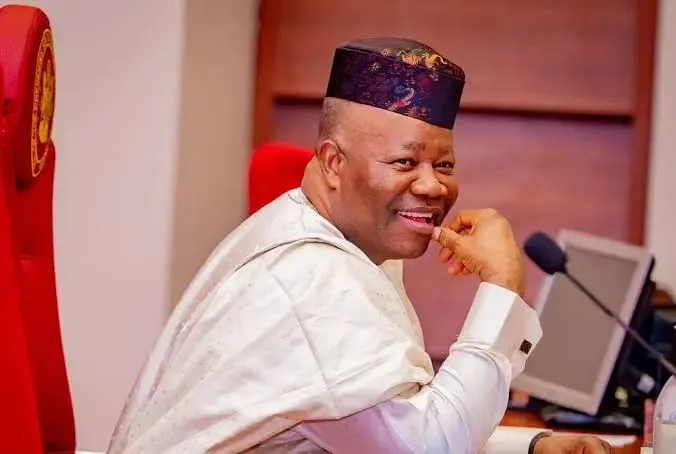
But the Senate, under the leadership of Senate President Godswill Akpabio, GCON, a first-class graduate of President Tinubu’s school of political strategy, he read the senate chamber with clinical precision, identified the loopholes before others even sensed them, offered the opposition a knowing smile, and then quietly went to work, delivering a Shaolin-style, pinpoint masterclass in legislative chess. What unfolded was less drama and more chess. The amendment preserved electronic transmission while safeguarding against infrastructural sabotage by physics, geography, or opportunistic litigation.
Cunning man die, cunning man bury am! The opposition arrived with hired hands and legs who had no clue why they had been called out, occupying holes, caves, and Aso drive gutters/drainage conduits like rats on heat, shouting and bellowing, hoping for a rigid clause they could either celebrate prematurely or weaponise spectacularly. Instead, they were handed a balanced framework that offers no easy talking points. No dramatic collapse to forecast. No rigid provision to exploit.
What the Senate delivered was not regression but resilience. A framework that recognises the promise of technology without surrendering the stability of the republic to network fluctuations. It was legislative realism over social media romanticism.
For a coalition still nursing electoral wounds, every issue must become a ladder. Every amendment must become a battlefield. But governance is not a campaign rally, and lawmaking is not a Twitter (X) Space. And that is their true frustration.
If anything was nailed to the wall today, it was not democracy but the attempt to convert a technical provision into a political grenade. The balanced amendment has removed oxygen from that unpatriotic fire.
Electronic transmission remains. Transparency remains. But so too does operational flexibility. That is not sabotage; it is statecraft. One suspects that by next week, another grievance will be discovered, another slogan minted, another narrative assembled. The rebuilding of a coherent political alternative is harder work for them than the recycling of outrage.
For now, however, the Senate has spoken with clarity. Technology will serve the process. The process will not be sacrificed to technological absolutism.
Master stroke? Perhaps.
Master class? Certainly.
And to those who arrived prepared to weaponise bandwidth, there is, regrettably, nothing for them here.
In the end, what played out in the Senate was not noise; it was precision. The opposition arrived, hoping for a rigid clause they could inflate into a national emergency. Instead, they were handed a balanced amendment that removed their talking points before the microphones were even warmed up. In the same process, their boy-friday in the Senate, Senator 360-Turnaround Abaribe, was publicly disgraced on the floor.
What occurred today deserves to be studied as a masterclass in political containment in our universities, how to preserve reform, protect institutional stability, and simultaneously deny adversaries the crisis they were itching to weaponise. The wailers came armed for chaos. They left with compliance. They came, they saw, they failed to conquer.
Now they must do the one thing they seem least prepared for: rebuild, reorganise, and reconnect with voters rather than recycle grievance as a campaign strategy.
Because this time, the trap they set was the one they fell into!
–Okebunmi is Senior Special Assistant on Publicity to Renewed Hope Global