Lagos cannot afford a governor learning on the job — by Olabode Opeseitan
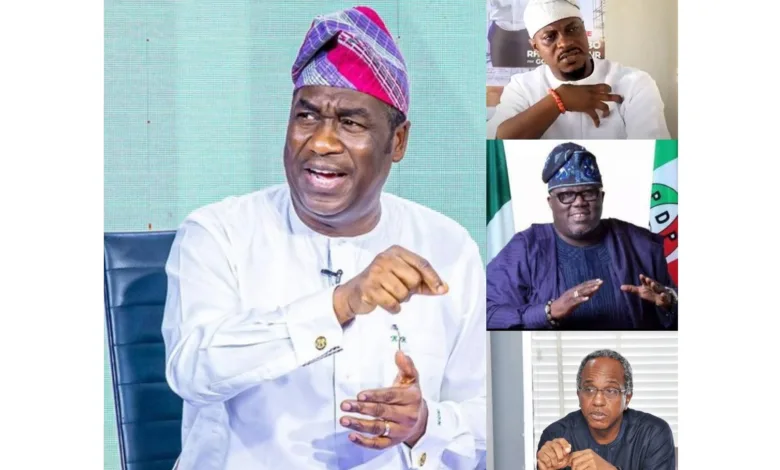
Lagos does not lack politicians with plans; it lacks the luxury of allowing just anyone to learn how to govern the city on the job. At Thursday’s town hall, The Platform, hosted by The Covenant Nation, four candidates offered competing versions of its future, from cheaper housing and better schools to cleaner streets and faster transport. All made persuasive points, but Kadri Obafemi Hamzat alone combined policy ambition with intimate knowledge of the government expected to deliver it.
On formal attainment, Hamzat holds the field’s highest earned degree: bachelor’s and master’s degrees in Agricultural Engineering from the University of Ibadan and a doctorate in System Process Engineering from Cranfield University. His experience outside politics is equally broad, encompassing academia, New York’s municipal system, Merrill Lynch, Morgan Stanley and Oando. It is a résumé that joins technical intelligence to financial and administrative literacy.
His more consequential qualification, however, is a record that can be examined rather than imagined. As Commissioner for Science and Technology, Hamzat drove the integration of Lagos’s public service through an Oracle enterprise system and biometric reforms; as Commissioner for Works and Infrastructure, he coordinated the delivery of landmark projects including the Lekki-Ikoyi Link Bridge. Since 2019, he has occupied the state’s second-highest executive office.
That institutional memory showed in his town-hall answers. Hamzat proposed completing existing housing schemes, widening access to mortgages requiring an initial payment of about 10%, removing unauthorised levies, coordinating charges across levels of government and reducing commuting time through an integrated transport system. Unlike promises that arrived as impressive totals, his ideas came with mechanisms, institutions and identifiable projects. His ruthless clarity, unflappable demeanour and flawless frame control evoke memories of Lee Kuan Yew’s legendary political communication: answering difficult questions with precision, wit and unshakeable composure.

Gbadebo P Rhodes-Vivour remains the strongest opposition challenger. He is intelligent, well educated and politically resilient, with architecture degrees from Nottingham and MIT, a public-policy master’s from the University of Lagos, and the name recognition earned by his strong 2023 campaign. Yet his pledges to deliver 100,000 homes and complete every rail line within two years need fuller costing, sequencing and evidence of executive capacity. The town hall’s most politically damaging moment came when he could not sustain an answer in Yoruba while discussing the preservation of Yoruba culture. Language fluency is not a substitute for competence, but a governor seeking to embody Lagos should not require the cultural distance of an interpreter to converse with its ancestral soul. That uncomfortable spectacle recalled the remoteness of colonial administration, when rulers governed a people whose language they could not speak.
Funso Doherty offers perhaps the most formidable financial mind in the contest, with accounting training at the University of Lagos, an MBA from Harvard and experience at Goldman Sachs and major pension institutions. His pledges of free public education, books, examinations, school meals, transport and maternal care possess moral clarity. Their weakness is arithmetic: until he explains what will be taxed, borrowed, deferred or cut, an expansive welfare programme remains more compassionate prospectus than executable budget.
Adedeji Doherty brings engineering, business experience, political endurance and a useful instinct for the pressures facing enterprise. His focus on affordable housing, electricity, security and a friendlier business environment addresses real urban anxieties. Yet a broad ten-point agenda does not by itself demonstrate command of the vast bureaucracy, competing interests and execution bottlenecks through which every Lagos governor must work.
Hamzat is not exempt from scrutiny. As the continuity candidate, he must answer for the congestion, flooding, housing deficit, chaotic street trading, failure to transform many ordinary streets into orderly boulevards, waste-management breakdowns and arbitrary levies that persist under a government in which he serves. But that burden is also his advantage: Lagos would not be hiring on promise alone. Among accomplished alternatives, he offers the rarest combination of scholarship, private-sector range, institutional memory, political reach and tested public execution.
He is not merely the favourite; he is the most prepared candidate.