Senate passes N68.3trn 2026 budget
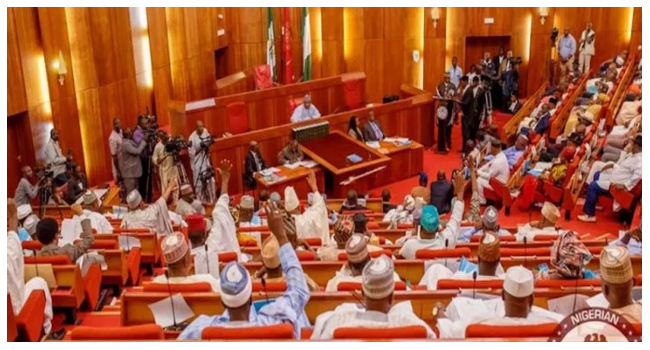
The Senate on Tuesday approved the 2026 Appropriation Bill, increasing the proposed budget to N68.3 trillion, an addition of over N9 trillion to the initial figure submitted by President Bola Tinubu.
The upward revision is aimed at addressing legacy obligations, funding critical infrastructure, strengthening the judiciary, boosting healthcare interventions and supporting preparations for the 2027 general elections.
Chairman of the Senate Committee on Appropriations, Senator Solomon Adeola, while presenting the report, said the adjustment was necessary to regularise outstanding commitments from previous fiscal years, align the budget with current economic realities and maintain macroeconomic stability.
President Tinubu had initially presented a N58.18 trillion budget proposal to the National Assembly on December 19, 2025. Tagged the “Budget of Consolidation, Renewed Resilience and Shared Prosperity,” the proposal prioritised economic growth, with major allocations to security and capital projects.


However, the revised budget, now passed by both chambers of the National Assembly, reflects a significant increase in overall spending.
A breakdown of the revised proposal shows that N4.799 trillion is allocated to statutory transfers, N15.809 trillion to debt servicing, N15.427 trillion to recurrent (non-debt) expenditure, while a substantial N32.287 trillion is earmarked for capital expenditure, reflecting a strong commitment to infrastructure development and economic expansion.
The committee explained that the adjustments totalling N9.09 trillion became necessary following a formal communication from the president seeking to incorporate critical expenditures omitted in the initial proposal and to ensure that unresolved obligations from previous budgets do not undermine the 2026 fiscal programme.
A major component of the adjustment is the inclusion of N7.71 trillion in outstanding capital obligations from the 2025 Appropriation Act.
According to the committee, these obligations are unlikely to be implemented before the expiration of the 2025 capital budget window, necessitating their rollover into the 2026 fiscal framework.
The lawmakers noted that about 70 per cent of capital projects in the 2025 budget were affected by revenue shortfalls, underscoring the need for continuity in funding to avoid project abandonment and cost escalation.
In addition to clearing legacy liabilities, the committee introduced new provisions targeting strategic national interventions across critical sectors.
Foremost among these is a N478.6 billion Federal Government equity contribution under the Ministry of Finance Incorporated (MOFI) framework to support presidential legacy light rail projects in Lagos, Kano, Kaduna and Ogun States.
The provision also covers feasibility studies for proposed urban rail systems in Enugu and Maiduguri, as well as improvements to the narrow-gauge railway network.
The committee further approved N8.96 billion for feasibility studies on the Calabar–Maiduguri corridor and the Maiduguri–Sokoto superhighway under the Tinubu National Beltway Initiative, a project designed to enhance regional integration and facilitate trade across multiple zones of the country.
In the health sector, an additional $344.83 million, equivalent to about N482.76 billion, was provided for priority interventions tied to existing bilateral agreements and implementation commitments.
The committee said the funding would support efforts to strengthen healthcare infrastructure and service delivery nationwide.
The judiciary also received a significant boost as part of preparations for the 2027 general election.
The committee approved N98.5 billion for the Court of Appeal, N36.7 billion for the Supreme Court, and N268.54 billion to restore the judiciary’s budget ceiling and accommodate the anticipated appointment of additional justices and judges.
The lawmakers emphasised that strengthening the judiciary was critical to sustaining democratic governance, particularly in managing election-related disputes and ensuring timely dispensation of justice.
To finance the expanded budget, the committee proposed a mix of revenue-enhancing measures and borrowing.
Chief among these is a $10 per barrel increase in the oil benchmark, projected to generate an additional N2.592 trillion in revenue.