9 most significant sociopolitical events of the year
Year 2024 was significant in the life of Nigerians and Nigeria. Several remarkable events occurred that shaped the country’s sociopolitical landscape. Some of them happened at the sub-national level while others were national in nature. In this analysis, OKUNADE ADEKUNLE succinctly takes a look at the events...
- Repeal of Kano Emirate Council Law 2019 and the Emirship Tussle
Kano State and the Emirate witnessed an unexpected drama that caught Nigerians unaware. The State’s House of Assembly in July passed a bill to abolish the emirates created from the old Kano Emirate by ex-Governor Umar Ganduje. The five Emirates are Gaya, Rano, Karaye, and Bichi. The law restores Kano as the only emirate in the state.

The repealing of the Kano Emirate Council Law 2019 altered the traditional rulership arrangements met by the Governor Abba Yusuf-led administration. It is right to note that this led to serious internal imbroglio in the state, pitching supporters of the ousted emir Aminu Ado-Bayero against those of the reinstated emir Lamido Sanusi Lamido.
2. Endbadgovernance Protest


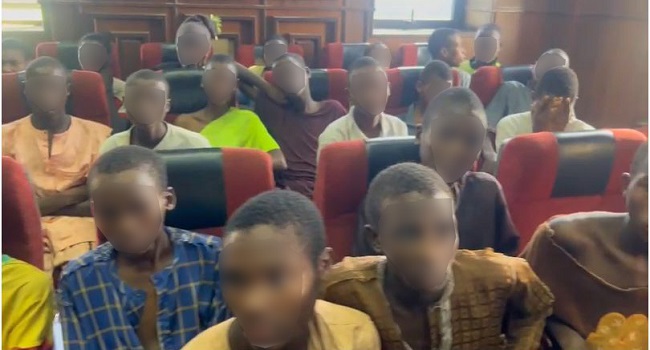
The Endbadgovernance Protest, or what some tagged the ‘Hunger Protest,’ was a major event that shaped 2024 in Nigeria. It was a protest that shook the entire country. The protest whose leadership was conspicuously unknown to the leadership of the country was nearly held for 10 days starting from August 10. It was purely a youth-organised protest. Although the protest took a new twist in the Northern region, where some protesters were seen flying Russian flags, mostly in Kano and Kaduna, clamouring for military intervention in Nigerian politics.
In the Southern region, mostly in the Southwest and South-South, the protest was suspended when it was observed that it had taken another dimension in the North. It is right to point out that several arrests were made by the security agencies, and those arrested, including minors, were tried at the law court for treason, breach of public peace, and felony.

One noticeable fact about the protest is that it made President Bola Tinubu have a national live broadcast and also restrategize his communications engagement with the citizenry.
3. Labour Party Internal Crisis
The effect of the 2023 general elections on the Labour Party (LP) was more pronounced in 2024 as the party went into a deep leadership crisis. The push for the removal of the National Chairman, Bar Julius Abure, was intense. In Edo state, party members were divided to the extent they could not forge a united front before the governorship election.
The crisis became obvious when the former presidential candidate of the party in 2023, Mr. Peter Obi, Governor Alex Otti, and the National Assembly Labour Party lawmakers held a stakeholders meeting in Abia State to constitute a 29-man Caretaker Committee led by the former Minister of Finance, Senator Nenadi Usman. Others in the committee were 3 senators, 4 members of the House of Representatives, 3 members from the States House of Assembly, 3 members from the Nigeria Labour Congress, 3 members from the Trade Union Congress, and 3 members from the gubernatorial candidates in the 2023 election, among others.
4. Rivers: Wike/Fubara Supremacy battle
The supremacy struggle between the Minister of FCT, Bar. Nyesom Wike, and his political godson, Governor Sim Fubara of Rivers, was an unforgettable political drama in Nigeria’s political history. In 2023, Wike, against all odds, installed Fubara as governor, but a few months later, their relationship went sour, and a political crisis erupted in the state, leading to major stakeholders in Rivers and the National PDP taking sides.
The crisis divided the state lawmakers and federal lawmakers.
The crisis led to the burning of the House of Assembly complex and some local government secretariats. It is worthy to point out that the crisis led to the winning of 22 local governments of the state by a relatively unknown political party, the Action Peoples Party (APP), in the state’s local government elections conducted in October.
5. Peoples Democratic Party (PDP) Crisis
Like the Labour Party, the main opposition party in Nigeria, the Peoples Democratic Party (PDP) is enmeshed in serious internal crisis as the party’s National Chairman, Amb. Umar Damagum, and the then National Secretary, Senator Samuel Anyanwu, were accused of working against the party. This had seriously caused damage to the unity of the party and its members. Leadership of the party at all levels was also divided along the various interests in the party.
The crisis was deep to the extent that the Board of Trustees, an elitist cadre of the party, could not resolve the issues. The crisis seriously affects the performance of the party in the Edo and Ondo off-cycle governorship elections, leading to the ruling All Progressives Congress (APC) winning both elections.
6. Edo, Ondo Governorship Elections
The year 2024 witnessed two off-cycle governorship elections. The elections were held in Edo and Ondo States with the All Progressives Congress (APC) winning the states in a very intense contest. In Edo, Governor Godwin Obaseki was unable to install his choice and party candidate, Asue Ighodalo, giving room for Senator Monday Okpebholo of the APC to emerge as the winner. Although the contest for the number one seat was among 17 political parties, with only three very prominent, APC, PDP, and LP.
In Ondo, the contest was strongly between the incumbent governor, Lucky Aiyedatiwa of the APC, who initially survived a political battle within his political circle, and a former deputy governor, Agboola Ajayi, who was the PDP flagbearer. In this case, the PDP internal crisis at the national level affected the party at the Ondo governorship poll. Eventually, the APC had its way, and Aiyedatiwa was re-elected.
7. President Tinubu’s Cabinet Reshuffle
In October, the reshuffling of the cabinet by President Bola Tinubu did not come as a surprise to many Nigerians, as there had been serious clamouring for it before it occurred. Tinubu kicked out five ministers, made 7 new appointments, and reassigned 10. Those who were sacked were Uju-Ken Ohanenye (Women Affairs), Lola Ade-John (Tourism), Tahir Mamman (Education), Abdullahi Gwarzo (Minister of State, Housing and Urban Development), and Jamila Ibrahim (Minister of Youth Development).
The new ones were Ambassador Bianca Odumegwu-Ojukwu (Minister of State, Foreign Affairs), Dr. Nentawe Yilwatda (Humanitarian Affairs and Poverty Alleviation), Muhammadu Maigari Dingyadi (Labour and Employment), Yusuf Abdullahi Ata (Minister of State, Housing and Urban Development), Idi Mukhtar Maiha (Minister of Livestock Development), Dr. Jumoke Oduwole (Industries, Trade and Investment), and Suwaiba Said Ahmad (Minister of State for Education).
8. EFCC, Yahaya Bello Face-Off
The most dramatic event in 2024 is the cat-and-rat moves by the Economic and Finance Crimes Commission (EFCC) and the immediate past governor of Kogi State, Yahaya Bello, over his arraignment before the court for alleged financial misappropriation.
Several efforts made by the anti-graft agency to arrest the former governor for arraignment in court were unsuccessful for months until he reportedly turned himself in. On December 19, the court eventually granted Yahaya Bello N500m bail with conditions. And by December 21, he was released after meeting the bail conditions.
9. Tax Reform Bills
The tax reform bills attracted much attention and still remain at the front burner of Nigeria’s political economy discourse. The bills are to restructure Nigeria’s revenue system. This generated controversy and nearly polarised the country along regional blocs. The North firmly pushed back against the bills while the South embraced the proposed reforms.
Arguments from the Northern Senators and their leaders were that some provisions of the bills were anti-North and would endanger the economic growth of the region. Their major concern is the alterations to the distribution of Value Added Tax (VAT). In this wise, the North called for the withdrawal, but President Bola Tinubu said the bills should be allowed to go through the legislative process.
As it is, the four tax reform bills are still in the National Assembly going through legislative consideration.