Igbokoda: The slippery ancient town where NAF 931 aircraft crashed
By Boye Oyeyemi –
Beneath the lush vegetation and winding waterways of Igbokoda, an ancient riverine town in Ilaje Local Government Area of Ondo State, lies a difficult terrain that can make rescue operations challenging.
Its muddy ground, tangled mangrove roots and murky waters have highlighted the difficulties facing those trying to recover the wreckage and victims of the Nigerian Air Force aircraft crash.
The tragedy, which occurred on October 5, 2025, plunged residents of Ondo State and Nigerians into mourning. The crash claimed 25 lives, leaving families and communities grieving the loss of their loved ones.




The aircraft, identified in reports as an ATR-42 military plane, was on a routine flight from Benin City, the Edo State capital, to Lagos when it lost radar contact at about 9:13 am.
The Minister of Aviation, Festus Keyamo, confirmed that the aircraft crashed near the Naval Base in Igbokoda, with no survivors.
The incident attracted widespread attention and condolence messages from across the country. President Bola Ahmed Tinubu also declared three days of national mourning.
As efforts to recover the victims and wreckage continued, the difficult terrain around the crash site became a major concern for emergency responders.
Unlike many communities in Ondo State, where agriculture plays a significant role in the local economy, Igbokoda is a major riverine settlement where fishing and other water-related activities provide livelihoods for residents.
With an estimated population of 300,000, the community is surrounded by creeks, waterways, wetlands and swamps that shape daily life.
For residents, the waterways serve as routes for transportation, fishing and commercial activities, connecting them to neighbouring settlements and markets. However, the same environment can make emergency operations difficult, particularly in areas with limited road access.
An independent investigation indicated that the swampy landscape, thick vegetation and unstable soil make movement difficult in parts of the community, especially during heavy rainfall.
Where roads are unavailable or inaccessible, rescue teams often have to rely on canoes, specialised equipment and the assistance of residents who know the waterways.
These challenges became more apparent during the recovery operation following the reported aircraft crash. The difficult terrain around the site complicated access to the wreckage and raised concerns about the time and resources needed to carry out the operation safely.
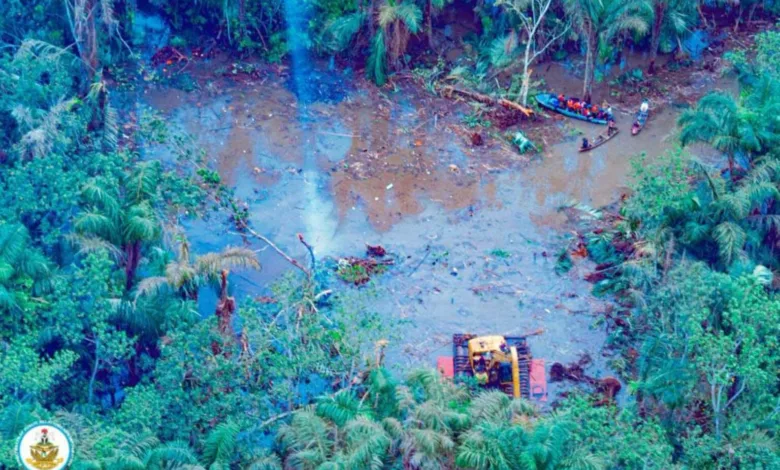
Thick vegetation, muddy ground and murky waterways made it harder for rescuers to reach the site. With the aircraft believed to have plunged into the swamp, they also faced the challenge of locating wreckage beneath the water and layers of silt.
Western Post Nigeria had reported that rescuers initially relied on canoes and manual clearing of vegetation before specialised amphibious equipment was deployed to navigate the terrain.
Recognising the difficulty of reaching the site, Ondo State Governor Lucky Aiyedatiwa explained that two amphibious machines, popularly known as swamp boogies, had been deployed to support the recovery operation.
The machines were intended to open access routes through the swamp and allow personnel and equipment to move around the crash site, which was difficult to reach by conventional means.
Aiyedatiwa described the incident as a national tragedy, noting that the challenging terrain required the intervention of the state Ministry of Works.
He said the deployment was intended to improve access for personnel and equipment involved in the recovery exercise.
Despite the intervention, the operation remained difficult. Some fragments of the aircraft were recovered, while the main body of the plane reportedly remained trapped beneath the swamp water.
The conditions at the site underscored the difficulties of recovering a large aircraft from a waterlogged environment where visibility is poor and the ground offers little stability.
At the crash site, the Nigerian Air Force’s Superintendent of Standards and Evaluation, Air Vice Marshal Ebimobo Ebiowe, said efforts were being made to recover the aircraft’s flight data recorder, commonly known as the black box, alongside its cockpit voice recorder.
He explained that the devices were important to the investigation because their contents could help investigators reconstruct the aircraft’s final moments and establish the circumstances surrounding the crash.
Aviation experts have also stressed that recovering the recorders would be an important step towards understanding what happened. However, they noted that information from the devices would need to be examined alongside physical evidence from the wreckage and the surrounding environment before conclusions could be reached.
An aviation specialist, Olugbenga Afolabi, explained that the two recorders provide different but complementary information that can help investigators determine the cause of an aircraft accident.
According to him, the flight data recorder captures technical information about an aircraft’s performance and operation during flight, while the cockpit voice recorder preserves cockpit audio, including conversations among crew members and warning signals that may provide clues about the events leading up to a crash.
A resident, Abayomi Sunday, who spoke with our correspondent, described the crash site as an extremely difficult environment where waterlogged ground and unstable swamp conditions slowed recovery efforts.
He said the ground was covered in thick, slippery mud and heavy silt that could give way under a person’s weight, making it difficult for rescuers and others assisting at the scene to move safely.
According to Sunday, first responders and local youths who attempted to help had to contend with deep mud and dense mangrove roots. The conditions made even simple movements difficult, as people could sink into the soft ground or struggle to find stable footing.
“The overlying mud is surrounded by deep, dark and murky swamp waters. The water is entirely opaque, filled with overgrown grass, reeds and river flowers. Because of the depth of the crash and the thickness of the silt, the multi-tonne fuselage of the ATR-42 plunged entirely out of sight, becoming deeply submerged and obscured beneath the surface,” he said.
He added that the waterways leading to the impact zone were too narrow and clogged with vegetation for conventional rescue boats and standard land vehicles to operate effectively.
Sunday further explained that the initial machinery deployed to the area reportedly struggled to stay afloat or gain a firm foothold on the unstable ground.
According to him, additional flotation support, including extension pontoons and auxiliary floaters, was needed to help the equipment move gradually through the swamp and create a passage for recovery operations.
Beyond the immediate challenges of recovering the wreckage, the incident has raised questions about emergency preparedness in riverine areas across the country.
For Igbokoda, the tragedy has brought the town’s geographical challenges into the national spotlight. The waterways that sustain its fishing economy and connect residents to neighbouring communities have also complicated efforts to recover the aircraft and establish what happened.
While Igbokoda’s slippery terrain has made access to the crash site difficult, the task goes beyond navigating muddy waters. It also involves recovering available evidence, establishing the facts surrounding the incident and drawing lessons that could improve emergency response and aviation safety in the future.