PROFILE: Liman, Rotimi, Fapohunda top Tinubu’s multidisciplinary state police reform committee
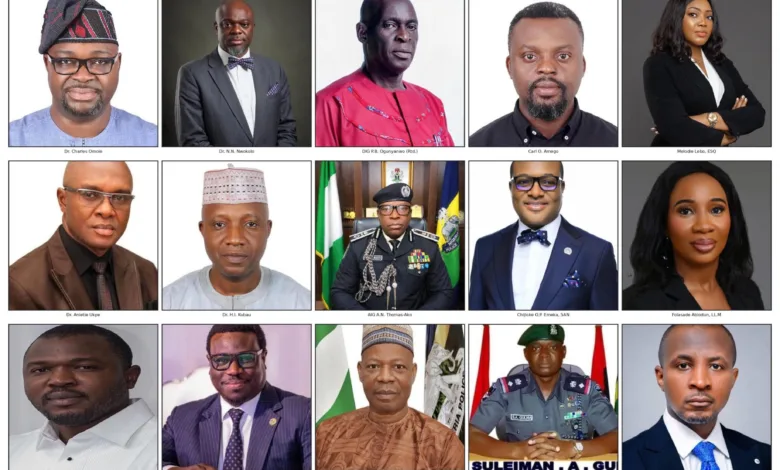
President Bola Tinubu on Monday unveiled a multidisciplinary Policy Advisory Committee comprising retired judges, renowned policing scholars, senior advocates, security experts, senior police officers and state attorneys-general to provide technical guidance for Nigeria’s proposed state police framework.
The committee was announced by the Chief of Staff to the President and Chairman of the Presidential Working Group on the National Policing Bill, Femi Gbajabiamila, while briefing State House correspondents after the inaugural meeting of the working group at the Presidential Villa, Abuja.

The advisory committee will scrutinise successive drafts of the proposed National Policing Bill, identify policy gaps and validate the legal, fiscal and implementation framework before the Executive Bill is submitted to President Tinubu.
Below is a profile of the key members.
Justice Mohammed Abdullahi Liman (Chairman)

Retired Justice Mohammed Abdullahi Liman chairs the committee. A former Justice of the Court of Appeal and former judge of the Federal High Court, Liman has built a distinguished judicial career spanning constitutional law, public law and election litigation. His judicial experience is expected to guide the constitutional safeguards required for Nigeria’s proposed dual policing system.
Prof. Emmanuel Olukemi (Kemi) Rotimi
One of the country’s foremost policing scholars, Professor Rotimi is a Professor of Criminology and Police Studies at Obafemi Awolowo University, Ile-Ife. He is widely regarded as an authority on police history and reform and authored The Police in a Federal State: The Nigerian Experience, one of Nigeria’s most referenced books on policing. His academic work has focused on community policing, police accountability and federal policing systems.
Olawale Fapohunda, SAN
Senior Advocate of Nigeria Olawale Fapohunda is among Nigeria’s leading justice sector reformers. He played central roles in drafting landmark legislations, including the Administration of Criminal Justice Act, the Police Act, the Nigerian Correctional Service Act and the Anti-Torture Act. He currently chairs the Federal Government Committee on the Review of Nigerian Laws and is expected to provide legislative drafting expertise for the state police framework.
Dr. Charles Omole
Dr. Omole serves as Director-General of the Institute for Police and Security Policy Research. He is also a serving judge in the London Circuit of the British judiciary. His expertise spans policing policy, security governance and comparative criminal justice systems, bringing international policing experience to the committee.
Dr. Ndubuisi Nwokolo
Nwokolo is Managing Partner of Nextier and one of Nigeria’s leading policy analysts on peacebuilding, governance and security sector reforms. Over the years, he has advised governments and international organisations on conflict prevention, policing and institutional reforms.
DIG Peter Babatunde Ogunyanwo (Rtd.)
Retired Deputy Inspector-General of Police Peter Ogunyanwo contributes over three decades of operational policing experience. Following retirement, he served on the Ogun State Judicial Panel on Police Brutality and Human Rights Violations, giving him practical experience in police accountability and institutional reform.
Fatima Usman-Katsina
Usman-Katsina brings subnational governance experience to the committee through the Nigeria Governors’ Forum, where she has worked on governance and intergovernmental policy coordination. Her inclusion reflects the committee’s emphasis on state participation in policing reforms.
Mohammed Maikudi
A technology and digital governance specialist, Maikudi is expected to contribute expertise on digital policing, interoperable data systems and technology-driven law enforcement reforms required under the proposed policing architecture.
Carl Amego
Carl Amego is an engineer and conflict resolution practitioner with experience in institutional development and public policy. His expertise is expected to support discussions on implementation planning and institutional coordination.
Melodie Lebo
Melodie Lebo is a legal practitioner with expertise in maritime and commercial law. Her inclusion broadens the committee’s legal perspective as it develops frameworks for jurisdiction, regulatory oversight and legal compliance.
Dr. Anietie Ukpe
Representing the National Assembly, Ukpe serves as Deputy Chief of Staff to the President of the Senate. He provides legislative liaison between the committee and the Senate as the proposed reforms move through the lawmaking process.
Dr. Hamisu Ibrahim Kubau
Kubau is Senior Special Assistant on Political Matters to the Speaker of the House of Representatives. His appointment ensures coordination with the House during consideration of the National Policing Bill.
AIG Abraham Thomas-Ako
Assistant Inspector-General of Police Abraham Thomas-Ako represents the Office of the National Security Adviser. As Director of Law Enforcement and Liaison, he provides national security input into the proposed state policing framework.
Mazi Afam Osigwe, SAN, and NBA nominees
The Nigerian Bar Association is represented by its President, Mazi Afam Osigwe, SAN, alongside Folasade Abiodun, Dr. Abubakar Bukar Kagu and Auta Ilia Nyada. Together, they bring expertise in constitutional law, criminal justice, public policy and legal administration.
Prof. Olu Ogunsakin
Professor Olu Ogunsakin heads the Nigeria Police Reform Secretariat in the Office of the Inspector-General of Police, serves as Director-General of the National Institute of Police Studies and chairs the Steering Committee on the Establishment of State Police. He has advised several Inspectors-General of Police and is recognised internationally for his work on police leadership and institutional reforms.
DCP Suleyman Abdullahi Gulma
Deputy Commissioner of Police Suleyman Gulma serves as Deputy Force Secretary at the Nigeria Police Force Headquarters. His more than two decades of operational and administrative policing experience provides practical institutional knowledge for the committee’s work.
State Attorneys-General
To ensure the perspectives of Nigeria’s federating units are reflected, Tinubu appointed six Attorneys-General representing the six geopolitical zones: Ibrahim Sulyman, SAN (Kwara); Yakubu Maikasuwa, SAN (Taraba); Bello Abdulkadir Fanini (Jigawa); Dr. Ben Uruchi Odoh (Ebonyi); Biriyai Dambo, SAN (Bayelsa); and Lawal Mohammed Alade Pedro, SAN (Lagos). All are serving chief law officers in their respective states with experience in justice sector reforms and constitutional law.