INTERVIEW: Why we’re turning Benue farm produce into finished products for local, export markets — Alia
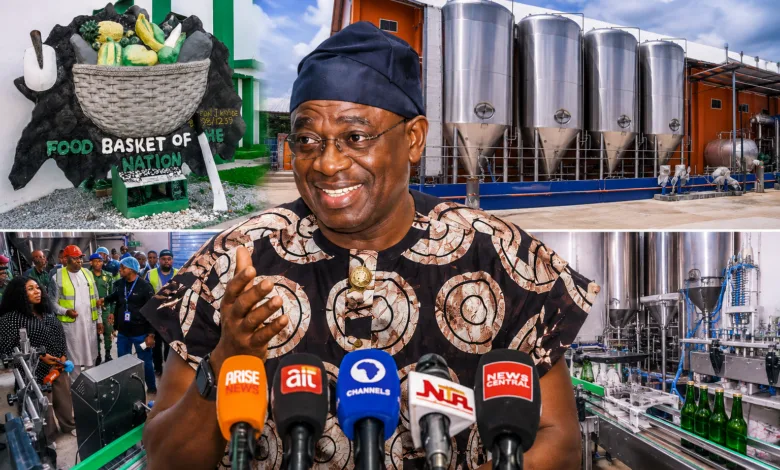
Benue State Governor, Hyacinth Alia, speaks on his administration’s development blueprint, ongoing infrastructure projects, reforms in education and healthcare, agricultural industrialisation, security and the state’s new 30-year development plan.
In this interview, conducted during a media parley with the Presidential Media Team of the Renewed Hope Ambassadors, led by Bayo Onanuga, Special Adviser to President Bola Ahmed Tinubu, who were in Benue to inspect Federal Government projects in the state, Governor Alia discusses his administration’s development agenda, agricultural reforms, infrastructure projects and efforts to transform the state’s economy by creating local value chains for its abundant farm produce.


Q: Benue is marking 50 years as a state. Looking back, what do you think has been the major development challenge?
Alia: Benue State is 50 years old today. In those 50 years, we have had a series of leadership that came in and went out. As a state, do we have a development plan, a master development plan? The answer is no, we didn’t.

When people came in, they made some inroads based on what they thought was meant for the people. But that is what a blueprint is expected to address.
You have to filter from the people you are going to serve. What are their needs? What are their priority needs? Do they really want this? Do they really have this as a need? Want is different from a need.
Q: So what is your administration doing differently?
Alia: We came into governance with our own blueprint and a way of identifying and quantifying projects for the good of the people of the state. We came out to have them executed.
Much has been done, but I know that so much is still left to be done.
We have also begun a 30-year master development plan for Benue. The idea is that even after power changes hands, the same development dynamics will be maintained. The same vision should be shared and the same mission pursued through the development plan.
If people continue to hold us and those who come after us accountable for the results, then we can keep moving forward.
Q: Roads appear to be one of the major priorities of your administration. Why?
Alia: The moment we came in, we declared a state of emergency on road infrastructure. If you go around the 23 local government areas, there has been very good connectivity of road networks in most parts of the state.
In our urban areas, we are also doing urban renewal roads. The roads we are constructing are different because they are stone-based roads with a durability guarantee of over 30 years.
The objective is not just to construct roads for the sake of it. These roads connect farms to markets and communities to urban centres. In that sense, people are actually benefiting economically from the roads.
Q: What about education?
Alia: We discovered that many local government primary schools were practically in the ICU because they were no longer receiving the attention they deserved.
We gave priority attention to revamping them, and hundreds of primary schools across the local governments have been brought back to life.
We also recruited 9,700 teachers for primary schools. Parents are enjoying not having to pay school fees for their children from Basic One to Basic Nine because we are using the resources entrusted to government to take care of that.
Q: You also mentioned healthcare. What has your administration done?
Alia: We first had to deal with the teaching hospital because life was literally running out of it. Today, the teaching hospital has been fixed to the point that we are having medical tourists coming from surrounding states.
But we also had to get back to the basics, which is primary healthcare. Hundreds of primary healthcare establishments had vanished because no attention was given to them.
We have brought many of them back to life. We are also expecting medical equipment from the United States through partnerships with U.S. subnational governments. The equipment will be deployed to primary healthcare facilities across the local government areas.
Q: How are you addressing the plight of internally displaced persons in the state?
Alia: We had 15 IDP camps across the state. Today, we are already making plans to close some of them because some of the occupants have voluntarily returned to their communities and gone back to farming.
Our plan is not simply to take people back to their farms and have them return to the camps again. We want durable solutions.
Through collaboration with the international community, including the United Nations, IOM and UNHCR, we have made considerable progress in returning displaced people to their homelands.
They are not only farming; they are also constructing their homes again. That gives us hope that the number of people in the IDP camps will continue to decline.
Q: Agriculture is central to Benue’s economy. What is your strategy for ensuring farmers benefit more from their produce?
Alia: We have to be mindful of the value chain. Anything short of that will not work.
Benue produces a lot, but if we continue to sell raw materials without processing them, we will not get the full economic benefit.
That is why we established the Benue Food Basket Brewery and the juice and concentrate factories. We are also reviving the Taraku Mills, which was once a major component of the state’s economy.
Benue was once the number one producer of soybeans in the country, and we are working our way back to the front line.
Q: What impact are these interventions having on farmers?
Alia: The farmers are going to enjoy because there is now a market for their produce.
Take oranges, for example. In the last one year, the price of a bag of oranges has moved from about N3,500 to N17,500. That is because there is now competition for the produce coming from the farms.
We have registered farmers and their orchards under cooperatives. They know where the funds are coming from to maintain and expand their farms.
We have also provided farm incentives and inputs. We want farmers to expand their farms and keep earning from them.
Q: You spoke about a Benue farm market in Abuja. What is the idea behind it?
Alia: The road from Benue to Abuja used to take about five and a half hours. Now it can take less than three hours.
So what stops us from taking fresh produce from Benue to Abuja? Oranges, yams and other agricultural products can get to the market much faster.
If people are making money consistently from their produce, they will continue farming. That is the direction we have taken.
Q: How important is the relationship between your administration and the Federal Government?
Alia: It is very important. There was a time when things had gone sour between the subnational and Federal Government, and the state lost so much because of it.
We had to renew that relationship, and I thank God it has been superb.
The Federal Government has been good to us. The support we have received has helped us execute a number of projects, including roads, water infrastructure, schools and healthcare projects.
At the end of the month, Benue will also host the national security summit. The entire country is coming here to share ideas on how to address insecurity.
Q: Some people may argue that the increased revenue available to states should have made development easier. How do you respond?
Alia: The important thing is the management of the funds.
What we receive is meant to take care of salaries, infrastructure, security and the common good. It is not meant for individual pockets.
If you understand the common good, the poor masses must be at the front burner of everything you do.
That is why we have been able to continue paying salaries and pensions while also addressing arrears. We have to pinch the pennies and ensure that the resources entrusted to us are properly managed.
Q: What is the ultimate objective of the reforms you are implementing?
Alia: There has to be a direction. There has to be a mission and there has to be a vision.
The reforms are meant to create something that will last beyond this administration. If we take care of the roads, primary healthcare and schools properly, subsequent administrations will have less pressure in those areas and can concentrate on new priorities.
This is why the 30-year master development plan is important. Each administration should come in, look at what has been achieved, identify what remains, and move forward from there.
That is how development should work.
Q: What do you want the people of Benue to remember about your administration?
Alia: They gave us a mandate, and we have to show that we are worthy of being their representatives.
When you send me somewhere, I should go and return with results. What we have on the ground is what the people desired.
They have also kept us accountable, and that is how democracy should work. The resources we receive must be felt, seen and used by the people who entrusted us with them.