Beyond personal recognition: Tunde Rahman and the reward for a life of purposeful work
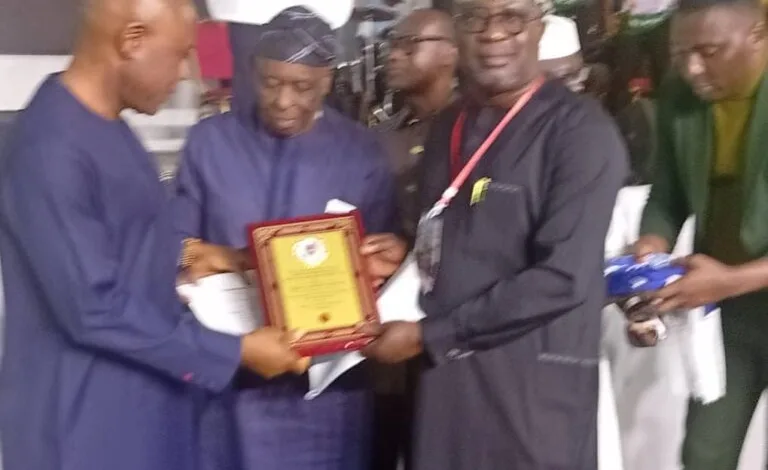
There are honours that decorate a career. There are others that explain a purposeful one. The Fellowship of the Nigerian Guild of Editors conferred on Tunde Rahman belongs to the latter category.
Its significance is not simply another distinction attached to a distinguished name. It represents something deeper: years of deadlines met, difficult stories interrogated, pages edited, colleagues guided, institutions served, mistakes absorbed, reputations tested and responsibilities carried.
For younger journalists, professionals and emerging leaders, that may be the most important part of this moment.
Success rarely arrives as one spectacular event. More often, it accumulates quietly.



One deadline met.
One difficult assignment completed.
One more qualification earned.
One relationship handled with integrity.
One disappointment survived without bitterness.
One opportunity treated as a responsibility rather than an entitlement.
Then, many years later, what once looked like ordinary working days begin to resemble an extraordinary career.
Benjamin Franklin captured the principle in five enduring words: “Well done is better than well said.”
Tunde Rahman’s journey gives those words contemporary resonance.
He came through the demanding world of Nigerian newspaper journalism. His professional journey included the old Daily Times, The Punch, where he rose through editorial positions to become Group News Editor, and THISDAY, where he occupied senior editorial roles, including leadership of its weekend titles.
His career later expanded into newspaper entrepreneurship, strategic communication and public affairs. Today, he serves as Senior Special Assistant to the President on Media and Special Duties.
Yet the most useful way to read that journey is not through the politics of any administration.
It is through the professional habits that allowed one career to keep evolving across decades.
The deeper story is about craft.
Learning.
Adaptability.
Resilience.
Credibility.
Service.
And the discipline required to remain useful as the world around you changes.
Before the recognition came the apprenticeship
Every distinguished career has a period the public rarely sees.
The apprenticeship.
The years when the title is modest, the assignments are demanding and the applause is almost nonexistent.
Newsrooms provide a particularly unforgiving apprenticeship.
There are deadlines that will not move because you are tired.
There are editors who will question every loose sentence.
There are facts that must be checked again.
There are stories that collapse after hours of work because one crucial element cannot be established.
There are corrections that teach humility more effectively than praise ever could.
There are days when the reporter gets the story and someone else receives the recognition.
Yet these are often the years when professional character is formed.
Consider a young reporter sent to cover what appears to be an insignificant event.
She can attend, collect the prepared statement, return to the office and file what everybody expects.
Or she can listen more carefully.
Check a number.
Ask one additional question.
Call another source.
Notice what others missed.
Perhaps nobody congratulates her that evening.
But if she repeats that discipline for ten years, something begins to happen.
Editors trust her.
Sources respect her.
Colleagues seek her judgement.
Responsibility follows.
That is how careers are built.
Not from one extraordinary performance, but from hundreds of ordinary assignments approached with uncommon seriousness.
Booker T. Washington captured this beautifully when he spoke of doing a common thing in an uncommon manner.
That remains one of the most practical definitions of excellence.
The extraordinary career is often assembled from very ordinary tasks done exceptionally well.
Write the report properly.
Check the figure.
Return the call.
Prepare before the meeting.
Correct the error.
Read beyond the brief.
Keep your word.
Help the colleague who knows less than you.
Do the work when nobody important is watching.
These things rarely trend.
But they compound.
Competence must keep moving
Rahman’s academic journey offers another powerful lesson.
Alongside his first degree in Political Science and postgraduate study in Communication, he later completed an MBA at the University of Leicester, decades after beginning his professional career.
That matters.
Here was not a young graduate simply accumulating qualifications before entering professional life.
This was an established practitioner returning to structured learning after years of experience.
That is lifelong learning in practice.
It speaks directly to the young executive who thinks graduation completed his education.
Keep learning.
It speaks to the mid-career professional who fears she is too established to acquire another discipline.
Keep learning.
It speaks most urgently to the senior leader surrounded by people who already call him an expert.
Especially you, keep learning.
Never allow today’s competence to become tomorrow’s complacency.
Technology changes.
Audiences change.
Organisations change.
Business models change.
Professions change.
What worked brilliantly ten years ago may be inadequate tomorrow.
The professional who wishes to remain useful must keep expanding capacity without surrendering principle.
Nelson Mandela famously observed: “Education is the most powerful weapon which you can use to change the world.”
Education, however, is larger than certificates.
It is curiosity.
It is humility.
It is having enough confidence to admit what you do not know.
It is entering a room containing people younger than you and recognising that they may understand something you do not.
It is remaining teachable after success has given you every temptation to stop listening.
The long road still matters
We live in an age fascinated by speed.
Rapid visibility.
Rapid promotion.
Rapid wealth.
Rapid influence.
Rapid recognition.
Social media can make accomplishment appear instantaneous because the public usually sees the announcement, not the apprenticeship.
We see the promotion.
We do not see the years of preparation.
We see the award.
We do not see the nights when the work went unnoticed.
We see the title.
We do not see the mistakes corrected quietly along the way.
A Fellowship tells a different story.
Some things still have to be earned over time.
Professional credibility is one.
Judgement is another.
Trust is certainly one of them.
Theodore Roosevelt once described one of life’s great rewards as “the chance to work hard at work worth doing.”
There is dignity in that idea.
But hard work should never be romanticised for its own sake.
Exhaustion is not excellence.
Being constantly busy is not the same thing as being useful.
A diary crowded with meetings does not automatically signify a life crowded with impact.
The deeper challenge is to find work worth doing and then to do it exceptionally well.
A young accountant who refuses to alter a figure because a superior finds the truth inconvenient is building something.
An engineer who insists that a safety check must be completed despite pressure to meet a deadline is building something.
A business development executive who follows up professionally after ten unanswered calls rather than becoming careless on the eleventh is building something.
A lecturer who prepares properly for students even after teaching the same subject for years is building something.
What are they building?
Reputation.
And reputation is one of the few professional assets that takes years to construct and minutes to damage.
Resilience is part of the qualification
Long careers inevitably contain disappointments.
Not every application succeeds.
Not every promotion arrives when expected.
Not every idea receives support.
Not every professional relationship lasts.
Not every season produces applause.
This is why resilience matters.
A career spanning decades cannot be understood only through appointments and achievements. It must also be understood through the moments when someone had to continue without knowing what came next.
Professional resilience is not pretending that disappointment does not hurt.
It is refusing to allow one disappointment to become a permanent definition of your capacity.
The journalist whose story is rejected can improve the story.
The entrepreneur whose first idea fails can learn what the market was trying to say.
The executive passed over for promotion can deepen capability rather than allowing resentment to become a strategy.
The graduate facing rejection after rejection can continue acquiring evidence that makes the next application stronger.
Resilience is not stubbornly repeating what failed.
It is learning, adjusting and continuing.
That distinction matters.
A meaningful career is rarely a straight line.
Sometimes the detour develops a capability the original route never would have produced.
Sometimes what feels like delay is preparation.
Sometimes an uncomfortable assignment becomes the experience that later distinguishes one candidate from everybody else in the room.
Young professionals should therefore be careful about judging their entire future from one difficult season.
The story is still being written.
Journalism is a profession of consequence
Journalism is not merely a profession of words.
It is a profession of consequence.
What is published can illuminate or distort.
It can expose wrongdoing or deepen confusion.
It can improve public understanding or reward sensationalism.
It can protect a reputation or destroy one unfairly.
That responsibility has become even more demanding in an age of artificial intelligence, manipulated images, synthetic audio and information travelling at extraordinary speed.
Imagine an editor receiving a convincing video of a public figure making an inflammatory statement.
Thousands of people are already sharing it.
Competitors are preparing to publish.
The temptation to move first is enormous.
But what if the video is fabricated?
In that moment, speed is no longer the highest professional virtue.
Verification is.
The editor who pauses, checks and refuses to publish what cannot be established may lose a few minutes of online traffic.
But that decision protects something far more valuable.
Trust.
This is one reason professional credibility matters more, not less, in an age where almost anybody can publish.
Technology can distribute information.
It cannot manufacture earned credibility.
That must still be built through behaviour.
Experience should travel
Rahman’s professional journey has crossed journalism, editorial leadership, media entrepreneurship, strategic communication and public service.
Those roles are different.
Their obligations are different.
Their pressures are different.
The useful lesson is not political.
It is professional.
Knowledge becomes more valuable when it can travel.
A journalist who understands institutions becomes a stronger analyst.
A communicator who understands journalism becomes more sensitive to evidence and scrutiny.
A political scientist who understands management sees organisations differently.
An experienced editor who understands business can appreciate why good ideas still require viable institutions to survive.
Specialisation should give us depth.
It should not imprison us intellectually.
The professional of the future will increasingly need both.
Depth in something.
Curiosity about many things.
Character travels farther than a CV
There is something no degree can confer and no appointment can guarantee.
Character.
Martin Luther King Jr. said: “Everybody can be great, because everybody can serve.”
That thought deserves far greater prominence in professional life.
Leadership is often presented as the art of occupying important positions.
Its harder expression is usefulness.
Can colleagues depend on you?
Can younger professionals learn from you?
Can people trust your word when there is nothing written down?
Can you disagree without destroying a relationship?
Can you exercise influence without humiliating people who possess less of it?
Can you remain grounded when access, money and recognition increase?
These questions ultimately matter more than the size of an office.
Imagine three executives with identical qualifications.
The first walks past struggling junior colleagues because mentoring is not in his job description.
The second notices talent, gives feedback and creates opportunities.
The third habitually takes credit for the work of the people beneath him.
Their CVs may initially appear similar.
Their legacies will not.
One conversation can redirect a young professional’s career.
One recommendation can open a door.
One piece of constructive criticism can prevent a costly mistake.
One introduction can eventually produce a business that employs hundreds of people.
Impact is not always dramatic.
Sometimes impact is simply what continues happening in other people because you took the trouble to help them.
That is why the movement from experience to mentorship is so important.
A profession loses something whenever accomplished people carry decades of knowledge into retirement without deliberately passing it on.
Experience should not merely accumulate.
It should circulate.
Excellence must eventually become service
Professional achievement reaches its deepest meaning when personal success creates value beyond the individual.
That is where nation building becomes practical.
Not only in presidential villas, parliaments and ministries.
Nation building happens in ordinary places every day.
It happens when a newsroom checks a claim before millions of people read it.
It happens when a lecturer refuses to lower academic standards because doing so would be easier.
It happens when an entrepreneur chooses to pay employees fairly.
It happens when a doctor gives the same care to an unknown patient that she would give to someone influential.
It happens when a public servant refuses to change an inconvenient fact in a report.
It happens when a chief executive develops talented younger colleagues instead of seeing them as threats.
It happens when a young professional decides that competence will be his answer to mediocrity.
These are not small acts.
Countries are ultimately shaped by millions of choices made when there is no television camera present.
Ralph Waldo Emerson wrote: “Nothing great was ever achieved without enthusiasm.”
Enthusiasm matters.
But lasting nation building demands disciplined enthusiasm.
Passion must acquire competence.
Ambition must acquire ethics.
Influence must acquire responsibility.
Education must acquire usefulness.
Leadership must acquire service.
From success to significance
There is a profound difference between success and significance.
Success asks, “How far have I gone?”
Significance asks, “Who is better because I went there?”
Imagine an editor who retires after four decades with awards, influence and photographs with powerful people.
Now imagine another editor with similar achievements who deliberately mentored 20 younger journalists.
Some become editors.
One creates an investigative platform.
Another becomes an outstanding broadcaster.
Several carry his insistence on accuracy into newsrooms he will never enter.
The second career keeps working long after the final office has been vacated.
That is what purpose does.
It multiplies achievement.
The banker who only closes transactions may be successful.
The banker who also develops ethical professionals, finances productive businesses and expands opportunities for others has begun converting success into significance.
The lecturer who merely delivers slides has completed a task.
The lecturer who helps a hesitant student discover intellectual confidence may alter the trajectory of a family.
The entrepreneur who builds personal wealth has achieved something.
The entrepreneur who also creates dignified work, develops people and solves a genuine societal problem has created impact beyond the balance sheet.
Purpose does not necessarily require doing something enormous.
It requires understanding why what you do should matter beyond you.
The Fellowship beyond the Fellowship
Perhaps this is the most meaningful way to understand Tunde Rahman’s recognition.
Fellowship carries prestige.
But prestige is the smaller part.
The greater part is stewardship.
Experience should become mentorship.
Networks should become bridges.
Lessons acquired through deadlines, mistakes, pressures, difficult assignments and changing professional seasons should become wisdom available to another generation.
A Fellow becomes part of the institutional memory of a profession.
In that sense, Fellowship is not simply an award for yesterday.
It is an obligation to tomorrow.
That is why this recognition reaches beyond one individual.
For the young journalist wondering whether painstaking work will ever be noticed, keep doing the work properly.
For the young executive tempted to substitute visibility for competence, build substance.
For the professional disappointed that progress appears slower than expected, keep learning and keep moving.
For the leader surrounded by younger talent, develop it.
For the person contemplating another course, another qualification, another challenging assignment or another unfamiliar responsibility, remain teachable.
For those fortunate enough to rise, remember those still trying to find their first opportunity.
And for everyone building a career, remember that the real measure of ascent is not simply how high you climb.
It is what becomes possible for other people because you climbed.
Tunde Rahman’s Fellowship deserves celebration for precisely that reason.
It recognises a long professional journey.
But its greater value may lie in what that journey can teach another generation.
Work matters.
Learning matters.
Resilience matters.
Character matters.
Service matters.
Purpose matters.
And excellence, pursued patiently and deployed purposefully, can become something greater than personal recognition.
It can become contribution.
Contribution can become example.
Example can awaken possibility in somebody else.
And when that possibility strengthens people, professions, institutions and communities, a career becomes something far more enduring than a collection of titles.It becomes a legacy.That is the reward for purposeful work.And that is how professionals help build nations.
Curled from BusinessDay