BREAKING: Amid CPI methodology review, Nigeria’s inflation rate hits 15.15% in December 2025
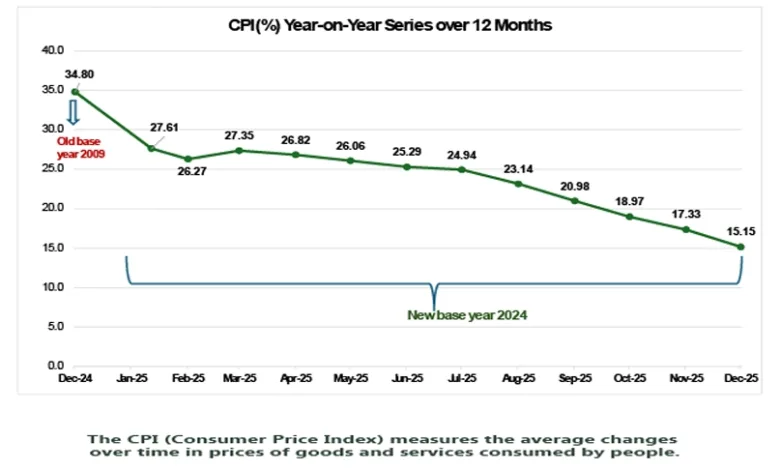
Nigeria’s headline inflation eased sharply to 15.15per cent in December 2025, following a methodological review by the National Bureau of Statistics ((NBS).
The ease in inflation rate signal a significant moderation in price pressures compared with both the previous month and the same period last year.
Data from the latest Consumer Price Index report showed that the CPI rose to 131.2 points in December from 130.5 points in November, indicating a slower pace of increase in average prices across the economy.
On a year-on-year basis, headline inflation fell to 15.15per cent in December 2025 from 17.33per cent in November and was far lower than the 34.80per cent recorded in December 2024. This reflected a sharp deceleration in inflation over the twelve-month period.




The report read, “The Consumer Price Index (CPI) rose to 131.2 in December 2025, up by 0.7 points from the previous month (130.5). The December 2025 year-on-year Headline inflation rate stood at 15.15% relative to the November 2025 headline inflation rate (17.33per cent).
“On a year-on-year basis, the December Headline inflation rate was 19.65per cent lower than the rate recorded in December 2024 (34.80per cent).
“This shows that the Headline inflation rate (year-on-year basis) decreased in December 2025 compared to the same month in the preceding year (i.e., December 2024), though with a different base year, November 2009 = 100.”
The bureau stated that the CPI increased by 0.7 points month on month, adding that “the December 2025 year-on-year Headline inflation rate stood at 15.15per cent relative to the November 2025 headline inflation rate of 17.33per cent.”
It further noted that the December 2025 headline rate was 19.65 percentage points lower than the level recorded a year earlier, highlighting the scale of the slowdown, although under a revised base year.
On a month-on-month basis, headline inflation moderated to 0.54per cent in December from 1.22per cent in November, indicating easing short-term price pressures.
The NBS clarified that the December figures reflected a change in methodology following the rebasing of the CPI. Under the new approach, year-on-year inflation and sub-indices were calculated using a twelve-month index reference period, with the average CPI for 2024 set to 100, rather than a single-month reference base.
According to the bureau, using a single-month base would have created an artificial spike in December inflation due to base effects rather than real price movements.
The adjustment, it said, aligns with international best practice under the IMF Consumer Price Index Manual and the ECOWAS Harmonised CPI framework.
This methodological shift also led to a revision of November inflation to 17.33per cent, higher than the previously reported 14.45%, showing the impact of the rebasing exercise on recent inflation readings.
Despite the monthly moderation, inflationary pressure over the year remained elevated. The twelve-month average inflation rate stood at 23.01per cent in December 2025, reflecting cumulative price increases over the period.
Food and non-alcoholic beverages remained the largest contributor to headline inflation, accounting for 6.06 percentage points of the year-on-year figure. Restaurants and accommodation services contributed 1.96 percentage points, transport 1.62 percentage points, while housing, water, electricity, gas and other fuels added 1.28 percentage points.
Food inflation recorded one of the sharpest improvements, falling to 10.84% year on year from 39.84per cent in December 2024. On a month-on-month basis, food prices declined by 0.36per cent, reversing the 1.13per cent increase recorded in November.
The NBS linked the decline to lower prices of staples such as tomatoes, garri, eggs, grains, vegetables, beans and fresh onions.
The 12-month average food inflation rate stood at 22.00per cent.
Core inflation, which excludes farm produce and energy, eased to 18.63per cent year on year from 29.28per cent a year earlier. Month on month, core inflation slowed to 0.58per cent while the 12-month average rate remained high at 23.49.
Urban inflation fell to 14.85per cent year on year from 37.29per cent in December 2024, although month-on-month urban inflation edged up slightly to 0.99per cent. Rural inflation declined to 14.56per cent year on year and recorded a month-on-month fall of 0.55per cent, compared with a 1.88% increase in November.
At the state level, Abia recorded the highest year-on-year inflation at 19.03%, followed by Ogun at 18.80per cent and Katsina at 18.66per cent, while Sokoto recorded the lowest at 8.61per cent.
The NBS cautioned against direct interstate comparisons, noting that differences in consumption patterns and CPI weights across states could make such comparisons misleading.