Crossing into captivity — by Folorunso Adisa
There is a particular grief reserved for the Nigerian who discovers, too late, that the country he fled has simply reassembled itself abroad, wearing a different flag. He left in search of dignity and found servitude with better lighting. He left in search of safety and found himself chained to an airline seat like cargo awaiting manifest. The tragedy of irregular migration is not that Nigerians dream of elsewhere. It is that elsewhere, for so many of them, turns out to be a more expensive way of being despised.
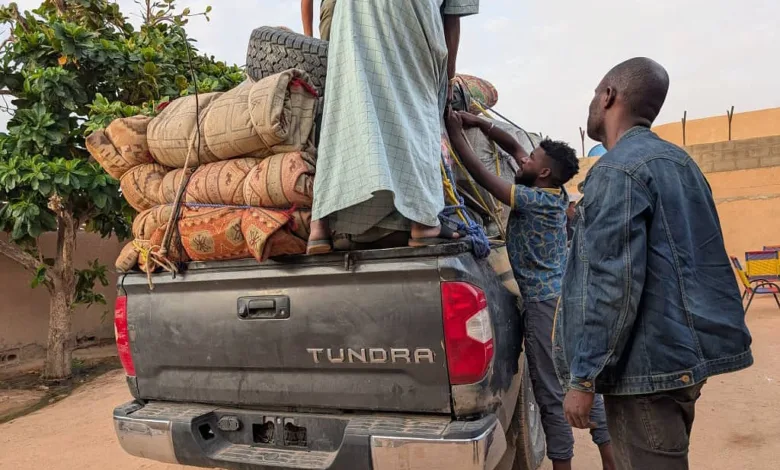
Fisayo Soyombo’s recently published three-part exposé, an investigation conducted the way only Soyombo investigates, by walking into the danger rather than just reporting on it, follows the clandestine migration routes that snake from northern Nigeria across the Sahara Desert and onward to the Mediterranean. It is not journalism content to describe suffering from a safe distance. It is testimony extracted from inside the machine. Migrants are kidnapped and held for ransom, a practice the traffickers themselves call being “tranked”. Others are delivered to farms where they labour against their will, unpaid, unfree, unheard. They are packed into vehicles beside livestock, denied the basic mercy of relieving themselves, and when the vehicles break down in the desert, as they often do, the migrants become the engine: pushing, hauling, surviving on the threat of abandonment. What begins as a pilgrimage toward opportunity ends as a lesson in how cheaply a human life can be priced once it has crossed a border without documents to protect it.
I do not come to this subject as a distant commentator. In June 2025, transiting through Charles de Gaulle Airport, on my way home to Nigeria to celebrate Ileya, I boarded an Air France flight and walked into a scene I have not been able to fully set down since. A tall, athletically built Black man was chained hand and foot to his seat, crying out as officers restrained him. “Don’t kill me!” he shouted, in French, then in English. “You are hurting my neck and my legs!” He was being deported, or, in the sanitised vocabulary bureaucracies prefer, “removed.” He insisted his hearing was scheduled for the following day, that he was not even French but Swiss, that due process had not run its course. Whether every claim he made was accurate, I cannot say. What I can say is that a cabin full of strangers, Nigerians among them, rose as one and refused to let the plane depart until the restraints were loosened. Five plain-clothes officers eventually sat around him instead of having him chained to the seat, and the aircraft, and the man, made it to Lagos intact.
I have carried that image the way one carries a stone in a shoe, present in every step since. And reading Soyombo’s account of the desert and the sea, I recognised the same architecture of contempt, differently costumed. The man on my flight had already reached Europe, and Europe still had no patience for him. The migrants in Soyombo’s report have not yet arrived, and the desert has already begun teaching them what arrival will cost. Different stages, same predicament: the indignity is not an unfortunate accident of migration. It is the business model.




It would be convenient, and lazy, to end this discourse there, with pity for the migrant and horror at his captors. But horror is not analysis, and a discourse that stops at horror has abdicated its actual work. The harder question is why so many Nigerians conclude, correctly, that the Sahara is a more rational gamble than staying home. Nobody sells himself into (shagala) servitude in Libya or Baghdad, or accepts the odds of Egypt’s smuggling routes, because he undervalues his own life. He does it because he has already priced the alternative, and the alternative, a country that cannot guarantee him security, electricity, a functioning currency, or the reasonable expectation that hard work will be rewarded, has been found to cost more in the long run than the desert does in the short run. The trafficker is a criminal. But the conditions that make his pitch persuasive are manufactured, quarter after quarter, by a state that has not yet decided that keeping its citizens is a policy priority worth the same energy it spends on keeping its currency afloat.
This is where I part ways with the version of this argument that ends in a moral appeal alone. Telling a desperate man not to go is a humane instinct, but it is not a policy, and it will not survive contact with hunger. If we are honest about what drives this migration, the argument has to run in two directions at once. To the state: a government that has failed to make staying viable forfeits the right to be surprised when its citizens leave by whatever door is open, however narrow, however dangerous. To the migrant, and here I will not pretend otherwise, even a government’s failure does not obligate you to accept whatever a trafficker offers as your only remaining option. No land is worth your humiliation. No dream is worth your soul. But that sentence is a comfort, not a strategy, and it should never be mistaken for the latter.
John Steinbeck understood this dual indictment better than most. In The Grapes of Wrath, the Joads are not driven from Oklahoma by nature alone. They are driven out by a system, a bank, a drought made catastrophic by bad land policy, that failed to protect the people who worked its soil, and then, having expelled them, they are exploited again on arrival in California by landowners who profit precisely from their desperation. Steinbeck’s genius was to refuse the reader an easy villain. The dust is real. The bank is also real. Both expel the Joads; neither absolves the other. Nigeria’s migrants inhabit the same double bind. The push is real, and the state that fails to address it bears real responsibility. The pull, the promise of Europe, is also, too often, a lie sold by men who profit from believing it. To indict only the smuggler is to let the state off far too cheaply. To indict only the state is to pretend the migrant has no agency at all. The honest discourse, like the honest novel, holds both.
There is an old proverb, closer to scripture than to folk wisdom, that a dinner of herbs where there is love is better than a fattened ox where there is hatred. I thought of that verse often on the flight home, watching a chained man beg for a hearing that may or may not have existed, in a language that was not fully his own, in a country that had already decided what it thought of him. Whatever he had gone to Europe seeking, he had not found it. He had found, instead, a version of Nigeria’s own indifference, better funded and more efficiently enforced.
I do not think the lesson here is quietism, that a Nigerian should simply endure whatever conditions his country offers because the alternative might be worse. That is precisely the fatalism this column refuses. The lesson, rather, is that the state’s failure and the trafficker’s cruelty are not competing explanations. They are accomplices. One produces the desperate; the other harvests them. A column that condemns only the desert and says nothing of the drought that emptied the land is a column that has flinched from its actual subject.
Not every plane carries hope. Some carry chains. But the more uncomfortable truth, the one this country has not yet made itself sit with, is that some of those chains were forged at home, long before the migrant ever reached the airport or bus station, and the desert only finished what a failing state had already begun.
The conversation does not end here. You can continue it with me on X via @folorunso_adisa, LinkedIn: Folorunso Fatai Adisa, or on Facebook at Folorunso Fatai Adisa.