From misstep to myth: Deconstructing the Türkiye spectacle –by Abayomi Ishola
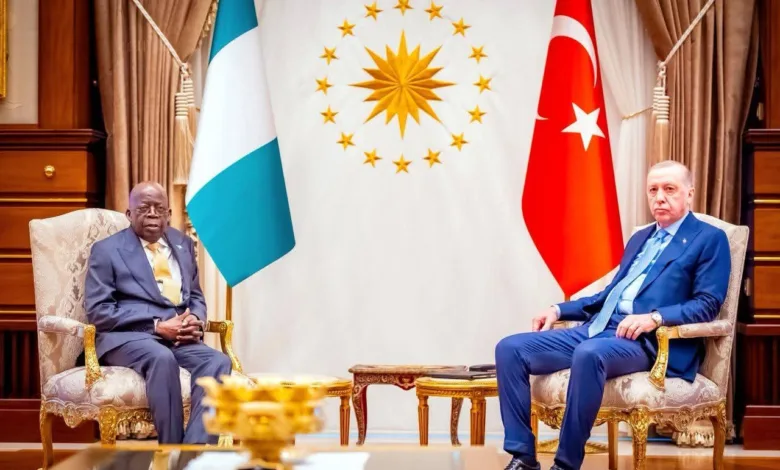
Public life has a peculiar cruelty: it can seize a fleeting human slip and inflate it into a symbolic sentence. President Bola Ahmed Tinubu’s brief loss of balance in Türkiye has been stretched beyond proportion, transformed from a momentary physical miscalculation into a sweeping allegory of decay. In Farooq Kperogi’s rendering, gravity ceases to be physics and becomes prognosis. A stumble mutates into a symptom; age is recast as illness; governance is quietly pronounced terminal.
This is not scrutiny. It is sleight of hand.
A misstep is recoded as malaise.
A passing moment is embalmed as meaning.
A sitting president is reframed as a medical case study.
Let us first anchor ourselves in the stubborn discipline of fact: there is no medical evidence in the public domain that President Tinubu suffered a cognitive or neurological episode during his Türkiye visit. None. No diagnosis. No physician’s report. No independent clinical assessment. What exists instead is circulating footage—cropped, looped, slowed, replayed with forensic obsession by a public eager to extract destiny from pixels. From this sliver of imagery, an entire architecture of decline has been constructed.
This is what happens when metaphor outruns medicine. A foot slips, and suddenly the mind is indicted. Balance falters, and cognition is placed on trial. Ordinary human frailty is conscripted into extraordinary political inference.
By this logic, diplomacy must henceforth be conducted only on frictionless floors, lest leadership itself be declared neurologically compromised.
History, however, resists such reductionism. The world stage is populated by elderly leaders who governed with deliberation even as their bodies betrayed their years. Joe Biden, despite a halting gait and verbal stumbles, managed alliances, wars, and economic recalibrations at the helm of the world’s largest economy. Paul Biya, well into his nineties, still grips the levers of Cameroonian power. Ronald Reagan steered the United States through Cold War tempests long before any post-presidency diagnosis entered public consciousness.
Age, in political life, is not an automatic obituary. It is an ambiguous mirror capable of reflecting wisdom or wear, lucidity or rigidity, but never conclusively, and certainly not from a single frame of video.
This distinction matters deeply in Nigeria because the country has lived through a very different, very real precedent: Muhammadu Buhari’s prolonged illness in office. Buhari’s case was not inferred from a stumble or deduced from posture. It was defined by extended medical absences, repeated trips abroad for treatment, prolonged silence, and eventual formal transmission of power to his vice president. The concern then was not speculative; it was structural. Governance slowed, uncertainty thickened, and authority diffused in the vacuum created by absence.
It is precisely because Nigerians remember Buhari’s illness that caution is required now. To casually equate Tinubu’s brief physical misstep with Buhari’s documented medical incapacitation is to flatten history into hysteria. One was a sustained condition that altered the machinery of governance; the other is a moment seized and magnified by narrative appetite.
To insist otherwise is to confuse appearance with essence, posture with performance, surface with substance. It is to judge the engine by a dented bonnet, to dismiss the orchestra because the conductor limps.
The original article’s prose is vivid, even arresting, but it repeatedly crosses from grounded concern into speculative theatre. Tinubu is described as “disoriented,” “mentally strained,” “out of his depth”, yet these descriptors float free of proof. They are impressions posing as diagnoses, metaphors masquerading as measurements.
The president’s body is made to speak as though it were betraying secrets the mind itself has not confessed.
Then comes the curious conscription of the First Lady into the narrative. Remi Tinubu appears less as a person than as an absence faulted for not hovering, not tailoring, not choreographing dignity into place. Her nonappearance is treated not neutrally but narratively, as neglect, as failure, as dereliction of some unspoken spousal duty.
This argument presents itself as pragmatic realism, yet it quietly imports an old expectation: the wife as custodian, caretaker, curator of male authority. Jill Biden is elevated as the vigilant archetype, circling like a human stabiliser, while Remi Tinubu is faulted for not performing an equivalent vigilance.
But Nigeria’s constitutional order does not vest governance in spousal proximity. Power is not sustained by marital choreography. To suggest that effective leadership hinges on a wife’s physical presence is to collapse statecraft into stagecraft and reduce partnership to prop management.
Most troubling is the analytical shortcut from bodily frailty to cognitive erosion. This shortcut is especially dangerous in a polity still haunted by Buhari’s illness. The body is an unreliable narrator; it announces its weaknesses loudly. The mind, by contrast, declines quietly or not at all. To fuse the two is to assume that a flickering bulb means the entire power grid has failed.
It is an imprecise metaphor, and therefore a perilous one.
Yes, Nigerians are entitled to transparency. Yes, leadership demands stamina. Yes, optics matter in an era where governance is relentlessly visual. But critique must be disciplined rather than dramatic, forensic rather than fevered. Without that restraint, concern curdles into spectacle, and empathy hardens into accusation dressed in moral language.
The Türkiye incident warrants calm inquiry, not operatic conclusions. If there are genuine health concerns, they must be addressed with evidence. If there are failures of governance, they should be demonstrated through policy incoherence, administrative paralysis, or poor decision-making—not inferred from a momentary imbalance abroad.
A head of state is not a gymnast.
A wobble is not a diagnosis.
And age is not pathology.
Nigeria deserves leadership that is capable, conscious, and accountable. It also deserves commentary that remembers its own history accurately. Buhari’s illness taught the nation what real incapacitation looks like. To forget that lesson and to weaponise a stumble as its equivalent is to trade judgment for drama.
Losing balance briefly is not the same as being brought down.
Age is not an illness.
And a president is not a prognosis waiting to be pronounced.
Let us insist on evidence over echoes, truth over tremors, and reason over reflex. Because mistaking shadows for substance does more damage to a nation’s judgment than any brief loss of balance ever could.
-Ishola, an analyst, writes from the UK