King Sunny Ade at 80: My reminiscences — by Kayode Adebiyi
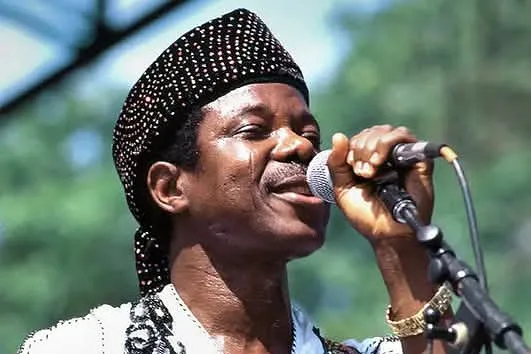
I grew up in the 1970s and 1980s, the years when King Sunny Ade released some of the albums and tracks that would go on to become timeless classics. For me, however, King Sunny Ade’s music was more than just music. It became the soundtrack of my childhood, the signature tune of my growing-up years and, in many ways, the sound of home.
To understand why his music occupies such a special place in my memory, I have to take you back to the early 1970s, to a rural but remarkably eclectic town in Ekiti called Ode-Ekiti.
My father was an English Language teacher. At a time, he was teaching at St Louis Girls Grammar School, Owo, where my older brother was born. He later left Owo to attend the University of Ibadan. When he completed his studies, he travelled to Ibadan, the capital of the then Western Region, to the Ministry of Education to arrange his posting back to St Louis Girls Grammar School.
But things did not go according to plan.



The officer in charge of postings told him that St Louis now had an English teacher, so there was no need to send him back to Owo. Instead, he suggested that my father consider another secondary school in Ekiti that needed an English teacher. Since my father was from the Ekiti Division of the region, he suggested that he return home.
My father was not impressed.
He had become accustomed to Owo and wanted to return there. He asked the officer, almost dismissively, which secondary school in Ekiti he was talking about.
“Ode-Ekiti High School,” the officer replied.
My father could hardly believe it.
“How can I leave Owo and go and teach and live in a village in Ekiti?” he reportedly asked.
But sitting in that same office and listening to the conversation was Professor Sam Aluko, the renowned economist, who had come to the Ministry of Education to see how he could help secure good teachers for the only secondary school in his hometown, a school built largely through the efforts and contributions of the sons and daughters of Ode-Ekiti.
Professor Aluko challenged my father.
As an Ekiti man, how could he refuse to come home and help educate Ekiti children?
He urged him to come to Ode-Ekiti and help the school and the town. When he discovered that my father was not merely an NCE holder, but a university graduate of English, he became even more determined to persuade him.
Apparently, Professor Aluko had gone to the ministry looking for an NCE teacher and had found a university graduate instead.
He practically begged my father to accept the posting.
Eventually, my father reluctantly agreed. A posting letter was written that same day and handed to him.
That decision changed the course of my childhood.
Professor Sam Aluko offered his own house in Ode-Ekiti, a storey building, to accommodate our family until the staff quarters at Ode-Ekiti High School were ready. We lived in the upstairs flat and, about two years later, moved into the school premises when my father became a Boarding House Master.
The principal of the school, Mr Fayehun from Ondo town, was also someone Professor Aluko had helped recruit.
And that was how our family found itself in Ode-Ekiti in the early 1970s.
And then came King Sunny Ade.
I have given this background because it is impossible to tell the story of my childhood in Ode-Ekiti without telling the story of King Sunny Ade’s music.
Our flat in Professor Aluko’s house had a living room with a red-painted floor. Those who remember how houses were built and finished in those days will know exactly what I mean.
Then came another memorable event.
My father bought a brand-new yellow Volkswagen Rio saloon car. The day my Uncle Johnson drove the car all the way from Mandilas in Ibadan to Ode-Ekiti, he brought something else with him: a turntable record player.
That record player became almost as important to our household as the car.
My father had a collection of King Sunny Ade’s vinyl records, and as far as I remember, our flat was the only place in the town with a turntable.
So, Sunday afternoons became something of an institution.
After church, my father would put on a King Sunny Ade album. Once the music began to blare from the speakers, the atmosphere in our flat would change.
My father’s teacher colleagues would arrive. The nurse from the town’s health centre would come. Friends and neighbours would show up.
And then the dancing would begin.
Sunday after Sunday.
King Sunny Ade’s music would fill that living room, and people would dance.
It got to the point where the red paint on the floor began to peel off from the repeated Sunday dancing.
I would usually find a quiet corner of the room and watch.
I listened.
I absorbed everything.
And by the time I was about eight or nine, I could sing practically every notable King Sunny Ade track I heard.
His music fascinated me so much that I made up my mind that I would become a musician like him when I grew up.
I even went to a carpenter and asked him to carve a piece of wood into something resembling a guitar. I removed wires from old electrical flex cables and used them as guitar strings.
Then I would practise my King Sunny Ade moves, strumming my homemade guitar and imagining myself performing before an audience.
That was how deeply his music had entered my consciousness.
What makes those memories even more remarkable today is the environment in which they were created.
Ode-Ekiti had no electricity.
We depended on Professor Aluko’s generator whenever he was around, having returned from the University from time to time to spend some days in town.
There was no pipe-borne water either.
My uncles and aunties who lived with us would fetch water from the streams. My mother would boil it, allow the dirt to settle, and then my father would pour it into a water filter he had bought from Ibadan before we could drink it.
By today’s standards, there were obvious inadequacies.
But as a child, I did not see them that way.
I did not feel deprived.
Because somehow, every Sunday afternoon, King Sunny Ade’s music transformed our little world.
The speakers positioned around the four corners of our red-painted floor living room would come alive, and the sound of the music would fill the house.
There was dancing.
There was laughter.
There was companionship.
There was community.
And there was a little boy sitting somewhere in that room, watching, listening and dreaming.
Looking back now, I realise that King Sunny Ade’s music was one of the lights of my childhood.
It was part of the texture of my growing up. It was intertwined with memories of my father, our home, his colleagues, our neighbours, my mother’s daily routines, my uncles and aunties, and that fascinating little town called Ode-Ekiti.
It is amazing how music can preserve a moment in time.
Decades later, I can still close my eyes and almost hear the turntable spinning, the crackle of the vinyl record before the music starts, and then that unmistakable sound of King Sunny Ade filling our living room.
For me, that is what King Sunny Ade @ 80 represents.
It is not just the birthday of a legendary musician.
It is a celebration of a man whose music became part of the memories of an entire generation and for people like me, became part of the story of our lives.
On the occasion of King Sunny Ade’s 80th birthday, I wish him a blessed and fulfilling year and many more years in good health.
Thank you, KSA, for the music.
Thank you for the memories.
Thank you for giving a little boy growing up in rural Ode-Ekiti a soundtrack that he would carry with him for the rest of his life.
And to commemorate his eight decades on earth, I have decided that for the next eight days, I will play nothing but King Sunny Ade in my car, one decade at a time, celebrating eight decades of a life that has given us so much music.
Some of the tracks I love so much include 365 Is My Number, Synchro System, Ma Jaiye Oni, Ase, Mori Sisi Meji, Ja Funmi, Mo Ti Mo, and many others.
Are you a lover of King Sunny Ade and his music?
Do you have a personal memory or story connected to him or his music? Is there a particular KSA track that takes you straight back to a special moment in your life?
Drop it in the comment section.
Happy 80th Birthday, King Sunny Ade.
The music lives on.