The ADC saga: How history, factions and political miscalculations collided — by Oluwadare Ayeni

In Nigerian politics, crises rarely begin where the public first notices them. They build quietly over time, through unresolved leadership disputes, fragile alliances, and institutional weaknesses, until one day they explode into national attention. The current turmoil surrounding the African Democratic Congress (ADC) is a classic example. What is today being presented by some political actors as a sudden disruption caused by the entry of a new opposition coalition is, in reality, the climax of nearly two decades of internal tensions that long predate the arrival of today’s political heavyweights.
The African Democratic Congress traces its roots to 2005 when it was founded by political activists led by Ralph Okey Nwosu. The party was subsequently registered in 2006 by the Independent National Electoral Commission as a new political platform promising to provide Nigerians with a credible “third force” outside the dominant political establishments. In its early years, however, the party remained relatively small and struggled to establish itself as a major national force.
Throughout this period, Nwosu remained the central figure in the party’s leadership, serving as national chairman for close to two decades. For supporters, this continuity provided stability for a young party navigating Nigeria’s difficult political terrain. For critics, however, the long tenure raised questions about internal democracy and institutional renewal within the organization.
The ADC first moved into the national spotlight in 2018 when former Nigerian president Olusegun Obasanjo adopted the party as the political platform for his Coalition for Nigeria Movement. The initiative was designed to create a new national opposition force ahead of the 2019 elections. For a brief moment, the party appeared poised to transform itself into a major political platform.
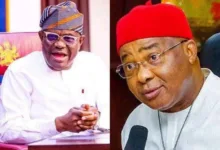


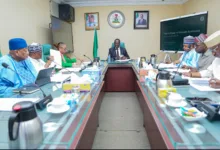
In the lead-up to the 2019 election, the party nominated former minister Oby Ezekwesili as its presidential candidate. But the alliance soon ran into internal turbulence. Disagreements over campaign strategy, party control, and coalition management created tensions that proved impossible to manage. In January 2019, barely weeks before the election, Ezekwesili withdrew from the presidential race, citing irreconcilable differences within the coalition. Her withdrawal exposed deep structural weaknesses within the party and marked the beginning of a prolonged internal crisis.
Following the 2019 elections, the ADC entered a period of sustained factional disputes. Questions about leadership tenure, internal democracy, and the control of party structures began to dominate internal discussions. These tensions eventually spilled into the courts, where rival factions sought judicial recognition of their authority.
One of the earliest legal confrontations emerged after disagreements over the legitimacy of party congresses and leadership decisions in the years following the 2019 elections. Various party members approached the courts to challenge decisions taken by the national leadership under Nwosu, arguing that some processes violated the party constitution. These disputes produced several injunctions and counter-injunctions that complicated the party’s internal governance.
The situation intensified in the period leading to the 2023 general elections. In 2022, businessman Dumebi Kachikwu emerged as the party’s presidential candidate. His emergence immediately triggered fresh litigation within the party. Rival factions challenged the legitimacy of the process that produced him, while others argued that the national leadership had manipulated internal mechanisms to control the outcome.
The dispute eventually reached the courts where Kachikwu and other party figures sought judicial interpretation of the party’s constitution and leadership structure. The litigation produced competing legal positions over who actually controlled the party’s national machinery. Even after the 2023 elections, the disagreements did not disappear. Instead, they hardened into long-standing factional divisions.
Another legal confrontation emerged when a faction within the party challenged decisions taken by the national leadership regarding party congresses and internal appointments. These cases further complicated the legitimacy of the party’s national structures and reinforced the perception that the party was operating under multiple competing authorities.
By 2025 the crisis had reached another turning point. The founding leadership announced a restructuring of the party aimed at repositioning it as the platform for a broader national opposition coalition ahead of the 2027 elections. As part of that transition, Nwosu stepped aside and a new leadership arrangement was announced, with former Senate President David Mark emerging as national chairman and former governor Rauf Aregbesola becoming national secretary.
But this transition immediately triggered another legal challenge. A faction led by Nafiu Bala Gombe rejected the restructuring, arguing that the process violated the party’s constitutional provisions. The faction approached the courts seeking to nullify the leadership arrangement and restore what it described as the lawful order within the party.
It was in the middle of these unresolved court disputes that a new opposition coalition began to gravitate toward the ADC as a political platform. Figures such as Atiku Abubakar, Peter Obi and Rotimi Amaechi began aligning with the party as part of an effort to build a broad opposition alliance ahead of the 2027 elections.
But by the time these political heavyweights arrived, the ADC was already deeply fragmented and entangled in multiple legal disputes. Entering such a volatile environment required careful navigation of the party’s complex internal history. Instead, the coalition appeared to engage primarily with one faction of the party while other factions continued to challenge the legitimacy of that leadership in court.
This decision revealed a significant strategic miscalculation. Political coalitions often assume that financial resources, political influence, and public visibility can quickly consolidate control of an existing party structure. But political parties are also legal institutions governed by constitutions, court decisions, and regulatory oversight. Ignoring those legal realities can produce unintended consequences.
The situation also explains the cautious posture adopted by the electoral authorities. When rival factions of a political party are already contesting leadership legitimacy before the courts, regulators typically avoid recognizing any faction until the judiciary resolves the dispute. In such circumstances, the legal doctrine of status quo ante bellum becomes relevant. The principle simply requires that the situation revert to the last uncontested arrangement before the conflict escalated, ensuring that no faction gains administrative advantage while the legal process is ongoing.
Seen in this broader context, the present crisis within the ADC is not the product of a sudden conspiracy or external interference. It is the natural outcome of years of unresolved disputes over leadership, internal democracy, and institutional control. The arrival of powerful opposition figures did not create the crisis; it merely intensified the contradictions that had been simmering within the party for years.
And that raises a deeper political question that Nigerians must now confront. If a political party has spent nearly two decades battling unresolved internal conflicts and repeated court interventions, can it realistically serve as the foundation for a stable national coalition, or will those same unresolved conflicts eventually swallow the coalition that hopes to ride on it?
Oluwadare Ayeni, PhD