Domestic equities market may respond positively to MPC’s decision on interest rate, says analysts
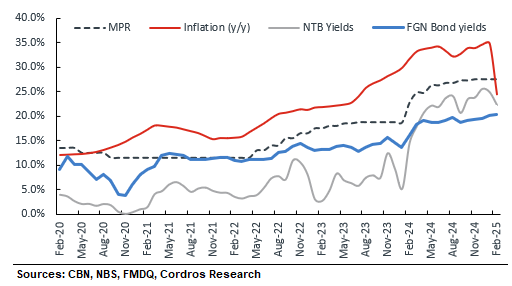
A group of analysts at Cordros Research have hinted on the Nigerian Exchange Limited (NGX) equities market section to respond positively to the Monetary Policy Committee (MPC) members of the Central Bank of Nigeria (CBN) to pause interest rate or Monetary Policy Rate (MPR) hikes as investors assess the likelihood of policy easing in the medium term.
The MPC of the CBN halted its policy rate tightening cycle at the first meeting of the year, marking the first pause since it began raising rates in May 2022.
The MPC’s decision was primarily steered by its optimistic inflation outlook, underpinned by the naira appreciation and the steady reduction in PMS prices amid the impact of the CPI rebasing on the inflation print.
Accordingly, the Committee voted to hold the MPR constant at 27.50 per cent and retain all other parameters – Cash Reserve Requirement (CRR) for Deposit Money Banks (DMBs) and Merchants Banks at 50per cent and 16per cent, respectively; the asymmetric corridor around the MPR at +500bps/-100basis points and the liquidity ratio at 30 per cent.




Cordros Research responding to halt in rates expressed that further decline in fixed income yields may trigger a capital shift to the equities market, supporting broader market activity.
They stated that “While we note that the NGX All-Share Index’s year-to-date return remains subdued at +5.5per cent (vs. +35.2per cent in the same period last year), we anticipate a gradual revival of risk appetite, further supported by declining inflation (following the rebasing) and expectations of currency stability.
“We also expect to see some rotation into sectors positioned for expansion in a lower-rate environment, particularly the manufacturing sector, as lower financing costs, improved input cost dynamics, and stronger consumer demand enhance growth prospects, making the sector more attractive to investors.
“Furthermore, foreign portfolio investor (FPI) participation is expected to rise (2024: 15.3per cent | 2023: 11.5per cent) as improving macroeconomic conditions and prospects of monetary easing enhance the appeal of Nigerian equities.”
The Committee anticipates robust GDP growth in the medium term, driven by strong contributions from the non-oil sector.
Additionally, the MPC noted the sustained rise in domestic crude oil production (1.74mb/d) and expects an improved contribution from the oil sector, further strengthening overall GDP growth.
On Inflation, the MPC acknowledged the rebasing of the CPI as well as the adjustments in the weights of items in the CPI basket, citing that the new methodology reflects current consumption patterns. Furthermore, the Committee expects inflationary pressures to moderate in the near future, helped by a relatively stable naira and gradual moderation in PMS prices.
The MPC highlighted the recent naira appreciation buoyed by improved FX liquidity. The Committee also acknowledged the current measures by the CBN to foster transparency and credibility in the FX market, including the implementation of the Electronic Foreign Exchange System (EFEMS) and the Nigerian Foreign Exchange Market (NFEM) FX Code.
The Committee expects the sustained policy initiatives to improve Foreign Direct and Portfolio investments as investors’ confidence increases. The MPC also highlighted that the increased domestic crude oil production is expected to improve the current account balance and support FX reserve accretion.
As anticipated, the MPC retained the MPR at 27.5per cent while keeping other parameters unchanged. Notably, despite the lower inflation reading under the new CPI methodology, the MPC’s stance signals a cautious approach.
The CBN governor, Mr. Olayemi Cardoso at the meeting stressed the need for further inflation data to confirm a sustained moderation.
He reaffirmed the MPC’s commitment to orthodox monetary tools to drive inflation toward minimal levels over the medium to long term.
“Looking ahead, we expect future MPC decisions to be primarily influenced by developments in the FX market and the trajectory of inflation.
“While a potential rate cut could be considered at the May policy meeting, we anticipate a gradual approach aimed at balancing exchange rate stability with the anticipated disinflationary process,” they added.