Is France real or déjà vu with Africa? — by Kelechi Deca
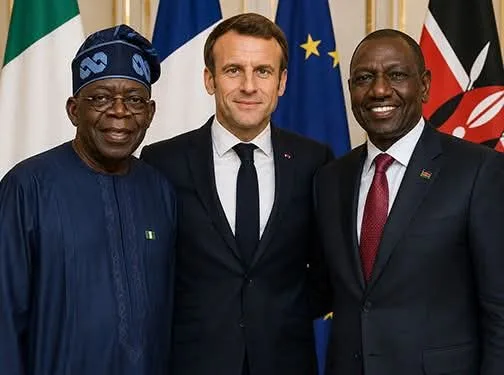
The events that took place in Nairobi Kenya over the week reminded me of Jacques Foccart, the man who literally and singlehandedly drew up France’s policies in Africa. This is against the backdrop of the ‘defrenchifisation’ air across Africa.
Jacques Foccart was head of the Africa Department at the Elysée Palace under President Charles de Gaulle with the official title of Secretary-General for African and Malagasy Affairs (Secrétairegénéral pour les affaires africaines et malgaches) from 1960 to 1974.
He was the architect of France’s post-colonial policy in sub-Saharan Africa as he was later referred to as “Monsieur Afrique.”Françafrique as a foreign and economic policy was his brainchild.
As the most influential man in the Fifth Republic after de Gaulle, he built a dense, often shadowy, network of personal, political, and intelligence connections between that enabled Paris to have its sometimes chocking stranglehold on the newly independent African states. A grip that lasted over 50 years.
Monsieur Foccart operated a clandestine diplomatic office parallel to the official foreign ministry as he managed sensitive and, at times, opaque military and political affairs in Francophone Africa. He elevated ordinary men into the office of the presidents, and deposed presidents who showed streaks of independence.
Those he could not overthrow, he made life unbearable for, including SekouToure of Guinea. Those who understood his game played along and got him to protect their stranglehold on power.
Foccart played a very interesting, double role during the Biafra War.
He got Cote d’Ivoire and Gabon to support Biafra. He also arranged the use of Cotonou in Benin Republic as transit point for “dare-devil” night flights of relief materials and much-needed weapons to Uli Airstrip by volunteer pilots to Biafra.
When Foccart could not get Charles de Gaulle to stop sitting on the fence and make commitments as a result of the conflicting national interests involving the aspirations of Elf Acquitaine, he abandoned the young nation to its fate.
Why am I providing this background?
I was shocked during an engagement with some friends in the Foreign Service from five West African countries recently, that they had no idea who Jacques Foccart was. The most I could do was to tell them to read his memoire, titled; “Foccart parle”, a five volume autobiography that covered most of the shadowy activities of the French government from 1965 to 1974.
Infact, earlier publications of that book so embarrassed the French government that copies disappeared from bookshops in Europe and initial efforts at translation into English hit the rocks. That should be a special handbook for trainees in Foreign Service across West and Central Africa, but because I do not have Foreign Service experience, my advice doesn’t matter. However, I know a little about the French and Africa.
President Emmanuel Macron has been on a charm offensive across Africa in recent times. He is using Nigeria as a linchpin to restore strained relationship in West Africa, and Kenya as a launch pad to venture into East Africa. Central Africa is still shaky ground for him.
He already has a foot in Nigeria,so he hopes to use it to link with Anglophone East Africa as a counterweight to other hegemonies in the latest scramble for and partition of Africa where the United States, China, Russia, and even Israel, Saudi Arabia, UAE and Qatar are all busy slicing out shares.
At the height of the anti French sentiments amongst former colonies across Africa, President Macron angrily blurted out three years ago in Libreville, Gabon that “The age of Francafrique is well over,” referring to France’s post-colonisation strategy of supporting authoritarian leaders to defend its interests.
A position shared by one of his predecessors, notably, Francois Hollande, who previously declared that the policy is dead and that France has no intention of meddling in sovereign affairs.
Humiliated by military juntas in Mali, Burkina Faso, and Niger, and the subsequent sidelining in Chad and Senegal, France has been forced to execute a desperate pivot toward Anglophone East Africa.
Aware of the growing discontent amongst young Africans who are not shackled by the “table manners” of the older generation, France has rebranded its engagement as a “partnership of equals.”
However, those who know Frances antecedents know that the old colonial fox is merely repackaging is strategic self-interests by leveraging Nigeria’s economic weight and Kenya’s diplomatic ambition to maintain its hegemonic foothold on the continent.
From the days of Jacques Foccart, French authorities have treated former colonies in West Africa as appendages for maintaining the regional currency it controls, the CFA franc as well as its strategic military bases. This model has now been rendered unworkable, as a generational shift in Africa is making it grossly unpopular.
The “Africa Forward Summit” is seen as both humbling project and a reality check. It was the first time France would co-host such an event in an Anglophone country. Macron is pushing for a “new beginning” with Africa to reset France’s strained relationships on the continent, shifting from a history of politico- economic domination and military intervention toward a future focused on equal economic partnership.
Yet this new “partnership of equals” is a blatant ruse. France is losing influence globally as its tentacles that used to spread from St. Louis off the coast of Senegal in West Africa to Djibouti on the Horns of Africa has been seriously decimated.
As of 2023, France had over 6000 troops stationed across key military bases across Niger, Mali, Burkina Faso, and Cote d’Ivoire. Today they have a little about 1500. The last straw was the July 2025 final hand over of its military base in Dakar Senegal. This left it with only one military base in Djibouti.
Interestingly, this is happening at a time Africa willing provided its head for breaking coconut for virtually anyone with a coconut to break, just for a token. Aside the United States, Russia and China, others joined the scramble for space along the Indian Ocean frontier of Horn of Africa because that is the most strategic chokepoint of global trade. Others joined the fray, from the UK to Japan, Italy to Turkey, Israel to UAE and Saudi Arabia. They have all joined to break Africa’s coconut head.
But France wants more, having lost over seven military bases in a space of two years, it felt small. That is why it is using trade and investment as the voice of Jacob while setting up a new military base in Kenya.
The defense pact in Kenya has already faced civil society backlash over sovereignty, mirroring the grievances that got France ejected from the Sahel.
Macron has promised to back the African Union’s permanent inclusion in the G20 and call for reforms to give Africa permanent seats on the UN Security Council. This, according to him, points to his country’s repositioned view of Africa.
I have read some African business leaders calling on the youth of the continent to forget the past and welcome every investment with open hands.That is a most ignorant call. Must we erase a past whose scars are protruding like endless contours across our bodies inorder to be in the good books of foreign Investors?
As if China and Korea forgot their past in welcoming investment from Japan. As if Israel forgot their past in welcoming investment from Europe. It is the refusal to forget the past that kept all these countries on their toes and focused in pursuing a future that would protect them and ensure that they are not vulnerable to the mistakes of the past.
Nomatter how mouthwatering the offers from France, it is pertinent to heed the words of the legendary Bob Marley in his iconic song “No Woman No Cry” that “In this bright future, you cannot forget your past.”
This is because forgetting the past is forgetting the very essence of being. Substantial as his proposed €23 billion investment package is, it would not erase the country’s awful colonial “legacy”.
This is in no way a “partnership of equals” because a close interrogation of the economic terms of the investment still, and typically, favours France.
And just as Loius Faidherbe and Charles de Gaulle came up with the strategy of diplomacy on one hand, and gun on another, Macron’s proposal and charm offensive are barely concealed one-sided deal with hidden barbs.
In the words Jean-Baptiste Alphonse Karr, “Plus ca change, plus c’est la meme chose.”