National Theatre: A reawakening of a nation’s cultural soul — by Dayo Adedayo
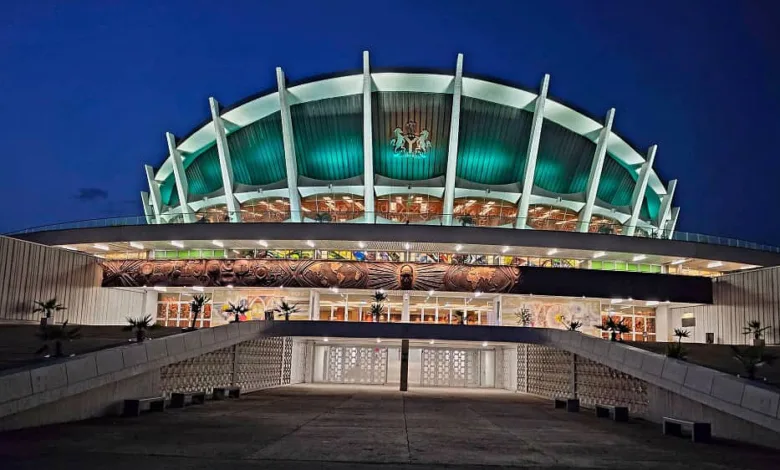
There are places you visit, and there are places that stay with you long after you have left.
The Wole Soyinka Centre for Culture and Creative Arts, formerly the iconic National Theatre, belongs firmly to the latter. It does not merely stand; it announces itself. It does not simply exist; it commands reverence.
From the very moment you approach its gates, the experience begins.
The structure rises boldly into view, majestic, unapologetic, and deeply symbolic. To your left stands the powerful statue of Queen Amina of Zaria, frozen in motion yet radiating strength, courage, and leadership. It is as though she guards the gateway into a sanctuary of Nigerian heritage, inviting you to step into history while reminding you of the resilience that defines it.

As you follow the gentle curve of the one-way drive, anticipation builds. Your mind begins to wander, what stories lie within these walls? What echoes of the past still linger? This is, after all, the very ground that hosted FESTAC ‘77, a defining cultural moment not just for Nigeria, but for the entire Black world.
And then you enter.
What unfolds inside is nothing short of breathtaking.
The Centre reveals itself as a masterful blend of architecture, art, and identity. Every surface tells a story. Every corridor feels intentional. The interplay of light, wood, marble, and glass creates an atmosphere that is both contemporary and timeless.
The cinema halls, three in total,offer more than just screens; they present an experience. The largest hall draws you in with scale and sophistication, while the others complement it with intimacy and precision. This is cinema redefined, where storytelling meets world-class ambience.
The banquet hall, expansive and commanding, stretches across 2,000 square metres, a space designed not just for gatherings, but for moments that matter. Adjacent to it, the exhibition hall, nearly as vast, feels like a canvas waiting to be filled with creativity, innovation, and cultural expression.
But it is the main bowl, the heart of the Centre, that truly humbles you.
With seating for 3,560 people, it is both grand and intimate, a rare balance achieved only by the finest theatres in the world. Standing there, you cannot help but imagine the performances, the applause, the standing ovations that will once again define this space.
Yet, beyond its scale, what truly sets this Centre apart is its soul.
What elevates the Wole Soyinka Centre for Culture and Creative Arts beyond architecture is the depth of artistic expression embedded within its walls.
The space is not merely decorated, it is curated with the spirit of Nigeria’s finest creatives. Echoes of masters such as Ben Enwonwu, Bruce Onobrakpeya, Demas Nwoko, Yusuf Grillo, and Erhabor Emokpae can be felt in the visual language of the Centre, while the enduring influence of traditional greats like Lamidi Fakeye lives on in the sculptural storytelling that greets you at every turn. One also senses the broader legacy of cultural custodians like Nike Davies-Okundaye, Kolade Oshinowo, and Muraina Oyelami, whose works continue to shape the narrative of Nigerian art across generations. These are not just artworks; they are cultural signatures, timeless imprints of Nigeria’s artistic excellence.
From the intricate wood carvings that celebrate Nigeria’s diverse cultures to the stunning stained glass installations that dance with colour and light, the building is alive with expression. One of its most striking features, the glass wall inscribed with the names of all 774 local government areas, serves as a powerful reminder of unity in diversity. It is Nigeria, etched in transparency, illuminated both literally and symbolically.
And when night falls, the transformation is magical.
The building glows.
Soft lights trace its contours, colours rise and fade across its surface, and the Centre becomes a beacon, visible, vibrant, and unforgettable against the Lagos skyline. It is no longer just a structure; it is a spectacle.
Standing there, one cannot help but reflect.
There was a time in the 1970s when Nigeria dreamed boldly, when we built with vision, with pride, with permanence. This Centre is a reminder of that era. More importantly, it is proof that such ambition can be revived.
The Federal Government of Nigeria, alongside the Bankers’ Committee, has not merely restored a building, they have reignited a legacy. They have taken history, polished it, and returned it to us with dignity.
But perhaps the most important question is this:
Why should only a few experience this?
This is not just a venue for theatre lovers or event-goers. It is a national treasure. A living museum. A cultural pilgrimage site that every Nigerian should see, feel, and embrace.
There is an urgent need for guided tours, for open access, for intentional engagement, because this is not just architecture; it is identity.
If you are in Lagos, make the time.
If you are outside Lagos, make the journey.
Stand before it. Walk through it. Let it speak to you.
Because in its walls, in its light, in its silence and its grandeur, you will rediscover something profound.
As I stood there, taking it all in, I realised I should not be among the few who have seen this.
Places like this are not meant to be hidden. They are meant to be experienced. Shared. Remembered.
Because in telling these stories, in capturing these moments, I am not just documenting Nigeria,
I am preserving her pride.
I am revealing her beauty.
I am honouring her spirit.
And I will keep telling her story, until every Nigerian sees what I see, and the world sees her the way I do.
Nigeria is beautiful.