Nigeria GDP plummets by $300bn in value over last decade, says report
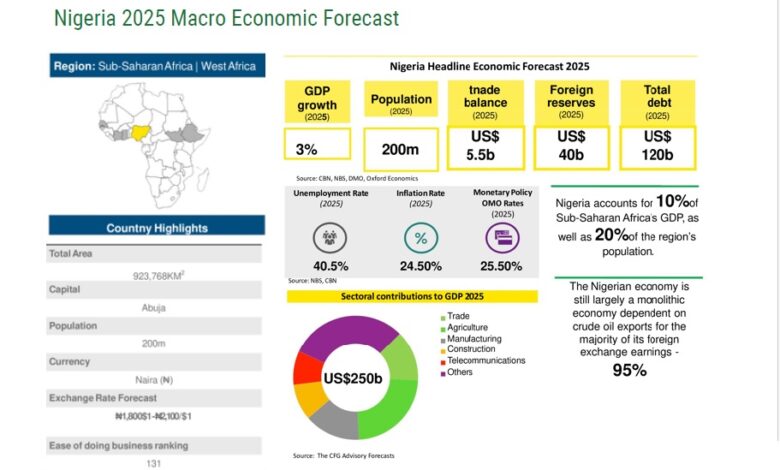
A report by CFG Advisory has revealed that Nigeria Gross Domestic Product (GDP) at $195 billion has declined over the last decade losing over $300 billion in value due to devaluation, low productivity and stagflation.
The report titled, ‘Nigeria’s 2025 Economic Forecast from Reform Fatigue Quagmire to Sustainable Growth’ stated that the country is no longer the largest Economy in Africa, ranking fourth behind South Africa, Egypt and Algeria.
“This owing to prolonged policy inconsistency since the economy came out of post covid-19 recession. The ongoing exercise to rebase GDP and CPI might therefore not yield the desired results,” the report explained.
The report chaired by Adetilewa Adebajo noted that Nigeria’s 18-month economic reform program has yielded mixed results, largely due to poor implementation and putting the cart before the horse.



“The program’s biggest impact on the economy has been the devaluation of the naira from about 450- N1700/US$.
“The cost push effect of fuel subsidy removal worsened the situation in an economy already in stagflation with sharp increases in inflation trajectory. This led to reduced household purchasing power and higher interest rates for the firms and the economy. The social intervention program has also not made any impact failing to provide succour.
“To exacerbate matters, government borrowing has exceeded the $100 billion mark and debt service costs doubling from N8 trillion in 2024 to N16.3 trillion in the 2025 proposed budget. N16.3 trillion in debt servicing is not sustainable as it exceeds the defence, security, infrastructure, education, and health budgets combined at N14 trillion.
“The gains from the subsidy removal are now being used for debt servicing, instead of investment in capital expenditure that can create stimulus for economic growth. Money supply has also increased by 50per cent YOY, to N108 trillion, a historic high that subverted the CBN’s ability to meet its 24per cent 2024-year end inflation target.”
On getting the economy back on track, he urged the government to reduce its debt burden, restore its credit rating to investment grade and tame inflation.
“This would reduce borrowing costs and provide stimulus for investment, sustainable growth, productivity, and employment.
“To accomplish this, FGN must restructure its capital structure and balance sheet. Selling down its JV oil assets will raise $30-50 billion, that can be applied to reduce the debt burden, improve the foreign exchange regime, provide dollar supply for naira appreciation, restore credit rating and boost net reserves.”
The report projected another year of high interest rates with inflation trajectory downwards to about 22per cent by year end, with effective rate cuts to sub 20per cent by Q1 2026.
“The Naira position could be sub-1000/$ or north of 2000/$ depending on how government manages its debt profile, boost oil production and asset sales.
“The oil and gas sector GDP grew by 10.2per cent with only US$3 Billion investments in 2024. Investment levels of $22 billion recorded in 2009 and 2014 must be emulated to sustain optimal production.
“Ultimately, the success of this budget cycle, economic policies and reform strategies rests with the FGN. The sincerity and commitment to a coordinated monetary, fiscal, trade, industry and investment policy execution, the decisive factor,” the report added.