Nigeria is unfinished, not hopeless — by Abayomi Ishola
There is something deeply Nigerian about sitting in darkness while arguing about how to fix the country.
The generator coughs into life. A neighbour curses the electricity supply. Someone reaches for a phone and begins comparing Nigeria with Britain, America, Dubai or Singapore. Another declares that Nigeria is hopeless. Before the conversation ends, patriotism has become a quarrel between those defending the country and those denouncing it.
I think we are asking the wrong question.
Nigeria does not have to be perfect before Nigerians are allowed to love her. And loving Nigeria does not require pretending that her faults do not exist.
I love Nigeria.
Unapologetically.
Not because everything works. It does not. Not because our governments have always served us well. They have not. Not because Nigeria is free of corruption, insecurity, poverty, weak institutions, bad roads, unreliable infrastructure or political dysfunction. She is not.
I love Nigeria because she is home. Because millions have lived, struggled, sacrificed, dreamed and died within this complicated national story. Because beneath the failures is a country of extraordinary human energy, natural abundance, cultural richness and stubborn possibility.
To love a country is not to worship it. It is to care what becomes of it.
That is why our endless comparisons with other countries need some historical perspective.
We look at Britain, America, Germany, Japan, Singapore or Dubai and ask why Nigeria cannot simply become what they are. Comparison can teach us, but it can also deceive us when it ignores time.
Development has a history.
The roads, institutions, universities, industries, financial systems and accumulated wealth of today’s advanced economies were not created yesterday. They were built over generations through industrialisation, political struggles, wars, economic crises, technological revolutions, institutional reforms and, in some cases, exploitation of other societies.
We see the skyscraper. We forget the foundation. We admire the harvest. We forget the seasons of planting. No country arrived at its present condition by magic.
Britain did not become Britain overnight. America did not become America overnight. Japan did not emerge fully formed from the ashes of war. Singapore’s transformation did not happen in a political afternoon. Every one of these societies has its own history of failure, experimentation, conflict and reconstruction.
And none is perfect today.
Every country has inequality, crime, homelessness, political division, institutional failures or social tensions in varying degrees. What differs is the age, strength and effectiveness of the institutions developed to confront those problems.
That is what Nigeria should learn from the world.
Not shame. Not envy. Learning. We should borrow ideas without pretending we can import another country’s history. Nigeria must make her own journey. And Nigeria is still making it.
Look at the people doing the building every day.
The mechanic who diagnoses an engine by sound. The market woman who turns modest capital into a business, school fees and dinner. The farmer who plants despite uncertainty. The nurse completing another shift. The teacher working with inadequate resources. The young Nigerian writing software for a global market from a room where the electricity can disappear without warning.
Nigeria can frustrate you before breakfast and inspire you before lunch.
She is contradiction in motion: enormous problems alongside extraordinary ingenuity. But resilience must never become an excuse for poor governance. Nigerians should not have to perform miracles simply to live ordinary lives.
So loving Nigeria also means telling the truth about her.
There is nothing unpatriotic about asking why a country blessed with oil, gas, fertile land, minerals, a huge population and exceptional human capital still struggles to convert those advantages into broad prosperity.
There is nothing unpatriotic about asking why public money sometimes produces so little public value, why insecurity persists, why infrastructure decays or why corruption survives changes of government.
Questions are not betrayal. Criticism is not hatred. Accountability is not treason.
Nor should political allegiance determine whether we recognise a fact. In Nigeria, criticise one party and you are accused of supporting another. Praise a government achievement and somebody assumes you have been sponsored. Criticise a government failure and somebody concludes that you hate the president.
Why must every opinion carry a political surname?
I refuse to rent my conscience to politicians. I can acknowledge an achievement without becoming a cheerleader and criticise a failure without becoming an enemy.
Consider the petroleum industry. For decades, Nigeria lived the extraordinary paradox of an oil-producing country exporting crude while importing much of the petrol it consumed. We possessed the resource but captured too little of its downstream value.
The Dangote Refinery has altered that equation by bringing substantial domestic refining capacity on stream and reducing dependence on imported petrol. That is significant. But the policy ambition should not stop at filling petrol stations.
Nigeria should use domestic refining as the anchor for an integrated crude-oil value chain ; petrochemicals, fertilisers, plastics, lubricants, aviation fuel, gas processing, logistics and manufacturing, so that every barrel generates far more domestic value, skilled jobs, technology, industrial capacity and exports before its economic life is exhausted.
The objective should not simply be to refine what we consume. It should be to industrialise around what we produce. That is how a natural resource becomes an economic ecosystem rather than merely a source of government revenue.
The principle applies beyond petroleum.
Our forests, rivers, farmland, minerals, coastline and cultural heritage are an inheritance, not a clearance sale. They belong partly to Nigerians who have not yet been born.
Every public asset stolen, institution weakened, school neglected, forest destroyed or opportunity squandered becomes part of the inheritance we leave them.
The future is not an abstract place. It is populated by Nigerians who will one day ask what we did with what we inherited.
That is why patriotism is less about waving a flag than accepting responsibility.
Pay your taxes. Do your work properly. Refuse the bribe. Protect public property. Challenge corruption even when the corrupt person belongs to your ethnic group. Reject political manipulation even when it comes from your preferred party.
These are not grand gestures. They are the small foundations upon which functional countries are built.
I do not need Nigeria to be perfect before I love her. But I will not romanticise her failures either.
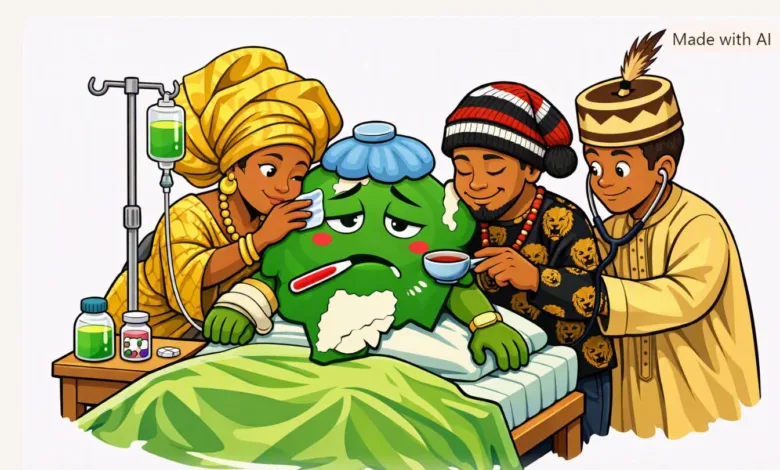
A doctor does not prove love by denying that a patient is sick. A parent does not help a child by celebrating every bad habit. Love becomes meaningful when it demands better.
Nigeria needs that kind of love.
Not sentimental nationalism.
Not contemptuous cynicism.
Something harder: honest attachment.
We can celebrate what works while demanding more. We can acknowledge progress without declaring the journey complete. We can criticise failure without declaring the country a failure.
Nigeria is neither the paradise of patriotic fantasy nor the wasteland of perpetual pessimism.
She is unfinished.
That word matters.
A country still building institutions is not necessarily doomed to dysfunction. A nation still wrestling with its contradictions is not incapable of resolving them. The question is whether each generation learns enough from the previous one to leave a stronger foundation.
We should therefore stop asking why Nigeria is not already somebody else.
The more useful question is: what must Nigeria become, and what are we prepared to build to get there?
That answer will not arrive in one administration or one election cycle.
Countries are built across generations.
One generation receives the baton, runs its distance and passes it on. Our responsibility is not to complete everything. It is to ensure that we do not hand the next generation a poorer country than the one we inherited.
So yes, I love Nigeria. With the potholes. With the bureaucracy. With the frustrations and contradictions. With the corruption we must defeat and the insecurity we must overcome. But also with the ingenuity that refuses to surrender, the music that survives hardship, the entrepreneur who starts again, the professional who keeps serving and the young Nigerian who still believes tomorrow can be better than today.
I love the Nigeria that is.
I believe in the Nigeria that can be.
And I will not apologise for either.
No country is perfect. Nigeria is no exception. Perfection is not the price of love.
The challenge is to love Nigeria honestly enough to confront her faults, intelligently enough to learn from others and patiently enough to build what generations before us could not.
I love Nigeria with all her faults.
And I make no apology for it.
- Ishola can be contacted at [email protected]