Nigeria’s headline inflation drops to 15.43% in July 2026, says NBS
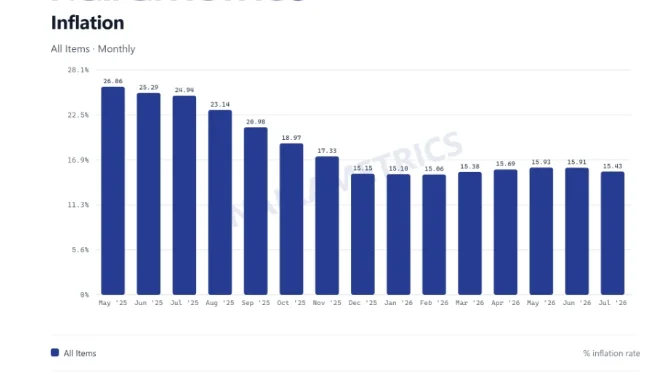
The National Bureau of Statistics (NBS) on Monday disclosed that Nigeria’s headline inflation rate declined further to 15.43per cent in July 2026, representing a 0.48 percentage-point decrease from the 15.91per cent recorded in June.
The NBS in its latest figure contained in the Consumer Price Index (CPI) report showed a significant decline from the 24.94per cent recorded in July 2025.
Despite the decline in the year-on-year inflation rate, the CPI increased to 145.3 points in July from 143.0 points in June, representing a 2.2-point increase during the month.
On a month-on-month basis, headline inflation stood at 1.57per cent in July 2026, down from 1.66per cent in June, indicating that the average price level increased at a slower rate during the month.




The July headline inflation rate was 15.43per cent, down 0.48 percentage points from 15.91per cent in June.
On a year-on-year basis, the rate was significantly lower than the 24.94per cent recorded in July 2025.
Monthly inflation declined to 1.57per cent in July from 1.66 per cent in June.
The CPI increased to 145.3 points in July from 143.0 points in June.
The figures indicate that the annual pace of price increases continued to moderate, although prices still increased during the month.
Urban inflation stood at 16.12per cent year-on-year in July 2026, while the month-on-month rate declined to 1.90per cent from 2.13per cent in June.
The July urban month-on-month rate declined by 0.23 percentage points from June.
The corresponding 12-month average urban inflation rate stood at 16.81per cent.
The 12-month average was 13.93 percentage points lower than the 30.74per cent recorded in July 2025.
The figures show that urban inflation remained above the national headline rate, although the annual rate continued to moderate.
The rural inflation rate stood at 13.77per cent year-on-year in July 2026, below the urban rate during the period.
Rural month-on-month inflation increased to 0.78per cent in July from 0.52per cent in June.
The July rate represented a 0.25 percentage-point increase from the previous month.
The corresponding 12-month average rural inflation rate stood at 16.72per cent.
This was 10.33 percentage points lower than the 27.05per cent recorded in July 2025.
The increase in rural month-on-month inflation contrasts with the decline recorded in the urban measure during the month.
On Food inflation, the report by NBS disclosed that it stood at 20.31per cent year-on-year in July 2026, down from 26.20per cent recorded in July 2025.
On a month-on-month basis, however, food inflation increased to 5.56per cent in July from 3.75per cent in June, representing a 1.82 percentage-point increase.
The increase was attributed to changes in the average prices of crayfish, fresh pepper, fresh onions, carrots, rice and water yam.
Other products cited included fresh tomatoes, garri, plantain, beef, eggs, guinea corn, ginger and plantain flour.
The average annual food inflation rate for the 12 months ending July 2026 stood at 16.06per cent.
This was 14.79 percentage points lower than the 30.85per cent recorded in July 2025.
The figures show that while annual food inflation continued to moderate, food prices recorded a faster monthly increase in July.
Core inflation, which excludes the prices of volatile agricultural produce and energy, stood at 14.97per cent year-on-year in July 2026.
The rate was lower than the 23.95per cent recorded in July 2025, while the month-on-month core inflation rate declined to 0.15per cent from 1.66per cent in June.
The 12-month average core inflation rate stood at 18.09per cent for the period ending July 2026, down 8.47 percentage points from the 26.56per cent recorded in July 2025.
Overall, the latest CPI figures show continued moderation in Nigeria’s annual headline, food and core inflation rates, although the monthly increase in food prices points to continued pressure in some food categories.