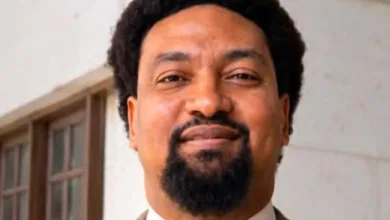
Rev. Jesse Jackson: Hero of hope — by Van Jones
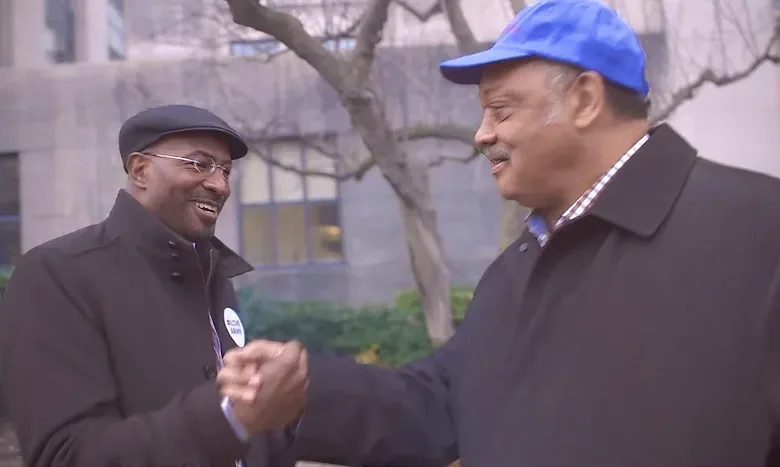
His “Rainbow Coalition” Was Blueprint For Obama
I saw my father cry only once. It was the summer of 1984. And he was listening to the Rev. Jesse Jackson.
It was a hot summer night. A dozen or so of my relatives were all packed into a modest hotel suite – the kind where a single door joined two separate rooms. I don’t know why we were all there. But all the kids were in one room, having fun and acting crazy.
The adults were in the other room – quiet and pensive. They were gathered around a TV set, anxiously waiting for Rev. Jackson to mount the global stage and address the Democratic National Convention.


It’s hard to imagine now, but in those days black people almost never got the opportunity to address the entire nation like that. So my parents, uncles and aunts were all desperately hoping he would “represent us well.”
Rev. Jackson’s unprecedented 1984 run for the presidency had electrified black America – and shocked the white establishment.
He had come up short, losing the nomination to Walter Mondale. But along the way, MLK’s protégé had become the nation’s most dynamic and charismatic figure – offering liberals a brilliant and colorful counterpoint to the unwelcome and intimidating figure of Ronald Reagan.
I decided to slip over and join the adults. My dad was sitting on a bed – casting his trademark scowl at the TV screen.
My father was a tough SOB who didn’t suffer fools. My dad had grown up poor in the segregated South. He joined the military to get out of crushing poverty in Memphis. He became a no-nonsense educator of disadvantaged students in my hometown of Jackson, Tennessee.
He was the least sentimental man I have ever known. He never cried – ever. No matter what. No matter who died. No matter how bad things got. Willie Anthony Jones was a rock. A brick. A stone.
Then Rev. Jackson walked out on that big stage. And within 10 minutes, he had my dad in tears.
When it was over, my dad was weeping – with his head in his hands.
Such was the power of Rev. Jackson. His singular ability to speak to the hopes, fears, pain and aspiration of his constituency was unmatched – then and now. He was able to convey to the wider world all of the dreams and aspirations of people like my dad – and somehow get 30,000 people of every color and hue to stand and cheer in rapturous ovation.
MLK’s ELOQUENCE x BERNIE’S POPULISM x ROCK STAR CHARISMA
I have never seen anything like it. Imagine the power of Bernie Sanders’ populist message. Now imagine that power exponentially multiplied by the transcendent eloquence of a Dr. King. Add to that a football player’s physique and rock star presence.
That combination would just begin to describe Rev. Jackson at the height of his powers. He was a peerless force of nature who rearranged the molecules in the air, just by walking into a room.
During his 1984 and 1988 runs, he invented and perfected the brand of inclusive politics that Democrats now take for granted. His “Rainbow Coalition” united blacks, Hispanics, women, gays, students, union members – all the people who were overlooked or underestimated in Reagan’s America.
As Rev. Jackson often said: “My constituency is the desperate, the damned, the disinherited, the disrespected and the despised”. He proved that real power was in the hands of the powerless – when a leader emerged who could move the masses.
MY FRIEND AND MENTOR
Soon after my father died in 2008, I got the chance to meet Rev. Jackson in person. It was a life-changing moment for me. He took me under his wing, personally mentoring me for more than 15 years.
After I left the Obama administration, he encouraged me – saying, “We are long-distance runners. We just keep on serving.”
He and I worked together to open up Silicon Valley to overlooked talent when I was running #YesWeCode.
The Reverend’s example of including everyone – from AIDS patients to family farmers – in his coalition encouraged me to keep my own heart open and my own arms wide.
He was of singular importance to me. And not just me.
It is impossible to overstate – and difficult to even to comprehend – the importance and power of Rev. Jackson in his prime. Today he is overshadowed by other figures. But for nearly half a century, Rev. Jackson was the United States’ most important black political figure.
After all, Dr. King died in 1968, and Obama was not elected until 2008. For black America, that was a long 40 years in the wilderness. Through those four difficult decades, the man who put the cause on his back and carried us through was Rev. Jackson.
BLUEPRINT FOR OBAMA 2008
Exactly 20 years after King’s death and 20 years before Obama’s triumph, Rev. Jackson led a presidential campaign that felt more like a spiritual revival than an electoral bid. Here was a black man lighting up the sky with an incandescent politics of possibility, telling a despairing nation to “keep hope alive.”
Sound familiar? In many ways, his 1988 campaign offered a roadmap for Obama’s successful run 20 years later – showing the enthusiasm that a dynamic black outsider could generate with a message about “hope” and change.
Most importantly: after his 1988 campaign, Rev. Jackson insisted that the DNC change its rules. He wanted – and won – a fairer, more proportional model to select party delegates.
Had the old rules applied to the 2008 campaign, Hillary Clinton likely would have been the Democratic Party’s nominee – not Barack Obama. But the post-Jackson rules made it possible for the next outsider to beat the establishment candidate and go on to win the presidency.
R.I.P. TO OUR LONG-DISTANCE RUNNER
In other words, Rev. Jackson unlocked the door. Then Obama forced it open and walked through. Without Rev. Jackson’s advocacy for a change of rules, Obama might have been stopped by the same system that blocked the Reverend’s rise.
The quest for justice, freedom and equal opportunity is a long one. It can’t be completed in one generation – or even one century.
It’s a relay race. And there was never a better “long distance runner” than the beloved Rev. Jesse Louis Jackson. My father – and millions of others like him – deeply appreciated him. So do I. May he rest in peace and power.