The rise and fall of parties: PDP and Nigeria’s democratic evolution, by Okoi Obono-Obla

Since Nigeria’s return to democratic rule in 1999, the political landscape has been marked by the rise and fall of parties that once seemed destined to dominate. Today, the People’s Democratic Party (PDP), which for years stood as the country’s most formidable political machine, faces a crisis that could well determine its survival.
For many advocates of democracy, the possible demise of the PDP would be painful. Yet, it would also serve as a hard but necessary lesson for other parties navigating Nigeria’s maturing democratic ecosystem. The turbulence within the PDP—marked by internal divisions, leadership struggles, and shifting allegiances—is not unique. It is part of the evolutionary process of democratic growth, where parties rise, falter, and sometimes collapse under the weight of their contradictions.
History offers a striking parallel. The defunct Alliance for Democracy (AD) emerged in 1999 as a powerful regional force in the South-West. Sweeping gubernatorial seats in Lagos, Oyo, Ogun, Ondo, Ekiti, and Osun States, AD also secured legislative dominance in the region. Its influence was so strong that it defeated the PDP’s presidential candidate, Chief Olusegun Obasanjo, in the South-West, even though Obasanjo went on to win the presidency nationally.
But AD’s success was short-lived. Internal power struggles and external political pressures weakened the party. By 2003, all its governors—except Asiwaju Bola Ahmed Tinubu—lost their re-election bids. That defeat triggered a crisis from which AD never recovered. A faction broke away to form the Action Congress, which later evolved into the Action Congress of Nigeria (ACN). In 2013, the ACN merged with other parties to form the All Progressives Congress (APC), now Nigeria’s ruling party.


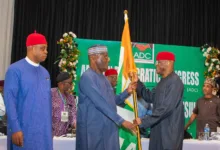

The PDP’s current predicament raises the question: could it suffer a similar fate? The answer lies in how it manages its internal contradictions. If the party fails to reconcile its factions and reinvent itself, it risks sliding into irrelevance, much like AD did two decades ago. Yet, if it learns from history, it could still reposition itself as a credible alternative in Nigeria’s competitive political space.
Ultimately, the story of Nigeria’s democracy is one of constant evolution. Parties rise like phoenixes, dominate for a time, and sometimes collapse under the weight of their own crises. The PDP’s trajectory—whether toward renewal or decline—will be another chapter in this unfolding narrative.
Conclusion: The fate of the PDP is not just about one party; it is about the resilience of Nigeria’s democratic experiment. Whether it survives or fades, its journey will serve as a reminder that democracy is not static but a living system, shaped by the successes and failures of its actors.
-Obono-Obla is a lawyer and former Presidential aide