Ukrainian mid-range strikes deal double blow to Russia’s war effort
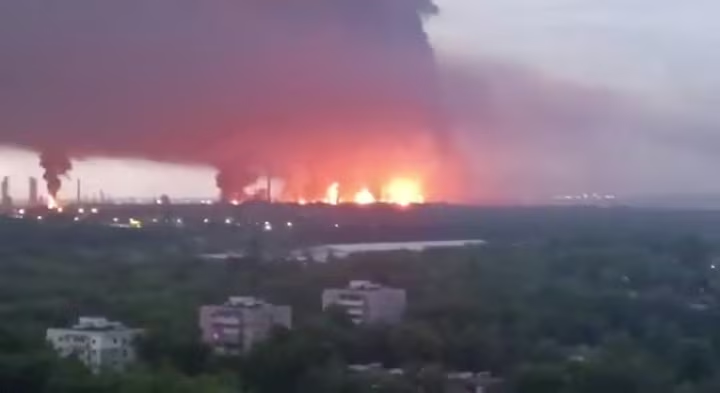
From burning oil refineries to a stalling ground offensive, Russia is suffering problems in its war against Ukraine that partly stem from a growing Ukrainian military strength: the use of medium-range drone attacks.
By targeting Russian air defences and logistics dozens of kilometres behind front lines, Ukraine is disrupting Russia’s battlefield advances and opening the way for long-range strikes on Russian oil and military facilities, said two Ukrainian commanders, two drone specialists and three military analysts.
Ukrainian officials say more resources have in recent months been poured into “middle strikes”, typically ranging between 30 km and 180 km behind front lines.
This has enabled Ukraine to strike Russian radars, short- and medium-range air defences, communications infrastructure, logistics and large military vehicles at “operational depth”, the sources said.


Long-range attack drones can now slip through defences more easily to hit Russian oil facilities far behind front lines, said Robert Brovdi, commander of Ukraine’s Unmanned Systems Forces.
“The role of middle strikes is currently decisive,” Brovdi told Reuters in a voice message, referring to strikes of up to 2,000 km.
Defence analysts say such attacks alone cannot turn the tide against Russia but that they are having an important impact and the dynamics of the war may be shifting.
In the last few months, Ukrainian long-range drone attacks have caused the most extensive damage to Russian oil infrastructure since Moscow’s 2022 invasion.
Last month, Russia reduced oil output because of drone attacks on ports and refineries, and crude oil supplies via Russia’s only remaining oil pipeline to Europe were halted, Reuters reported.
The attacks have lifted morale in Ukraine after a winter of Russian attacks on its power network and Russia’s rate of battlefield advances is at its slowest since 2023.
President Volodymyr Zelenskiy said this month the number of Ukrainian “middle strikes” had doubled compared to March, and quadrupled since February.
“Kusto”, a field commander in the 7th battalion of Brovdi’s 414th Separate Unmanned Systems Brigade, said Ukraine’s middle-strike capabilities had grown significantly since the autumn.
“We have scaled up, increased the number of crews, and expanded the number of systems in use. There is also greater diversity in the available platforms,” he told Reuters in written remarks.
Kusto said his unit focused mainly on targets up to 100 km from the line of contact. He said Russian radar installations and air-defence systems such as the Buk, Tor and Pantsir were the highest-value targets, alongside large vehicles and logistics infrastructure.
Ukraine has carried out multiple strikes on oil facilities in the Russian Black Sea port city of Tuapse, while Brovdi said his forces had also struck the Ryazan oil refinery, one of Russia’s largest.
Analysts say the strikes are forcing Russia to disperse air defences away from front lines, making it easier for Ukraine to target fuel depots, supply vehicles, command points and ammunition storage sites.
The U.S.-based Institute for the Study of War said Russia’s battlefield advances had slowed since October, partly because of the mid-range strikes, as well as local fortifications and terrain challenges in the Donbas region.
Military analysts also noted that Ukraine’s rapid expansion of its mid-range drone capability reflected efforts to compensate for shortages in manpower and weapons while reducing dependence on foreign military supplies.
Emil Kastehelmi, of the Finland-based Black Bird conflict analysis group, said the attacks may not reverse the course of the war entirely but were creating increasing pressure on Russian forces.
“And I don’t think we’ve seen the pinnacle of it yet,” he said.
Credit: Reuters