The last of the Awoists: The life and times of Pa Reuben Fasoranti — by Kazeem Tiamiyu
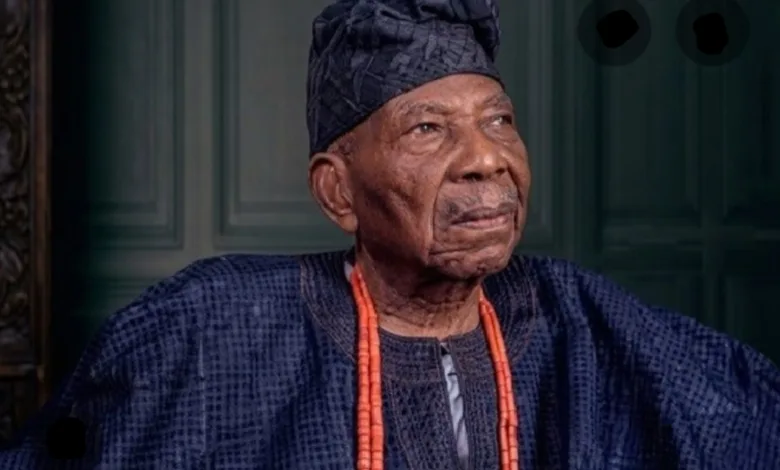
When a 100-year-old man dies, they say an archive burns. When Pa Reuben Fasoranti died on Tuesday, what burned was not just an archive, but the last bridge linking the Action Group classroom to the Afenifere living room.
The call came from Akure. It was short, solemn and final. Ondo State Governor, Lucky Aiyedatiwa, in a personally signed statement on Tuesday, October 20, 2026, announced that Pa Reuben Famuyide Fasoranti, the leader of the pan-Yoruba socio-cultural organisation, Afenifere, had gone to join his ancestors. He was 100.
In Uso, his birthplace, in Akure where he made his home, and in every corner where Awo’s name still evokes nostalgia, the reaction was the same: The last schoolmaster has dropped his chalk.
THE VILLAGE BOY WHO LOVED BOOKS

Fasoranti never forgot his beginning. In an interview in 2020 at 94, he introduced himself simply as “a village boy”.
He was born on May 11, 1926, in Uso, a small farming settlement in the Owo axis of present-day Ondo State. His grandfather had left Akure after failing to secure a chieftaincy title and trekked to settle in Uso. His father later moved to Ayede-Ogbese. That rootlessness would later define Fasoranti’s belief in education as the only true settlement.
He spent his first three years in a village school before his father, determined that the boy would not end up with a hoe, sent him to Owo for better education. From Owo he proceeded to Ondo Boys High School, one of the finest secondary schools in Western Nigeria then.
The village boy’s hunger for books took him to Yaba Higher College in Lagos and then to University College, Ibadan, where he studied English and Geography. He would later obtain a postgraduate diploma in Education from the University of Hull, United Kingdom and a Master’s in Education Administration from Macquarie University, Australia – a rare feat for his generation.
THE SCHOOLMASTER
If politics gave Fasoranti fame, education gave him life.
He was first and foremost a teacher. For decades, he stood in front of chalkboards. He taught at Oyemekun Grammar School, Iju-Itaogbolu Grammar School and Christ’s School, Ado-Ekiti where he served as Principal and was feared and revered in equal measure for his discipline and his Oxford English.
He believed government alone could not educate a people. So he founded schools – Omolere Nursery School and Akure High School – which to date have produced generations of Ondo professionals.
“He taught us that a man who does not read has no right to lead,” a former student of Christ’s School said yesterday.
CONVERTED TO AWOISM
Every great Yoruba man of Fasoranti’s generation had a Damascus moment, and his was meeting Chief Obafemi Awolowo.
Fasoranti was not born into the Awolowo political family; he was converted. As a young teacher in the 1950s, he was drawn to the Action Group’s ideology: free education, free healthcare, rural development and democratic socialism. While others joined politics for contracts, Fasoranti joined for conviction.
He followed Awolowo faithfully through the storms – from the Action Group in the First Republic, through the treasonable felony trial of 1963, through the civil war, to the Unity Party of Nigeria (UPN) in the Second Republic. He was not a loud man on the podium, but he was a trusted foot-soldier who kept the progressive family together in the North.
That loyalty was rewarded when the UPN won Ondo State in 1979. Governor Michael Adekunle Ajasin, himself a staunch Awoist, appointed Fasoranti as Commissioner for Finance from 1979 to 1983. In that role, he managed the resources that funded Ajasin’s free education and free health programmes – the purest implementation of Awoism outside the old Western Region.
FROM CLASSROOM TO TRENCHES: THE JUNE 12 YEARS
When the military annulled the June 12, 1993 presidential election won by Chief M.K.O. Abiola, Fasoranti, already in his late 60s and retired, could have stayed in his farm in Akure.
He chose the trenches.
He joined the National Democratic Coalition (NADECO) and Afenifere leaders who defied the Abacha dictatorship. It was a dangerous choice. Many of his friends – Chief Abraham Adesanya, Chief Bola Ige, Chief Ayo Adebanjo – were detained, harassed or forced into exile. Fasoranti remained in Nigeria, offering his modest house in Akure as a meeting point for pro-democracy activists in the South-West.
That sacrifice cemented his relationship with two men history will forever link him to.
HIS BROTHERS: BOLA IGE AND THE REST
His relationship with Chief Bola Ige, the Cicero of Esa-Oke, was that of brothers from different mothers. Ige, the brilliant orator, Attorney-General and later Governor of old Oyo State, was the fire; Fasoranti was the calm. Both were schoolmasters, both UPN men, both disciples of Awo. When Ige was assassinated in December 2001, Fasoranti wept openly and said “a library has been set ablaze.”
With Chief Abraham Adesanya, who led Afenifere after Awo’s death, Fasoranti shared a father-son relationship. With Chief Ayo Adebanjo, who was his deputy and later became factional leader, his relationship was more complex – one of mutual respect but ideological differences on how to handle Afenifere’s relationship with the Federal Government, especially in the later years.
With Ajasin, his boss and mentor, it was loyalty till death. With Papa Awolowo himself, it was that of a disciple who never questioned the master.
“He never met Awo without carrying a notebook,” a family source said. “He said Awo’s words were syllabus.”
LEADER OF AFENIFERE
When Pa Abraham Adesanya died in 2008, the question of who would lead Afenifere – the organization that sees itself as custodian of Awo’s legacy – was settled with Fasoranti’s emergence in Akure.
He led Afenifere through one of its most turbulent periods. Under him, Afenifere became more vocal on restructuring, devolution of powers, true federalism and security – especially after the killing of his daughter, Mrs. Funke Olakunrin, by suspected kidnappers on the Benin-Ore road in July 2019. That tragedy turned the old man, who had preached non-violence, into a fierce advocate for state police.
Under him, Afenifere split into factions – one led by himself in Akure and another by Chief Ayo Adebanjo in Lagos – reflecting the wider division in Yoruba politics over support for candidates at presidential elections. Yet, till his death, both sides respected him as the moral authority.
In his last years, even when age confined him to a chair in his Akure home, politicians trooped to him. Presidents, governors, presidential candidates – all came to seek his blessing. In February 2023, Asiwaju Bola Tinubu, then APC candidate, visited him in Akure for endorsement, a moment that showed his influence beyond party lines.
THE FINAL BELL
Pa Fasoranti lived through it all – colonial rule, independence in 1960, First Republic collapse, military coups, civil war, Second Republic, June 12 crisis, return to democracy in 1999, and 26 years of uninterrupted civil rule. He saw his daughter murdered, saw Afenifere factionalised, saw Nigeria turn 65.
He died at 100, a centenarian who proved that ideology can be a long-life drug.
Governor Aiyedatiwa said yesterday: “His counsel, fatherly guidance and principled positions on justice and good governance will be sorely missed.”
He is survived by children, grandchildren and great-grandchildren.
The last schoolmaster has dropped his chalk. The class of Awoists who learnt directly from Awolowo’s mouth is now empty. The question for Yorubaland is not just who will lead Afenifere next, but who will teach the next generation what Awoism truly meant.
As the bell tolls in Akure High School this morning, it tolls for the man who founded it.
May the soul of the village boy who became the conscience of a race rest in peace.