Lula wins fourth term as Brazil president after historic upset over far-right Flávio Bolsonaro
Leftist incumbent Lula says unprecedented comeback was a ‘defeat for denialism’ as Bolsonaro refuses to accept election result
Luiz Inácio Lula da Silva, the Brazilian president, has staged a dramatic election fightback, defeating his far-right opponent, Flávio Bolsonaro, to claim a historic fourth term in power.
With 100% of votes counted, the 80-year-old leftist received 4.4 million more votes than Bolsonaro, securing 51.79% of the vote against his 45-year-old rival’s 48.21%. However, soon after Brazil’s electoral authority confirmed Lula’s victory, Bolsonaro refused to concede defeat and called for the results to be annulled.
Lula narrowly lost the first round of the election to Bolsonaro in early October, casting his political future into doubt and plunging progressive Brazilians into three weeks of despair. Never, since the return of democracy in the 1980s, has the first-round runner-up won the second vote.
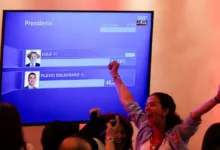
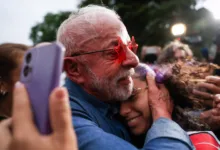
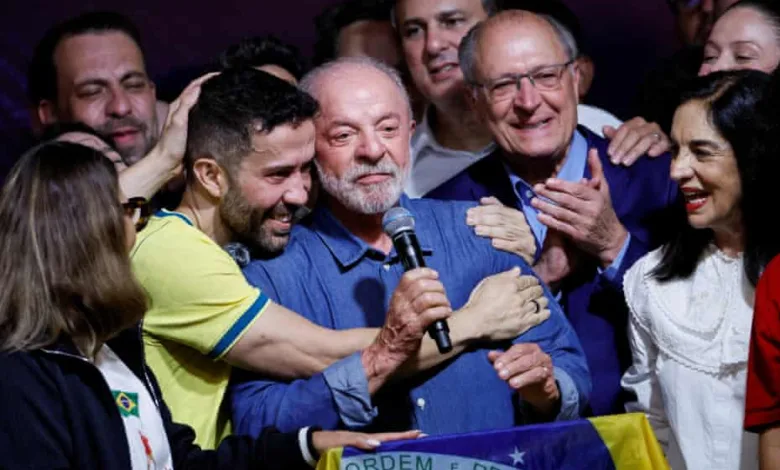
But Lula did precisely that on Sunday, prompting joyous scenes on the streets of São Paulo, where he had been following events, and at the hotel where he was watching the count.
Addressing a packed crowd of ecstatic supporters in a São Paulo conference hall, Lula said: “We are going to change the way that this country is governed … This election was a defeat for denialism … I want to thank God and to thank you, Brazilian men and women of this country … it was democracy that made this happen.”
After the result was confirmed, Alexandre Padilha, Lula’s health minister, said: “This is a huge victory for the Brazilian people who in the second round had the chance to think about what President Lula means for the environment, for the defence of our national health service and our education system and the Brazilian constitution. And the risks that the extreme right candidate entailed.”
“It’s a massive victory – not just for Brazil. It’s also an important signal to the rest of Latin America and to the world,” Padilha added.
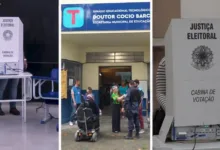
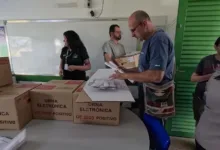
The 80-year-old appears to have made up much of the difference through what his allies had identified as his main opportunity: persuading his voters to turn out. After a record abstention rate of 21.08% in the first round, which disproportionately affected Lula voters because they tend to live further from polling stations, the rate fell to 19.21%.
Speaking during Lula’s victory speech, Bolsonaro said it was “impossible to concede the election result” and that his legal team would seek to have the election annulled.
Following in the footsteps of his father, former president Jair Bolsonaro, who four years ago also refused to acknowledge his defeat to Lula before attempting a coup and being convicted for it, the senator cited a Supreme Court justice’s decision to extend voting hours as the alleged reason.
His speech made no mention of the fact that his campaign had also asked the electoral court to extend voting hours. Nevertheless, he said Justice Cristiano Zanin’s decision to extend voting by two hours to 7pm “was not normal, it was unacceptable” and amounted to “changing the rules of the game while the game was being played”.
For Lula, who turns 81 on Tuesday, the victory represents a sensational final chapter in a storied political career that began when he emerged as a union leader in São Paulo’s industrial suburbs in the late 1970s.
After entering politics, the former factory worker, who was born into rural poverty, made three unsuccessful presidential bids in 1989, 1994 and 1998 before finally becoming Brazil’s first elected working-class president in 2002.
Lula stepped down after serving the maximum two consecutive terms allowed by the constitution but returned to power after winning the 2022 election against Bolsonaro’s father, then-incumbent president Jair Bolsonaro, who was subsequently jailed for plotting a coup.
Lula’s win is bad news for Jair Bolsonaro, who is serving a 27-year sentence for the failed power grab and had hoped to be freed and given a role in government if his son had prevailed.
It is also a blow for Donald Trump, the Bolsonaro clan’s most important international ally. The US president had hoped Bolsonaro would become the latest in a series of pro-Trump leaders to take power in Latin America, including Abelardo de la Espriella in Colombia, Daniel Noboa in Ecuador, José Antonio Kast in Chile and Javier Milei in Argentina.
Confirmation of Lula’s victory was greeted with anger and bewilderment in Brasília, where Bolsonaro is living under house arrest and where his son watched the vote count.
On Sunday night, political leaders applauded Lula. Mexican President Claudia Sheinbaum said: “Long live democracy, the people of Brazil won. Congratulations, President Lula!” Paraguayan President Santiago Peña said he saluted the Brazilian people for their “great democratic journey”.
Lula’s victory came after his supporters staged two massive shows of support on Saturday, with more than a million people flocking to Rio’s Copacabana beach and an even larger number marching on Paulista Avenue.
Many people on the streets of São Paulo were angry at an apparent attempt by pro-Bolsonaro politicians to derail the election by sabotaging public transport in Lula-leaning voting areas across the country.
“I think it’s another coup attempt that the extreme right is trying in Brazil. But we need to really fight so we can win,” said Lucas Lopes, a 32-year-old from São Paulo who works in public relations.
But the alleged attempt to scupper a Lula victory failed.
“I’ll be sincere: in the first round the left failed. But in the second round they woke up,” said Caio Marques, a 40-year-old photographer from Franca, a city in the interior of São Paulo state. “And there is no coup that will take this away from us.”
“I feel so, so happy … There’s not enough room in my chest for all this joy. Lula’s victory represents so much. It means life for those who believe in love and in life,” said Maicon Douglas Bento, a 34-year-old photographer, as he joined tens of thousands of jubilant Brazilians on Paulista Avenue in the heart of São Paulo.
Credit: The Guardian