Bagudu seeks stronger Nigeria-Germany ties to achieve $1trn economy target
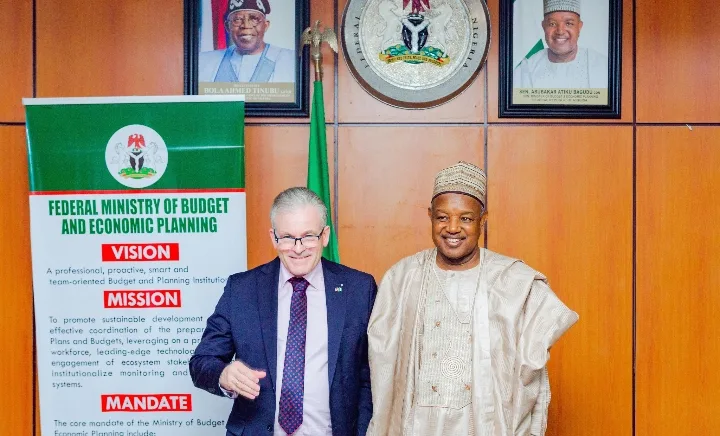
Minister of Budget and Economic Planning, Senator Abubakar Bagudu, has called for a result-driven partnership between Nigeria and Germany to help the country realise its $1 trillion economy target by 2030.
Bagudu made the call in Abuja on Wednesday when he received a high-level delegation from the Giessen Chamber of Commerce and Industry (IHK Giessen-Friedberg) of Germany, led by its Chief Executive Officer, Mr. Matthias Leder.
The meeting, held under President Bola Tinubu’s Renewed Hope Agenda, focused on strengthening collaboration in trade, investment, vocational training, and legal labour migration — all identified as key drivers of Nigeria’s growth ambitions.
Bagudu stressed the need for practical cooperation that delivers measurable results rather than routine diplomatic exchanges.

“We are committed to shifting from process to progress — from meetings to measurable results,” the minister said. “What matters most to this administration is impact. Partnerships must translate into jobs, enterprise growth, and tangible development outcomes for Nigerians.”

He commended the German delegation for its commitment to deepening ties with Nigeria, noting that Germany’s expertise in vocational education and industrial innovation aligns with Nigeria’s drive for inclusive and sustainable growth.
According to him, the Tinubu administration’s approach to international cooperation is rooted in reciprocity and mutual benefit, not aid or charity.
“Our partnerships must be mutually beneficial, rooted in shared accountability and strategic results,” he added. “The Federal Ministry of Budget and Economic Planning regards these engagements as a means to turn the National Development Plan into tangible, measurable outcomes.”
Bagudu further highlighted that structured and legal migration forms part of the government’s broader strategy to convert Nigeria’s youthful population into economic assets.
“We must transform Nigeria’s youthful population into productive capital,” he said. “Through initiatives like this, we are not just exporting labour — we are exporting skill, knowledge, and global competitiveness.”
He revealed that the forthcoming 2026–2030 National Development Plan would formalise such international partnerships to drive human capital development, trade facilitation, and innovation-led growth.
“We are deliberate about where we are going as a nation,” Bagudu stated. “Our goal is to make Nigeria a hub for talent, productivity, and responsible global collaboration. That is the spirit of President Asiwaju Bola Ahmed Tinubu’s Renewed Hope Agenda.”
In his remarks, Mr. Matthias Leder of IHK Giessen-Friedberg thanked the Nigerian government for its engagement and expressed readiness to expand cooperation in enterprise development and structured migration.
He also invited Bagudu to deliver the African Keynote Address at The World Meets in Giessen conference in June 2026, a global business platform that attracts participants from various countries.
The ministry’s Acting Permanent Secretary and Director of International Cooperation, Dr. Samson Ebimaro, reaffirmed the ministry’s commitment to building partnerships that yield tangible results.
“While processes are important, results matter even more,” Ebimaro said. “Our focus is to strengthen systems, build local capacity, and ensure that every engagement leaves a measurable footprint on national development.”