Iran sees ‘false flag’ operations after UK blames IRGC for airbase incident
Iran’s Ministry of Foreign Affairs has condemned the United Kingdom’s attribution of an alleged plot near a military airbase in Fairford to the Islamic Revolutionary Guard Corps (IRGC), describing the accusation as part of a broader Western effort against Tehran.
British Prime Minister Andy Burnham told Parliament on Monday that a suspected plot last month against the Royal Air Force base was “highly likely to have been coordinated in Iran” and “almost certainly directed by Iran’s Islamic Revolutionary Guard”.
Burnham promised action against what he described as Iran-linked criminal networks and their financing networks. The UK also announced sanctions against two Iranian nationals over alleged hostile activity linked to RAF Fairford in southern England.
The move followed an incident near the base in the early hours of September 27, when five British men in their 20s were arrested on suspicion of terrorism and explosives-related offences. The men were not charged and were released on police bail. Two other men were also arrested and later released.

Details surrounding the suspected security threat and the events near RAF Fairford remain unclear.
In a statement issued late Monday, Iran’s Foreign Ministry described Britain’s claims of Iranian involvement as “an ugly plot” intended to evade accountability for the UK’s participation in the war against Iran, which began on February 28.
The ministry said Britain had failed to provide sufficient evidence to support its allegations, dismissing them as a “clumsy false flag operation”.
“Britain’s track record of fabricating security claims against other countries, which have in some cases led to damaging tensions and conflicts in West Asia, is well known,” the ministry said.
British Home Secretary Shabana Mahmood said investigators believed the suspected coordinator was a known individual based in Iran. However, she did not identify the person or disclose the communications, financial records or intelligence supporting the assessment.
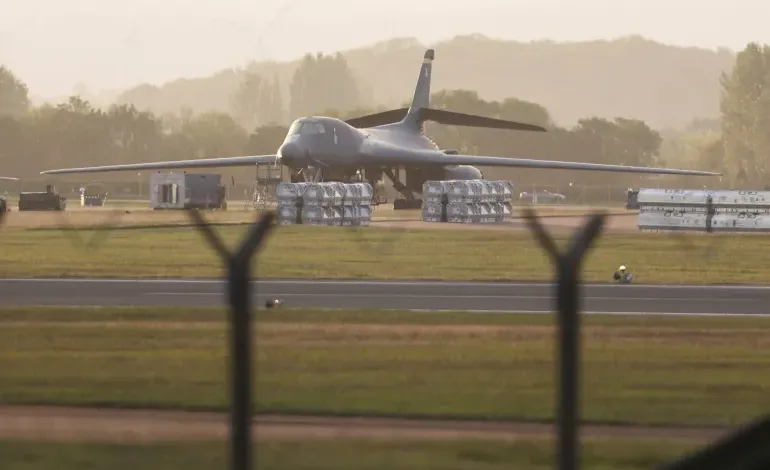
RAF Fairford is a prominent base for United States military aircraft that have participated in the war against Iran. The conflict began on February 28 following US and Israeli strikes that killed several Iranian leaders and officials, including Supreme Leader Ayatollah Ali Khamenei.
Following the incident, the United States withdrew approximately a dozen B-1 bombers from the base. US media reports, citing unnamed sources, said intelligence suggested the aircraft could be vulnerable to small drone attacks.
Israeli Prime Minister Benjamin Netanyahu claimed in early October that his government had warned Britain about the alleged plot.
“We gave the Brits the intel that there was going to be an attack, and it’s an Iranian-sponsored attack, and pretty much the next day they slapped sanctions on us,” Netanyahu said in an interview with US broadcaster Fox News.
Netanyahu made the remarks while criticising British measures in response to the expansion of Israeli settlements in the occupied West Bank, amid a diplomatic dispute between the two countries.
Earlier this month, Tehran linked the Fairford incident to allegations surrounding an attack involving a Flydubai aircraft cockpit. Authorities in the United Arab Emirates had described that incident as a suspected suicide mission intended to crash the plane at Israel’s Ben Gurion Airport in Tel Aviv.
Iranian Foreign Ministry spokesman Esmaeil Baghaei questioned the credibility of the alleged aircraft plot, describing it as amateurishly designed. He argued that such incidents were being manufactured to assign blame and justify a war facing public opposition in the United States and elsewhere.
Iran’s official news agency, IRNA, also argued that a Western-led vote at the board of governors of the International Atomic Energy Agency to refer Iran’s nuclear programme to the United Nations Security Council represented another attempt to pressure Tehran into accepting US demands.
The agency further said recent reports attributing responsibility for the Houthis’ battlefield advances in Yemen to Iran suggested a broader effort to portray Tehran as a major source of regional and global insecurity.
“The series of suspicious incidents recently, which have been attributed to Iran by the US president and senior officials without offering any evidence, appear to be a coordinated wave to smear Iran,” IRNA said.
Despite Iran’s denials, British authorities have proceeded with measures against the country. Foreign Secretary Ed Miliband summoned Iran’s ambassador and sanctioned two individuals, one identified as an IRGC counterespionage chief and another described as a facilitator for a criminal network. The measures include asset freezes and travel bans, although neither individual was explicitly identified as an organiser of the Fairford incident.
The UK government designated the IRGC as a terrorist organisation in July.
On Friday, Britain joined 31 other countries, including Australia, Canada, France, Germany and the United States, in condemning what they described as Iran’s use of violent attacks, including lethal plots, arson, sabotage, cyberattacks and other hostile activities against their countries and partners.
“We recognise the United Kingdom’s attribution of Iran’s involvement in the incident at RAF Fairford on 27 September,” the countries said in a joint statement, adding that the incident demonstrated the IRGC’s continued willingness to conduct hostile activities beyond Iran’s borders through covert networks and proxy actors.
Credit: Aljazeera