Iran’s allied militias prove their value in Tehran’s widening war
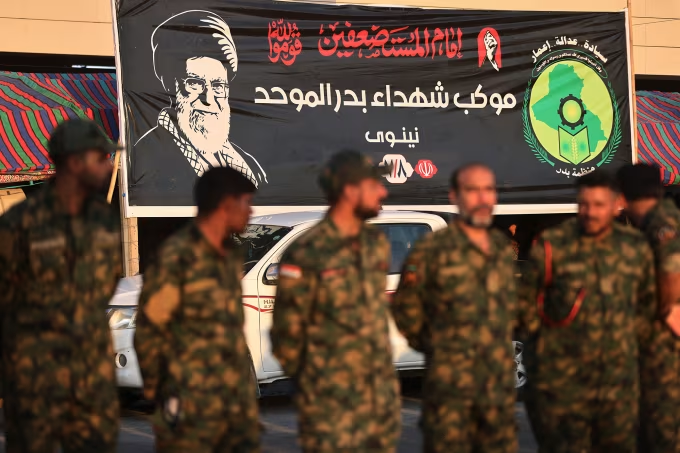
After three difficult years, armed groups allied with Tehran appear to be regaining strength across the Middle East, reinforcing Iran’s leverage in its conflict with the United States and Israel.
For decades, analysts say, these groups served as a powerful deterrent against direct attacks on Iran. The so-called “Axis of Resistance” — an anti-Israel and anti-Western alliance of regional militias backed by Tehran — was significantly weakened by Israel’s military response to the 2023 Hamas attack and the regional fallout that followed.
It was during this period of weakened influence that direct conflict between Iran, Israel and the United States erupted. Today, however, several of Tehran’s allies have resumed operations, opening new fronts that complicate the conflict and threaten global trade and energy supplies.
“The Axis worked very well for more than two decades, helping ensure there was no attack on Iran while these groups extended their influence within their own territories,” Trita Parsi, executive vice president of the Quincy Institute for Responsible Statecraft, told CNN. “Once they were weakened, Iran paid the price by having both the US and Israel attack it.”


According to Parsi, Iran has responded by reinvesting in its long-standing strategy of forward defence rather than abandoning it.
Israel’s campaign against Iran’s allies
Since the 1979 Islamic Revolution, Tehran has sought to expand its influence by supporting allied groups across Lebanon, Yemen, Iraq, Syria and Gaza.
Following the 2023 Hamas attack, Israel intensified military operations against these groups, killing several key figures, including Hamas leader Yahya Sinwar and Hezbollah chief Hassan Nasrallah. Israel also stepped up attacks on Iran-backed militias in Iraq, exchanged fire with Yemen’s Houthis and targeted senior Iranian leaders, including former Supreme Leader Ayatollah Ali Khamenei, in an effort to weaken Tehran’s leadership.
Three years later, analysts say Iran’s regional allies have adapted to the changing battlefield and are once again playing an active role.
“The Axis of Resistance is still alive,” Danny Citrinowicz, former head of the Iran branch of Israeli military intelligence, told CNN. “It is not disappearing, but it is changing.”
Shared interests beyond Tehran
Experts say the groups aligned with Iran are motivated not only by Tehran’s objectives but also by their own political and strategic interests.
“Iran’s relationship with these groups is more complex than simply calling them proxies,” Ali Ahmadi of the Geneva Centre for Security Policy and the Middle East Institute Switzerland told CNN.
He said the organisations have distinct identities and priorities but remain closely tied to Iran through shared ideological and geopolitical interests. Among them, Yemen’s Houthi movement is considered the most independent.
Houthis reopen a regional front
In recent days, the Houthis have intensified attacks against Saudi Arabia, a key US ally.
The group accused Saudi Arabia of striking Sanaa airport to prevent a plane carrying senior Houthi officials from returning from the funeral of Ayatollah Ali Khamenei in Iran. Saudi-backed Yemeni authorities said government forces carried out the strike.
The Houthis also fired missiles at two Saudi oil facilities on the Red Sea coast, with satellite imagery indicating extensive damage to one installation near Jazan. The attacks followed strikes on two Saudi tankers after the group declared a blockade on Saudi shipping through the Bab al-Mandeb Strait.
Analysts at the Middle East Institute said the actions reflected increasingly coordinated efforts by the Axis of Resistance to strengthen Iran’s regional influence while advancing the interests of its allies.
Iran reaffirms support for Hezbollah
Iran has also linked an end to Israeli attacks in southern Lebanon to its discussions with the United States, highlighting Hezbollah’s continued importance in Tehran’s regional strategy.
Over the weekend, Iran’s new Supreme Leader, Mojtaba Khamenei, reaffirmed support for Hezbollah in a letter to the group’s leader, Naim Qassem, describing the Lebanese movement as central to Iran’s resistance against Israel.
Analysts say the renewed activity of Iran’s regional allies suggests the Axis of Resistance has adapted rather than collapsed.
“The axis is not going anywhere,” Citrinowicz said.
Credit: CNN