UPDATED: Tinubu approves immediate six-month ban on raw shea nut exports to strengthen local industry
By Kunle Sanni –
President Bola Tinubu has ordered an immediate six-month suspension of raw shea nut exports to strengthen Nigeria’s domestic processing industry, curb informal trade, and increase earnings from the global shea market.
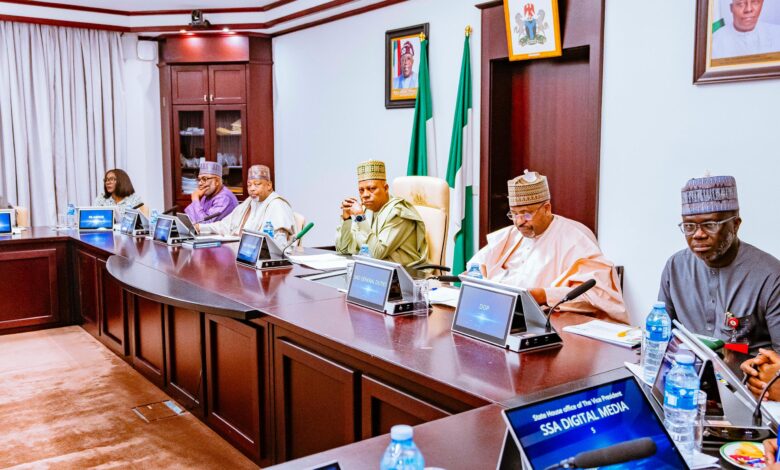
Vice President Kashim Shettima, who announced the directive on Tuesday during a multi-stakeholder meeting at the Presidential Villa, Abuja, said the policy is expected to generate at least $300 million annually in the short term and create a pathway for a tenfold increase by 2027.
Shettima stressed that the ban is not an anti-trade measure but a “pro-value addition policy” designed to secure raw materials for local processors, boost rural incomes, create jobs, and position Nigeria as a major global supplier of refined shea butter, oil, and other derivatives.




“Nigeria produces nearly 40% of the world’s shea nuts, yet we account for only 1% of the $6.5 billion global market. This is unacceptable,” Shettima said, adding that the directive was jointly taken by the Federal Government and subnational authorities. He further revealed that Nigeria and Brazil have agreed to prioritize access for Nigerian shea products into the Brazilian market within the next three months.

Minister of Agriculture and Food Security, Senator Abubakar Kyari, explained that Nigeria produces an estimated 350,000 metric tonnes of shea annually across 30 states, with the potential to reach 900,000 metric tonnes. However, over 90,000 metric tonnes are lost each year to informal cross-border trade, leaving local processors operating at only 35–50% of capacity despite a national installed capacity of 160,000 metric tonnes.
Kyari noted that neighboring countries such as Ghana, Burkina Faso, Mali, and Togo have already restricted raw shea exports to protect their industries, while Nigeria has remained vulnerable to unregulated buying. He said the ban would stabilize domestic supply, allow processors to operate at full capacity, and position Nigeria to capture a larger share of the projected $9 billion global shea market by 2030.
He further highlighted the policy’s gender impact, noting that 90% of shea pickers and processors are women. “By protecting the shea industry, we are protecting livelihoods, dignity, and opportunity for millions of our women,” he said.
The presidential directive followed a rapid assessment of the shea value chain by the Presidential Food Systems Coordination Unit (PFSCU), the Federal Ministry of Industry, Trade and Investment, and the Federal Ministry of Agriculture and Food Security. The study confirmed that Nigeria’s dominant role as a producer has not translated into economic gains due to unchecked informal exports and underutilized local processing capacity.