President Tinubu calls for ECOWAS to implement anti-corruption protocol
By Kunle Sanni
President Bola Tinubu of Nigeria has urged member countries of the Economic Community of West African States (ECOWAS) to ratify and fully implement the ECOWAS Protocol against Corruption. Stressing the urgency of the matter, President Tinubu emphasized that the region’s future hinges on its ability to establish governance structures that are transparent, accountable, and efficient, serving the interests of the people.
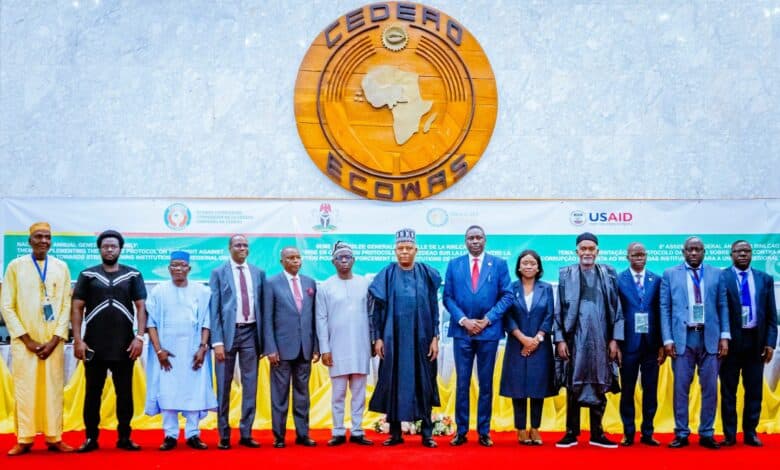
Speaking on Monday during the 6th Annual General Assembly of the Network of National Anti-Corruption Institutions in West Africa (NACIWA) at the ECOWAS Secretariat in Abuja, President Tinubu, represented by Vice President Kashim Shettima, reiterated the importance of the protocol. He also announced Nigeria’s donation of a building for NACIWA’s permanent headquarters, underscoring Nigeria’s commitment to strengthening the institution’s capacity.

“In recognition of NACIWA’s pivotal role in our regional anti-corruption efforts, I am proud to announce that the Nigerian government has donated a property to serve as NACIWA’s permanent headquarters,” President Tinubu stated. “This gesture underscores our commitment to strengthening NACIWA’s institutional capacity and providing a solid operational foundation. As we deliberate on implementing the ECOWAS Protocol against Corruption, I urge all member states to renew their commitment to this cause.”

The ECOWAS Chairman called for member countries to go beyond rhetoric and take concrete actions, such as harmonizing legal frameworks to close loopholes exploited by corrupt individuals. He emphasized the need for enhanced cross-border cooperation in investigations and asset recovery, investment in innovative technologies to detect and prevent corruption, and greater transparency in public procurement and resource management. President Tinubu also highlighted the importance of engaging civil society and the media as partners in the region’s anti-corruption efforts and strengthening the independence and capacity of national anti-corruption institutions.
“The task before us is enormous, but our collective resolve is strong,” President Tinubu remarked. “By working together, sharing best practices, and leveraging our diverse strengths, we can create a formidable bulwark against corruption in West Africa. All member states must ratify and fully implement the ECOWAS Protocol against Corruption. Let us move from commitment to action, from intention to implementation. The future of our region depends on our ability to create transparent, accountable, and efficient governance structures that serve the interests of our people.”

President Tinubu also warned of the dangers posed by corruption, describing it as “one of the most significant obstacles to the progress and prosperity of our nations.” He added, “Corruption undermines the very fabric of our societies, erodes public trust, and impedes the equitable distribution of resources. As leaders, we are responsible for confronting this challenge head-on with unwavering resolve and concerted action.”
Reflecting on his administration’s anti-corruption efforts since assuming office, the Nigerian leader highlighted his commitment to strengthening anti-corruption agencies by ensuring their independence and adequate funding. “I have encouraged them to operate within the ambit of the law. This is a template I recommend to other states within the region,” he noted.
President Tinubu reaffirmed Nigeria’s unwavering commitment to NACIWA’s success and the broader anti-corruption agenda within ECOWAS, expressing confidence that working together will enable member countries to “build stronger institutions, foster regional unity, and pave the way for a prosperous and corruption-free West Africa.”
Nigeria’s Minister of Foreign Affairs, Ambassador Yusuf Tuggar, also addressed the assembly, highlighting the urgent need for regional and global cooperation in the fight against corruption, which he described as a cancer threatening Africa’s stability and development. “Corruption has been a persistent obstacle to development, undermining our institutions, eroding public trust, and exacerbating poverty,” Tuggar stated, noting that in Nigeria, corruption has fueled insecurity and discontent, making it a matter of life and death.
Ambassador Tuggar also cited UN estimates that Africa loses $88.6 billion annually to illicit financial flows—funds that could have been used for essential public services like schools and hospitals.
Nigeria’s Attorney-General and Minister of Justice, Lateef Fagbemi (SAN), emphasized the importance of collaborative efforts in the fight against corruption, stating, “The fight against corruption is not just a matter of institutional duty but a crucial step towards securing a better future for our nations. We must work diligently to implement policies and strategies that effectively counter this menace.”
The Chairman of the Economic and Financial Crimes Commission (EFCC), Mr. Ola Olukoyede, called for anti-corruption bodies to adapt to evolving threats. “Corruption continues to evolve, adopting new forms and exploiting technological advancements. We must constantly adapt our strategies and enhance our capabilities,” Olukoyede said.
Similarly, the Chairman of the Independent Corrupt Practices Commission (ICPC), Dr. Musa Adamu Aliyu, emphasized that the fight against corruption is a long-term struggle requiring unwavering commitment. “Confronting this hydra-headed monster has become imperative given the debilitating challenges and effects posed by corruption on economic development,” Aliyu noted. He called for full adherence to the 2021 ECOWAS Protocol on anti-corruption and recommended the use of digital tools to enhance the effectiveness of anti-corruption measures.
The ECOWAS Commissioner for Political Affairs, Peace, and Security, Abdel-Fatau Musah, representing the ECOWAS President, outlined the strides made by ECOWAS in collaboration with national anti-corruption agencies. He acknowledged, however, that significant challenges remain. “Corruption remains one of the most significant challenges facing our nations. It undermines economic growth, erodes public trust, and hinders the development of our societies. As we convene today, we must reaffirm our commitment to tackling this issue head-on,” Musah said.
Other dignitaries present at the summit included the Chairman of the Senate Committee on Anti-Corruption and Financial Crimes, Udende Emmanuel; the Comptroller-General of the Nigeria Customs Service, Adewale Adeniyi; Heads of ECOWAS Anti-Corruption Agencies; and representatives of UN agencies, among others.