The Bible they tried to bury: Why Ethiopia’s sacred texts are speaking to this moment — by Kio Amachree
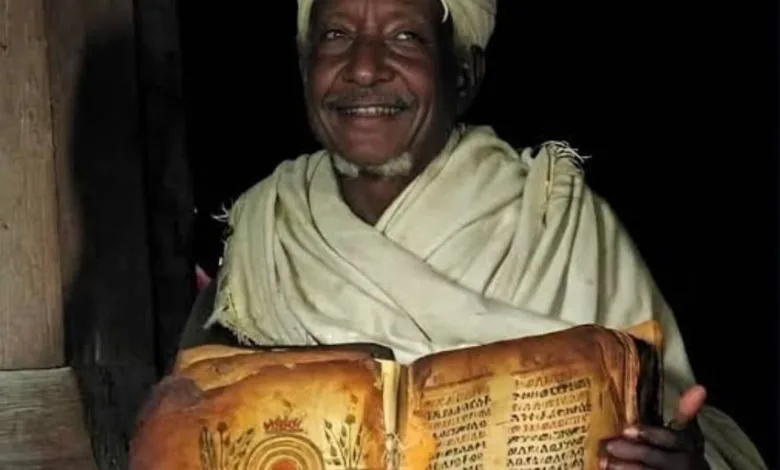
There is a Bible the Western world largely forgot to mention. It sits in the ancient monasteries of Ethiopia, written in Ge’ez, a liturgical language older than most nations. It contains books that Rome rejected, that Protestant reformers never included, and that scholars are only now beginning to treat with the seriousness they deserve. And in this particular moment in human history — when the language of apocalypse has migrated from the pulpit to the political podium — it may be the most relevant religious document on earth.
The Ethiopian Orthodox Tewahedo Church holds the oldest complete Christian Bible in existence. While the Western canon settled on 66 books (Protestant) or 73 (Catholic), the Ethiopian Bible contains 81. The difference is not merely arithmetic. It is theological, historical, and — critically — prophetic.
What the Other Bibles Left Out
The most consequential of the “extra” texts is the Book of Enoch. Everywhere else in Christianity, Enoch was quietly shelved. In Ethiopia, it was canonized. The book’s opening thunders: “Behold, the Lord comes with ten thousands of his holy ones, to execute judgment upon all.” The Apostle Jude quoted it directly in the New Testament. The early church read it widely. Then Rome held its councils, drew its lines, and Enoch fell outside them.




That excision matters. Enoch fills in the architecture of the end times — the defeat of fallen angels, the vindication of the righteous, the return of the Son of Man as what the text calls the “Elect One” — with a moral urgency and cosmic scale that the trimmed-down canon struggles to match. Ethiopian Christianity never lost that urgency. It built its entire liturgical culture around it.
Why This Matters Right Now
We are living through a period in which end-times rhetoric is being weaponized daily — by politicians invoking divine mandate, by media ecosystems built on manufactured tribulation, by movements that have confused nationalism with eschatology. The language of apocalypse is everywhere. The understanding of it is not.
The Ethiopian tradition offers a corrective. Its vision of Christ’s return is not a “rapture” — no secret escape hatch for the select few while the world burns. It is public, collective, and just. Trumpets sound. Nations bow. The living and the dead are judged together. It is, above all, an accounting — not a reward for those who picked the right political tribe, but a reckoning for what was done and left undone.
In a world where the richest men on earth are building bunkers and the poorest are living in them, that distinction is not theological abstraction. It is a moral mirror.
The Oldest Witness Speaks
Ethiopia’s Christian tradition predates most of what the West considers Christianity. The Ethiopian eunuch baptized in Acts chapter 8 carried the faith home before Rome had converted. The Ark of the Covenant, by Ethiopian tradition, rests in Axum. The Church of St. Mary of Zion has stood, in various forms, since the fourth century. This is not a peripheral Christianity. It is, in many respects, the original one.
Yet it has been treated as a curiosity — an exotic footnote to the “real” story of Western Christendom. That condescension is itself a kind of historical violence. And it is precisely the condescension that kept the Book of Enoch out of your grandmother’s Bible.
What Ethiopia preserved, the West discarded for reasons that were as much political as spiritual. The councils that shaped the canon were also shaping empires. Books that emphasized judgment of the powerful, vindication of the oppressed, and cosmic accountability for earthly injustice were not always convenient to keep.
Preparation, Not Panic
Here is what the Ethiopian tradition does not do: it does not traffic in doomsday panic. Its eschatology — its theology of the last things — is oriented toward preparation and righteousness, not fear and spectacle. Christ returns to Zion crowned and surrounded by angels, with nations bowing not in terror but in recognition. It is triumphant justice, not apocalyptic entertainment.
That is the frame the moment demands. Not the frenzied countdown of cable news prophecy culture. Not the political grifter invoking Armageddon to raise money. But the ancient, steady insistence that history moves toward accountability — and that how we treat one another in the meantime is the whole of the examination.
Ethiopia knew this. They wrote it down. In 81 books, they kept the receipts.
The world is finally paying attention. Perhaps it should have started here.