INTERVIEW: Nigerian languages must have space in our educational system — Mercy Martins
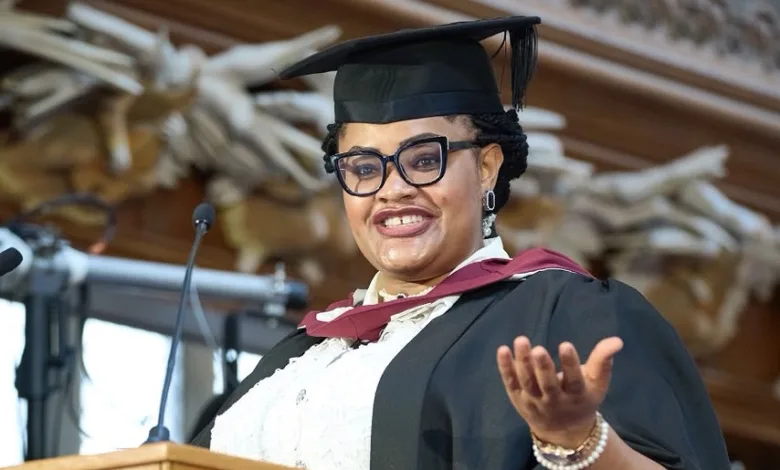
Mercy O. Martins is a First Class graduate whose academic journey transitioned from international studies to development and security, and will be defending her PhD thesis this September at the University of Bath, United Kingdom. In this interview with Kingsley Alumona, she speaks about her work in language decolonisation, among other issues.
You have had an impressive academic journey spanning two countries, from a First Class BSc in Nigeria to an MSc and a PhD in the United Kingdom. What does this journey mean to you?
Martins: This journey is proof that you can do anything you set your mind to. It started with wanting to make my parents proud, especially after hearing them tell me and my siblings about the sacrifices they continued to make to ensure that we had access to a quality education, something they themselves had not been privileged to have.
Looking back now, I think my journey has become much bigger than academic achievement. It has given me a platform to ask questions about education, language, identity and inequality, particularly questions that affect people from communities like mine.


Your studies transitioned from international studies to development and security, and now to a PhD in education. How did you manage these diverse fields of study?
Martins: Growing up, I wanted to work as a career diplomat and potentially become an ambassador. That was what led me to study International Studies at Ahmadu Bello University, where I graduated with a First Class and as the best graduating student in the Faculty of Social Sciences.
For my master’s, I applied to more than 13 universities in the UK and several in France. I was fortunate to receive the Commonwealth Shared Scholarship and eventually had to choose between two universities that offered me full scholarships, alongside several others that offered partial funding.
I chose the University of Bristol because I felt that the MSc in Development and Security gave me the opportunity to develop expertise in two areas at once. But it was actually when I arrived in the UK that some of my academic questions began to change. I became much more conscious of race and of what it meant to be Black, rather than simply Nigerian, in a different environment.
I started reading more about decolonisation, epistemic justice, social justice and racism. I reached out to people whose work I admired and, eventually, that journey led me to the University of Bath, where I began my PhD in Education with amazing supervisors and university funding.
You will be defending your PhD this September. What is the title of your thesis, its major findings, and its significance to society?
Martins: I will be defending my thesis this September, and cannot wait to become the first Dr in my family before 30.
My thesis is titled ‘Agency and Resistance as Anticolonial Praxis: Reimagining Language Practices in Nigerian Secondary Schools’. Essentially, the research examines language practices in Nigerian secondary schools and asks how we can reimagine them so that our marginalised local languages are not pushed out of education, particularly because language is deeply connected to culture and identity.
One of my major findings is that schools can have very strict systems of language policing, governance and surveillance. Students can be punished for using languages that are not considered appropriate in particular spaces.
At the same time, I recognise that Nigeria’s linguistic diversity makes this complicated. We have more than 500 languages, and simply saying that every school should teach every language is not necessarily practical or even inclusive. My argument is therefore not that English should simply disappear. Rather, we need to create more space for multilingualism.
The significance of this work is ultimately about identity, culture and the preservation of languages. When children are repeatedly taught that their own languages are inferior, they can internalise that message.
Why do you think it is important to decolonise the current language, English, that we use for education? What harm does the colonial language pose to our education and culture?
Martins: I think we need to be careful about framing English itself as the problem. English is now part of Nigeria’s linguistic reality, and it has provided access to international education, employment, diplomacy and global communication.
The question is not whether English should exist. The question is what happens when English becomes the only language associated with intelligence, success and legitimacy. The harm comes when children begin to believe that their own languages are inferior, backward or inappropriate for education.
Nigeria’s multilingualism should be an asset rather than something we constantly try to overcome. A child should be able to become globally competitive in English while still being proud of their local language.
For me, decolonisation is therefore not about replacing one language with another. It is about challenging the hierarchy that tells us that one way of speaking, knowing and being is inherently better than another.
Are there countries that have successfully decolonised their language of education into their local languages?
Martins: I do not think any country can completely decolonise itself, particularly in a modern and interconnected world where languages and cultures constantly influence one another.
What I think is important is the extent to which countries consciously value and protect their own languages. Countries such as India have recognised the importance of their linguistic diversity, while Wales has made significant efforts to protect and promote Welsh. Ghana, Tanzania and Rwanda have also developed policies to preserve and promote local languages.
What Nigeria can learn from other countries is that protecting indigenous languages does not have to mean rejecting English. We can prepare children to participate confidently in a global world while also ensuring that they do not have to abandon their languages and identities to do so.
Last year, there was a heated debate on the National Language Policy that seeks to promote the mother tongue and its usage as an instructional language in basic schools across Nigeria. What is your take on this?
Martins: I think this is a very complex issue. On the one hand, the transition from local languages to English can happen very quickly. On the other hand, if a child is living in a rural area where their primary exposure is to a local language, excluding that language from school can make education itself exclusionary.
Perhaps a single nationwide approach is therefore not the best way forward. We could instead consider different models that ultimately support students in transitioning to English, particularly by secondary school.
Some schools might use English as the primary medium throughout, some might use a mixture of English and local languages, while others might begin primarily in a local language and gradually transition to English.
The bigger question is how we fix the problem rather than simply removing local languages from the equation.
What advice do you have for parents and teachers in making sure that children understand the values in native languages while recognising the importance of the role English and other foreign languages play in making them global citizens?
Martins: My advice to teachers and parents would be simple: it is okay to hold beliefs based on what we have always been taught or what we have always known, but we also have a responsibility to seek knowledge for the betterment of society.
Learning English does not have to mean losing your local language. In fact, I think the ideal is for children to have both: the confidence to participate in the global world and the confidence to know where they come from.
What is next for you now that you are almost finishing your PhD? And where do you see yourself and your career in five years?
Martins: For me, the next stage is really about gaining diverse experience and ensuring that I have the skills and knowledge I need to make a meaningful difference.
I could remain in higher education as a researcher, lecturer or professional working in student experience. I could also move into organisations such as ECOWAS, the African Union or the United Nations, working on issues relating to culture, language, development, humanitarian affairs or international relations.
I am therefore quite open to where the next five years take me. What I do know is that I want my work to have an impact beyond myself.
Are you married? If yes, how do your husband and family support your studies and work? And how is the UK treating you since you moved to the country?
Martins: I am not married, but I hope to have a family in the future that is just as supportive of me as my immediate family has been.
I have also been incredibly fortunate to have supportive friends, an adopted family along the way, supervisors, teachers and mentors who have all contributed to my journey. I often say that I am a product of many people’s investments.
The UK has been an important part of that journey. It has challenged me academically and personally. So, while my journey began in Nigeria, the experiences I have had in the UK have helped me understand Nigeria, education, language and even myself in new ways.
I think that is one of the greatest gifts of education: sometimes you travel far away only to understand home more deeply.
Mercy Martins is a doctoral student, anti/decolonial researcher