Nigeria’s inflation rate drops to 21.88% in July, says NBS
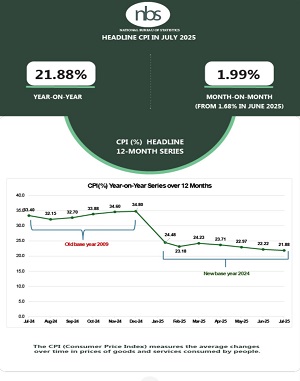
The National Bureau of Statistics (NBS) on Friday disclosed that the inflation rate in Nigeria eased to 21.88per ent relative to the 22.22 per cent reported in June 2025.
The data shows that, on a year-on-year basis, the headline inflation rate was 11.52per cent lower than the rate recorded in July 2024 which was at 33.40per cent.
“This shows that the Headline inflation rate (year-on-year basis) decreased in July 2025 com-pared to the same month in the preceding year (i.e., July 2024), though with a different base year, November 2009 = 100,” NBS stated.
On a month-on-month basis, the headline inflation rate in July 2025 was 1.99per cent, which was 0.31per cent higher than the rate recorded in June 2025 which was at 1.68per cent.



According to the NBS, this means that in July 2025, the rate of increase in the average price level was higher than the rate of increase in the average price level in June 2025.
The percentage change in the average CPI for the twelve months ending July 2025 over the average for the previous twelve-month period was 25.65per cent, showing a 5.11per cent decrease compared to 30.76per cent recorded in July 2024.
The latest NBS report shows that Nigeria’s urban inflation rate stood at 22.01per cent in July 2025, which was 13.76per cent points lower compared to the 35.77per cent recorded in July 2024.
On a month-on-month basis, the urban inflation rate was 1.86 per cent in July 2025, down by 0.25 per cent compared to June 2025 which was at 2.11 per cent.
The corresponding twelve-month average for the urban inflation rate was 27.04 per cent per cent in July 2025. This was 5.85 per cent points lower compared to the 32.89 per cent reported in July 2024.
On the other hand, the rural inflation rate in July 2025 was 21.08 per cent on a year-on-year basis.
This was 10.17 per cent points lower compared to the 31.26 per cent recorded in July 2024.
On a month-on-month basis, the rural inflation rate in July 2025 was 2.30 per cent, up by 1.67 per cent compared to June 2025 which was 0.63 per cent.
The corresponding twelve-month average for the rural inflation rate in July 2025 was 23.84 per cent. This was 5.02 per cent points lower compared to the 28.86per cent recorded in July 2024.
The report by NBS disclosed that food inflation rate in July 2025 was 22.74 per cent on a year-on-year basis.
This was 16.79 per cent points lower compared to the rate recorded in July 2024 which was at 39.53 per cent.
The significant decline in the annual food inflation figure is technically due to the change in the base year.
On a month-on-month basis, the food inflation rate in July 2025 was 3.12 per cent, down by 0.14 per cent compared to June 2025 which was at 3.25 per cent.
The decrease can be attributed to the rate of decrease in the average prices of Vegetable Oil, Bean (White), Rice Local, Maize Flour, Guinea Corn (Sorghum), Wheat Flour, Millet Whole grain, etc.
The average annual rate of food inflation for the twelve months ending July 2025 over the previous twelve-month average was 26.97 per cent, which was 9.39 per cent points lower compared to the average annual rate of change recorded in July 2024 which was at 36.36%.
Core inflation, which excludes the prices of vola-tile agricultural produces and energy stood at 21.33 per cent in July 2025 on a year-on-year basis; a decline of 6.13 per cent when compared to the 27.47 per cent recorded in July 2024.
On a month-on-month basis, the core inflation rate was 0.97 per cent in July 2025, down by 1.49 per cent compared to June 2025 which was at 2.46 per cent.
The average twelve-month annual inflation rate was 23.63 per cent for the twelve months ending July 2025, which was 1.01 per cent points lower than the 24.65 per cent recorded in July 2024.
Analysts told Nairametrics that improved domestic food supply, relative exchange rate stability, and moderating energy costs could have helped sustain the downward trajectory, although persistent structural cost drivers will keep price pressures elevated.