Reminiscing about Maj. Gen. Abubakar’s command of Operation Hadin Kai — by Samuel Aruwan
The end of a military command is rarely marked by celebration alone. Behind the ceremonial handshakes, salutes, photographs and carefully chosen words are memories that cannot be fully captured in official statements. There are battles won, communities reclaimed, captives rescued and families reunited. There are also empty seats in officers’ messes, soldiers who did not return from operations and families whose loved ones paid the supreme price.
It was against this mixture of accomplishment, sacrifice and remembrance that Major General Abdulsalam Enesi Abubakar handed over the leadership of the Joint Task Force North-East, Operation Hadin Kai, to Major General I.A. Ajose on 15 September 2026. The handover brought to an end nearly 17 demanding months of service as the 15th Theatre Commander.
Abubakar assumed command from Major General Waidi Shaibu, now the Chief of Army Staff, on 29 April 2025 amid the familiar challenges of the counterinsurgency campaign. Although the terrorists had been considerably weakened over the years, they remained capable of launching attacks and inflicting casualties. They continued to take advantage of the region’s vast territory, the difficult terrain of the Lake Chad Basin and instability along Nigeria’s international borders within Operation Hadin Kai’s area of responsibility.
The increasing use of improvised explosive devices and armed drones, alongside attacks by small and highly mobile groups, presented fresh dangers to troops and vulnerable communities. The mandate before the new Theatre Commander was clear but enormously demanding: to degrade the terrorists, protect civilians, recover threatened areas and help create the conditions for normal life to return to the North-East.
Normalcy in such an environment could not be measured by military victories alone. It had to be seen in reopened markets, schools and farmlands; in the return of displaced families; and in the ability of citizens to travel, trade, worship and sleep without waiting for the sound of gunfire.
According to the official account presented at the end of Abubakar’s tenure, more than 7,000 displaced families returned to their ancestral communities, with returned or resettled communities in every local government area of Borno State. Behind those figures were families carrying what remained of disrupted lives back home: elderly people returning to compounds built by their fathers, women reopening rooms that had stood empty for years and children seeing villages they had known only through the stories of their parents.
The Theatre also recorded the voluntary, safe and dignified repatriation of more than 3,000 Nigerians from the Republic of Cameroon. The exercise was undertaken by the Borno State Government in collaboration with the Federal Ministry of Humanitarian Affairs and Poverty Reduction and the United Nations High Commissioner for Refugees.
Other signs of returning life became visible. The National Youth Service Corps orientation exercise returned to Maiduguri after an absence of more than 13 years. West African Examinations Council and National Examinations Council examinations were conducted in Banki and Gwoza. Trade routes reopened, markets came back to life and farmers returned to lands that had been inaccessible.
These were not the accomplishments of the military alone. They resulted from cooperation among the Armed Forces, the Borno State Government, federal institutions, humanitarian organisations, traditional institutions and the communities themselves. The military’s role was to create and protect the environment in which civil life could resume.
Every reopened school, cultivated farm, restored market and returning family represented a rejection of the future the terrorists sought to impose upon the region. Terrorist organisations may occupy territory with weapons, but they sustain their influence by frightening people away from their homes and livelihoods.
The operational account presented at the handover stated that more than 1,106 Jama’atu Ahlis Sunna Lidda’awati wal-Jihad and Islamic State West Africa Province terrorists were neutralised during Abubakar’s tenure, including some commanders and other important figures within their structures.
The Theatre also reported the recovery of more than 475 assorted weapons and 24,409 rounds of ammunition. From April 2025, at least 295 improvised explosive devices were discovered and safely detonated. More than ₦300 million linked to terrorist financing was intercepted, while no fewer than 758 suspected logistics collaborators were arrested.
These aspects of the campaign were important because insurgencies do not survive on ideology alone. They require money, fuel, food, medicine, weapons, intelligence and networks capable of moving supplies. Targeting those networks weakened both the fighters and the concealed system that enabled them to survive, recruit and attack.
Sustained military pressure, combined with non-kinetic initiatives, contributed to further surrenders. According to the Theatre, 969 terrorists and members of their families surrendered within the final year of Abubakar’s command. The Theatre also recorded the rescue of 638 civilians from terrorist enclaves and all 46 students endangered during the attempted abduction at the Federal Government Girls College, Monguno.
For the families involved, these were not abstract operational successes. They represented the difference between a lifetime of grief and the indescribable relief of seeing a missing child or relative return alive.
One of the most consequential campaigns of the period was Operation Desert Sanity V in the Timbuktu Triangle. Beginning on 21 January 2026, the operation combined sustained ground action with coordinated air support against terrorist positions in an area that had long served as a sanctuary, detention centre and logistics base.
Military accounts stated that troops uncovered and demolished three ISWAP detention facilities with an estimated combined capacity of about 300 captives. At least 32 terrorists, including two Qaids and three Munzirs, were reported neutralised. The pressure exerted by the advancing troops also enabled more than 70 captives to escape and emerge in Goniri, Buratai and Mandaragirau.
Among the escapees was Malam Jidda Ba Jidda, a farmer from Kufi village reportedly abducted in December 2025. His experience placed a human face on the importance of the operation. For those held in such facilities, escape meant release from hunger, coercion, forced labour, violence and the constant fear of execution.
The destruction of the detention facilities denied the terrorists places they had used to imprison, punish and terrorise civilians. It also challenged the aura of invincibility that terrorist organisations seek to create around their enclaves.
At Mallam Fatori on 18 March 2026, troops repelled a coordinated ground and drone attack on a military position. The military reported that at least 80 terrorists, including three senior commanders, were killed. Four soldiers were wounded, while weapons, ammunition, explosives and armed-drone components were recovered.
The engagement reflected the changing nature of the threat. Terrorists who once depended mainly on rifles, motorcycles and suicide bombers had begun incorporating drones into their attacks. The response also demonstrated the value of regional cooperation, with Nigerian and Nigerien air assets supporting troops and striking retreating elements.
The Theatre was strengthened structurally and technologically during the period. Sector 4 became operational to close the security gap between Southern Borno and Northern Adamawa. Nigerian Army Aviation helicopters were inducted, while the Nigerian Army Remotely Piloted Aircraft System Regiment added surveillance and precision capabilities. The Military Command and Control Centre also linked frontline surveillance cameras, improving situational awareness and the flow of information from operational locations.
The strategic partnership operating under the Team Hadin Kai framework further strengthened intelligence sharing, precision targeting, non-kinetic operations and capacity building. A major demonstration of that collaboration came at Metele on 15 May 2026 during the joint Nigerian and United States operation that resulted in the death of Abu-Bilal al-Minuki, also known as Abu Mainok. Nigerian and United States authorities described him as the global second-in-command of ISIS.
Yet no honest remembrance of the period should dwell only on victories. The command also passed through moments of profound grief. Among those who paid the supreme price was Brigadier General Musa Uba, Commander of 25 Task Force Brigade, who died in November 2025 following an encounter with terrorists around the Wajiroko axis.
The Theatre suffered another painful loss on 9 April 2026 when Brigadier General Oseni Omoh Braimah, Commander of 29 Task Force Brigade, and other soldiers fell during a terrorist attack on the military position in Benisheikh.
Their names belong within the account of the Theatre’s accomplishments, not as evidence against those accomplishments, but as reminders of the courage and sacrifice upon which they rested. They were commanders who led from the front and shared the dangers faced by the troops entrusted to them. Their deaths, and those of the soldiers who fell with them, left pain within their formations, their families and the nation.
For Abubakar, they were not merely names in casualty returns. They were officers serving under his command and entrusted with troops and difficult operational responsibilities. Their loss formed part of the burden he carried as Theatre Commander: honouring the fallen, supporting those left behind and sustaining the campaign despite the grief within the Theatre.
The experience of achieving operational objectives while losing brave officers and men is not peculiar to Nigeria. In Sri Lanka, General Sarath Fonseka commanded the army during the final campaign against the Liberation Tigers of Tamil Eelam, widely known as the Tamil Tigers. The campaign ended the group’s territorial control in May 2009, but government figures indicated that more than 6,000 military personnel were killed and nearly 30,000 wounded from the resumption of major hostilities in 2006 to the end of the war.
The final stage of the Sri Lankan conflict remains the subject of serious controversy, particularly over civilian casualties and allegations concerning the conduct of the parties. That controversy cannot be overlooked. The narrower military lesson is simply that even a campaign which achieved its stated objective left thousands of service families grieving.
In the Philippines, General Carlito Galvez Jr., then Commander of Western Mindanao Command, exercised senior regional responsibility during the 2017 campaign against Islamic State-linked militants who occupied parts of Marawi. Government forces regained control after five months of intense urban fighting, but 168 members of the security forces were killed and more than 1,000 wounded.
In Iraq, General Raymond Odierno commanded Multi-National Force–Iraq from September 2008 to September 2010. He oversaw the consolidation of security gains, the expansion of Iraqi security forces and the transition towards greater Iraqi control. Violence declined and United States troop levels were reduced during his tenure, but American, coalition and Iraqi personnel continued to lose their lives.
These conflicts differed from the insurgency in Nigeria’s North-East and should not be equated with it. They nevertheless demonstrate that operational progress and painful loss can exist within the same command. Success does not spare a commander the grief of losing brave officers and men; it often requires him to continue leading while mourning the fallen, caring for the wounded and learning from setbacks.
Before assuming command of Operation Hadin Kai, Abubakar had served as Commander Sector 3 of the operation and the Multinational Joint Task Force in Monguno. He later became General Officer Commanding 7 Division and Commander Sector 1 in Maiduguri. These appointments gave him direct knowledge of the terrain, the formations deployed across the Theatre and the changing methods of the terrorists.
It was, however, during his tenure as General Officer Commanding 3 Division and Commander Operation Safe Haven that I came to know him more closely. Our official responsibilities brought us together, and I saw beyond the uniform and authority of command.
I encountered an officer who understood that lasting peace could not be secured by force of arms alone. He was firm in the pursuit of armed groups and criminal elements, but equally prepared to meet traditional rulers, religious leaders, community representatives and young people in search of understanding.
He appreciated that communal violence is sustained not only by weapons but also by fear, historical grievances, misinformation, suspicion and failures of justice. Under his command, Operation Safe Haven intensified efforts to recover illegal weapons, restrict the movement of criminal groups and protect communities. Stakeholder engagements were also held in troubled areas, including Mangu, where security operations had to be accompanied by difficult conversations about recurring violence.
Working with him allowed me to appreciate the balance required of a commander in an environment of communal suspicion. Every operation had to be firm enough to protect innocent people but carefully managed to avoid deepening existing divisions. He emphasised training, combat readiness, discipline, civil-military relations and cooperation among security agencies. He also believed in command presence—visiting troops in operational locations and meeting communities rather than relying entirely on reports.
Those experiences prepared him for the responsibility he later carried in the North-East. By the time he assumed command of the Theatre, he understood that security was ultimately about human beings: the soldier keeping watch through the night, the farmer longing to return to his field, the displaced woman carrying what remained of her family’s possessions and the frightened child waiting for school to reopen.
His tenure did not bring terrorism in the North-East to an end, and no serious account should make such a claim. The terrorist groups remain dangerous, adaptive and capable of exploiting operational gaps, difficult terrain and instability across the Sahel and Lake Chad Basin. The incoming Theatre Commander, Major General I.A. Ajose, therefore inherits both the gains recorded and the threats that remain.
Ajose is not a stranger to the Theatre. A seasoned infantry officer of the 43rd Regular Course, he previously commanded 5 Brigade in Borno State and served as Chief of Staff, 4 Special Forces Command. He also commanded 17 Brigade, served as Force Commander Operation Hadarin Daji and later became General Officer Commanding 8 Division and Commander Sector 2 of the Joint Task Force North West, Operation Fansan Yamma.
My knowledge of Ajose is not based entirely on his official profile. I met him at the Armed Forces Command and Staff College, Jaji, on 28 July 2026 during a seminar on counterterrorism and counterinsurgency. I presented a paper titled, “The Role of Communities in Strengthening Intelligence-Driven CTCOIN Operations,” and he served as the moderator.
His moderation provided an effective link between my presentation, the contributions of the two discussants and the questions from the students. He demonstrated an impressive command of the subject and directed the discussion towards the practical role of communities in strengthening intelligence-driven operations.
He broadened our understanding by drawing on both his knowledge and extensive operational experience. His insights and the different perspectives he brought to the discussion enriched the conversation. At the end of the session, he challenged me to examine another dimension of the subject through further research. I took careful note and promised to pursue it as part of the wider discussion.
I came to know Abubakar through our work together during his command of 3 Division and Operation Safe Haven, while I encountered Ajose within the intellectual environment of the Armed Forces Command and Staff College. In both men, I saw an understanding that contemporary security challenges cannot be addressed by force alone. Intelligence, research, community confidence, civil-military cooperation and continuous learning must form part of the response.
In introducing his successor, Abubakar expressed confidence in Ajose and asked stakeholders to extend to him the same openness, cooperation and goodwill he had received. It was the request of a departing commander who understood that military leadership is a relay in which one officer carries responsibility for a period before entrusting it to another.
After handing over command, Abubakar proceeded to the memorial area at the Maimalari Cantonment Military Cemetery. He stood before the monument honouring the officers and soldiers who had paid the supreme price, laid a wreath and rendered a solemn salute to the fallen. He also remembered in prayer those wounded in the course of operations.
It was more than a ceremonial obligation. It was a final act of remembrance by a commander standing before the memory of men who had served under the same flag but could not be present at the handover. The battles, statistics and operational reports had been written in their blood as much as in the decisions taken at headquarters.
The salute was for Brigadier Generals Musa Uba and Oseni Omoh Braimah, for the officers and soldiers whose names were known to the nation and for the many others remembered most intimately by their families and comrades. By praying for the wounded, Abubakar also acknowledged those who returned from battle carrying injuries that may remain with them for life.
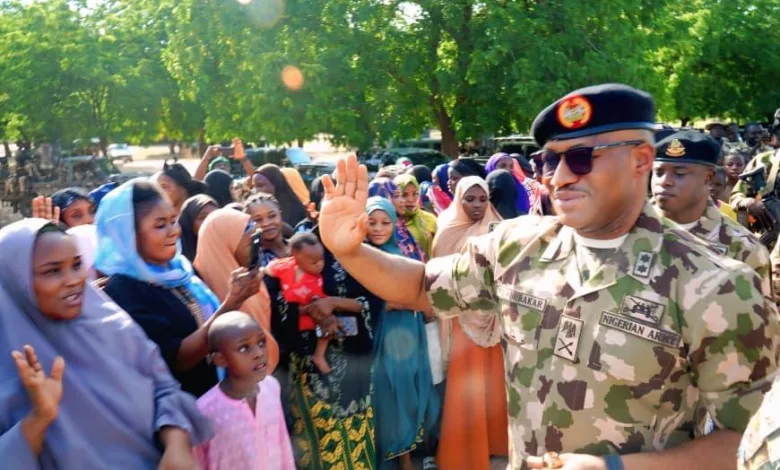
As he departed Maimalari Cantonment, another farewell unfolded beyond the formalities of the handover. In the video of his departure, women and children from the barracks came out in large numbers to bid him farewell. They stood along the route and waved as he made his way out of the cantonment.
It was a simple but deeply moving scene. These were members of the military community who had lived with the anxieties and uncertainties of the campaign: wives who had waited through long periods of silence while their husbands were deployed and children accustomed to watching their fathers leave without knowing exactly when they would return.
Such affection cannot be captured in operational reports. Their presence suggested that Abubakar’s leadership had reached beyond the command headquarters and battlefield statistics. He had left an impression upon the wider military community whose quiet sacrifices are too often overlooked when the history of a campaign is written.
The two scenes belonged together. At the monument were the memories of the fallen and prayers for the wounded. Along the road were the women and children whose lives were inseparable from the service and sacrifices of the troops. Between them stood the departing commander, taking his final leave of a community with which he had shared nearly 17 months of victories, anxieties, losses and hope.
Commands come and go, but the mission remains. Medals, citations and ceremonies matter, but the most enduring legacy of a commander is found in the communities that returned home, the captives who regained their freedom, the children who returned to school, the markets that reopened, the troops better prepared to confront the enemy and the memory of those who did not return.
The North-East will remember the victories. Returned families will remember the roads that led them home. Rescued captives will remember the day the walls of their prisons fell. Soldiers will remember the comrades who stood beside them but did not survive the journey. The women and children of Maimalari Cantonment will remember the commander whose departure brought them out of their homes to wave him goodbye.
For Major General Abdulsalam Enesi Abubakar, the command may have ended, but the human consequences of those nearly 17 months will endure. His tenure belongs not only to the institutional history of the Armed Forces of Nigeria, but also to the quiet stories of people who were able to return, rebuild and hope again. Perhaps that is the most meaningful legacy any commander can leave behind.
Aruwan served as Kaduna State Commissioner for Internal Security and Home Affairs from 2019 to 2024 and is presently a postgraduate student at Ahmadu Bello University, Zaria.